
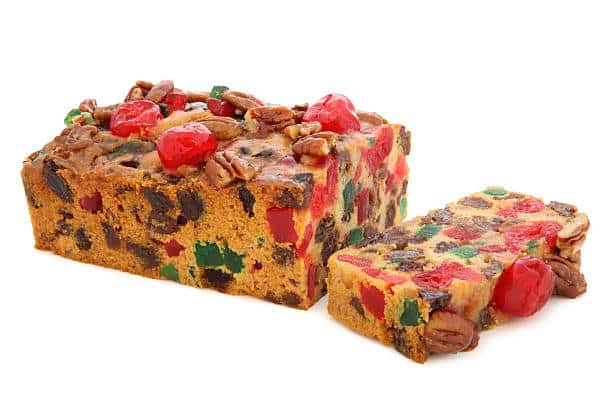
Today’s Spotlight is on Fruitcake.
Fruitcake or fruit cake is a cake made with candied or dried fruit, nuts, and spices, and optionally soaked in spirits. The ratio of fruit and nuts to the batter is high, with just enough cake batter to hold it all together. In the United Kingdom, certain rich versions may be iced and decorated. Fruitcakes are usually served in celebration of weddings and Christmas.
Fruitcake has been around for centuries. The oldest versions were a sort of energy bar made by the Romans to sustain their soldiers in battle. The Roman fruitcake was a mash of barley, honey, wine, and dried fruit, often pomegranate seeds.
Fruitcake has been a special food for weddings or Christmas since the 18th and 19th centuries. England passed laws restricting the use of the cake to holidays, which slowly spread the concept in that direction.
Fruitcake can include:
- Candied fruit, Dried fruit, Fruit rind, Nuts, Spices, Liquor or brandy.
In the United Kingdom, certain rich versions may be iced and decorated.
History
The earliest record of fruitcake is from ancient Rome. The Romans made a cake called satura that was made of barley mash, pomegranate seeds, raisins, and pine nuts. The cake was baked in a ring shape.
The modern fruitcake can be traced back to the Middle Ages. Dried fruits became more widely available and fruited breads entered Western European cuisine. Honey, spices, and preserved fruits were added to the recipe.
Some historians trace fruitcake back to ancient Egypt. Delicious and long-lasting cakes were placed in the great pyramids with deceased royal dignitaries to sweeten their experience in the afterlife.
By the early 19th century, the typical recipe was full of citrus peel, pineapples, plums, dates, pears, and cherries. In the late 1800s, fruitcake was gifted in decorative tins, becoming a holiday staple. Fruitcake was outlawed in Europe in the early 18th century because it was considered “sinfully rich”. Over time, people added more and more sweet ingredients to their fruitcakes, until they became a symbol of decadence. The laws were eventually repealed.
Fruitcake was also known as plum cake. It was popular at teatime in England, and was served at the weddings of British royals, including Queen Victoria.
Fruitcake Tradition
Fruitcake is a traditional Christmas dessert. It was originally a ceremonial cake made to celebrate a specific harvest. In the 18th and 19th centuries, fruitcake became associated with holidays because the ingredients were too expensive for most households to afford. It was considered an indulgence and reserved for special occasions.
Fruitcake is referenced in the Christmas carol “We Wish You A Merry Christmas” when they sing about “figgy pudding”. According to Swiss Colony, fruitcake was served to poor English Christmas carolers, which may be a reason it became so popular for the holidays.
In the English Caribbean, black cake is a traditional part of Christmas celebration. The cake incorporates a large quantity of mixed fruits and rum/wine.
Here are some fun facts about fruitcake:
- Fruitcakes can last forever.
- Fruitcakes were the first military ration bricks.
- Fruitcakes were a staple ration for astronauts during the 1960s space race.
- According to an old American superstition, placing a fruit cake under your pillow will help you find a good husband.
- The world’s oldest fruitcake was baked in 1878 by Fidelia Ford in Tecumseh, Michigan.
- Fidelia Ford made it an annual tradition to bake a fruitcake ahead of the holidays.
- She preferred to let the cake age for a year before serving it at family gatherings.
Here is a Fruitcake Recipe for you to try:
Ingredients
Fruit
- 1 1/2 cups (213g) dried pineapple, diced
- 1 1/2 cups (255g) raisins, golden or regular
- 1 cup (128g) dried apricots, diced
- 1 1/2 cups (223g) dates, chopped
- heaping 1 cup (170g) candied red cherries, plus additional for decoration, if desired
- 1/3 cup (64g) crystallized ginger, diced, optional
- 3/4 cup (170g) rum, brandy, apple juice, or cranberry juice
Batter
- 16 tablespoons (227g) unsalted butter, at room temperature, at least 65°F
- 2 cups (425g) dark brown sugar, packed
- 1 teaspoon salt
- 1 teaspoon cinnamon
- 1/4 teaspoon allspice
- 1/4 teaspoon nutmeg
- 1 teaspoon baking powder
- 4 large eggs, at room temperature
- 3 cups (360g) King Arthur Unbleached All-Purpose Flour
- 2 tablespoons (11g) black cocoa, optional, for color
- 1/4 cup (85g) boiled cider, golden syrup, or dark corn syrup
- 1/2 cup (113g) apple juice, cranberry juice or water
- 2 cups (227g) chopped, toasted nuts (almonds, pecans, or walnuts)
Topping/glaze (optional)
- rum, brandy, simple syrup, vanilla syrup, or ginger syrup
Instructions:
To prepare the fruit:
- Combine the fruit with the liquid of your choice in a non-reactive bowl; cover and let rest overnight. Too impatient to wait until tomorrow? Microwave everything for 1 minute (or until it’s very hot), cover, and let rest 1 hour.
- Preheat the oven to 300°F. This recipe makes enough batter for ONE (not all!) of the following: 3 dozen individual (muffin pan) cakes; 16 mini loaves (about 3 3/4″ x 2 1/2″); 6 to 8 medium loaves (about 3″ x 5″); or 2 standard 9″ x 5″ loaves. Choose your pans (or combinations), and lightly grease them. If you’re making muffin-size cakes in a standard muffin pan, line the pan with muffin papers, and lightly grease the papers.
To make the batter:
- Place the butter and sugar in a large bowl (at least 6-quarts), and beat together until well combined.
- Beat in the salt, spices, and baking powder.
- Beat in the eggs one at a time, scraping the bowl after each addition.
- In a separate bowl whisk together the flour and cocoa.
- Add the flour mixture and the syrup (or boiled cider) to the mixture in the bowl, beating gently to combine.
- Stir in the juice or water, then the fruit (including any additional liquid that has collected in the bowl), and the nuts. Scrape the bottom and sides of the bowl, and stir until everything is well combined.
- Spoon the batter into the pans, filling them about 3/4 full.
- Bake the cakes on the middle shelf of the oven, as follows: about 60 minutes for the individual cakes; 65 to 70 minutes for the small loaves; 75 minutes for the medium loaves, and 2 hours + 10 to 15 minutes for the 9″ x 5″ loaves. The cakes are done when a cake tester inserted into the center comes out clean.
- Remove the cakes from the oven. Fruitcake can remain in its pan for storage, if desired. Or carefully remove cake from the pan after about 5 minutes, loosening its edges first.
- Brush the warm cake with rum, brandy, simple syrup, or flavored simple syrup (vanilla, rum-flavored, etc.). If you like just a hint of rum or brandy flavor, add 1 tablespoon of liquor to 3/4 cup vanilla syrup or simple syrup, and brush this mixture on the cakes. (This keeps them moist for weeks; you can skip this step, but they won’t stay moist long-term.)
- When the cakes are completely cool, wrap them tightly in plastic wrap, and store at room temperature for up to 6 to 8 weeks.
- Enjoy!
Consumption
According to Serious Eats, over two million fruitcakes are sold each year. On average, fruitcake is consumed 1.44 times every year.
The Swiss Colony, America’s largest hand-decorating baker, produces more than 66,000 fruitcakes per year. The USDA suggests that fruitcake can be kept in the pantry for up to one month, refrigerated for up to six months, and frozen for up to a year.
Celebrating Fruitcake
December 27 is designated as National Fruitcake Day. Let us know in the comments if you have ever eaten a fruitcake.
0 Comments