National Smores Day

Aug 9, 2026 | Food Blog

Today’s spotlight is on a fireside favorite – S’mores.

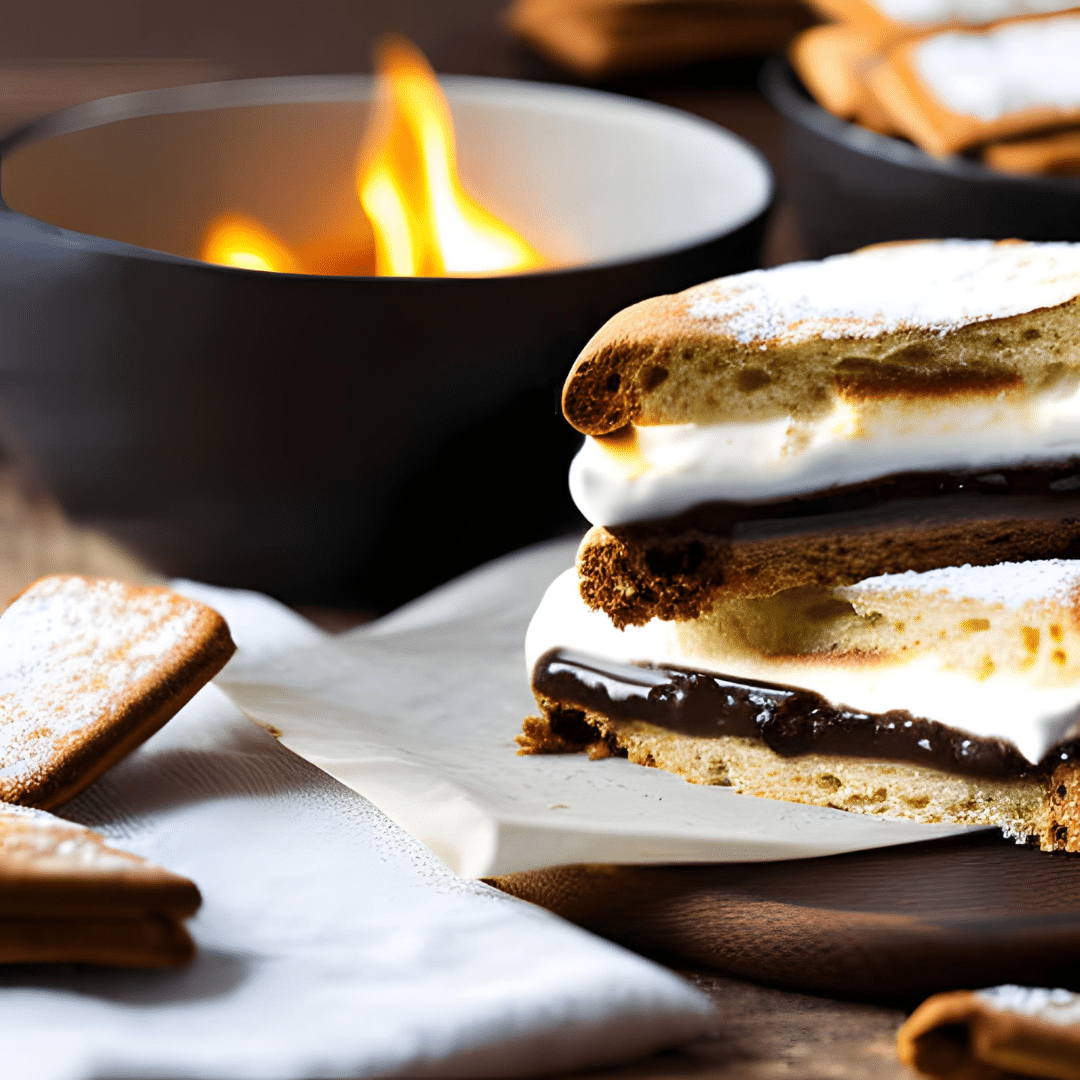
S’mores are a confection made of toasted marshmallows and chocolate sandwiched between two graham crackers. They are a traditional camping snack that are popular in the United States and Canada. S’mores are traditionally cooked over a campfire and warmed over an open flame until melted and gooey.

History.

As far as foods go s’mores are relativity modern.

The first recorded version of the s’mores recipe can be found in the Girl Scouts of America handbook, published in 1927. This recipe has been largely considered as the official introduction of the s’more into popular culture.

There are a few people who are credited with coming up with the name “s’mores”:

A 1920s US cookbook is where the first as a recipe called “Graham Cracker Sandwich” appeared in the 1920s. The first mention of the treat was in a 1927 edition of the Girl Scout manual “Tramping and Trailing with the Girl Scouts”. The treat was originally called “Some More” in a nod to its addictive qualities. Recipes for “some mores” appeared in Girl Scout publications until at least 1971.

Loretta Scott Crew (a troop leader) is credited with writing the first s’mores recipe (then known as Some Mores) and creating the name in the Girl Scout guidebook. The recipe called for 16 graham crackers, eight bars of chocolate broken in two, and 16 marshmallows. Instructions were to toast the marshmallows over coals to a crisp and gooey state and put them inside a graham cracker and chocolate bar sandwich. Regardless of her credit, the recipe may have existed previously.

William Henry Gibson is credited with coining the term “s’more” in his 1938 guidebook “Recreational Programs for Summer Camps”. The name was a contraction slang reducing “Some More” to s’more.

In 1956 the s’more original recipe was leaked by a global magazine that is how s’more received its national recognition. The magazine described s’more as a sandwich of two graham crackers, toasted marshmallows and ½ chocolate bar, thus the modern-day s’more was born.

Here’s some information about the history of s’mores:

  • The treat was originally called “Some More” in a nod to its addictive qualities.
  • The treat was already popular with both Boy Scouts and Girl Scouts in the early 1920s.
  • The recipe is considered the official introduction of s’mores into popular culture.
  • While the exact origin of s’mores is unknown, the first recorded version of the recipe can be found in the Girl Scouts of America handbook.

S’mores have made their way into popular culture by appearing in films and TV shows such as Toy Story 2, The Big Bang Theory, and Melissa & Joey. The sticky campfire treat has also inspired a range of spin-offs.


Here are some fun facts about s’mores:

  • The word “s’more” officially became a word in 1974 in the Merriam-Webster dictionary.
  • The “S’MORE” trademark was filed on June 30, 1983.
  • The largest s’more ever made weighed over 200 pounds.
  • The graham cracker was invented in 1829 by Sylvester Graham, a Presbyterian minister in New Jersey.
  • The earliest evidence of marshmallows dates back to around 2000 BC.
  • In the 1900s, marshmallows were being sold as penny candies in tiny tins.
  • Folklore suggests that the name “s’more” came from kids chanting “Gimme some more!” after eating one.
  • 87% of Americans have tried a s’more.
  • 31% of Americans make s’mores on a grill.
  • You don’t need a campfire to make s’mores.


Here are some estimates for how many s’mores are consumed annually:

  • 50 million s’mores are estimated to be consumed in the United States each year.
  • 746 million s’mores can be made from the 90 million pounds of marshmallows Americans buy each year.
  • 3 million s’mores are estimated to be consumed each summer by The Hershey Company
  • 50% of marshmallows sold are roasted for s’mores during the summer.
  • Half of the 90 million marshmallows sold annually are used to make s’mores.


National S’mores Day is celebrated annually on August 10 to honor the iconic campfire treat. So why not fire up the stove, campfire or any appropriate heat source and prepare yourself a delicious s’more. Let us know your favorite first s’more memory.

0 Comments

Submit a Comment

Your email address will not be published. Required fields are marked *

Subscribe to our Blog to receive more content like this. Click here to subscribe.

Be sure to watch our shows on QVC+  or our YouTube channel

Give us your feedback on our Social Channels 

FacebookInstagramTik TokLinkedInPinterestTwitter  

National Rice Pudding Day

National Rice Pudding Day

Today’s Spotlight is on Rice Pudding.
Rice pudding is a creamy mixture of rice and milk and other ingredients such as cinnamon, vanilla and raisins. It's cooked until it's thick and soft. It can be sweet or savory. Variants are used for either desserts or dinners. When used as a dessert, it is commonly combined with a sweetener such as sugar. American rice pudding often uses leftover rice and can be baked in the oven or cooked on the stove.

Read More

Sneak Some Zucchini onto Your Neighbor’s Porch Day

Sneak Some Zucchini onto Your Neighbor’s Porch Day

Today’s Spotlight is on Zucchini (and your neighbors)!
There are a lot of odd holidays but this one has got to be one of my favorites. Sneak Some Zucchini Onto Your Neighbor's Porch Day is celebrated on August 8th every year. The holiday encourages people to sneak their extra zucchinis onto the porches of unsuspecting community members. The day celebrates the bounty of the summer's zucchini harvest by demonstrating generosity, desperation, and cunning.

Read More

Raspberries and Cream Day

Raspberries and Cream Day

Today’s food spotlight is aimed at Raspberries and Cream.
Raspberries and cream is a simple treat that combines fresh, ripe berries with sweetened, hand-whipped cream. It's a good option for anyone with a sweet tooth.
Raspberries are the fruit of several shrubs in the rose family. They are usually red but can also be black or yellow. When ripe, they separate from the receptacle and are rounder and smaller than blackberries. The name "raspberry" may have come from "raspise", which means "a sweet rose-colored wine". The name may also be related to the Old English word "rasp", which means "rough berry".

Read More

National Root Beer Float Day

National Root Beer Float Day

Today’s spotlight is on Root Beer Floats!
The root beer float is traditionally made with vanilla ice cream and root beer, but it can also be made with other ice cream flavors. It's sometimes referred to by the nicknames “brown cow” or “black cow”. Root beer floats were a popular dessert drink in 1950s diners.

Read More

Oyster Day

Oyster Day

Today’s food spotlight is on Oysters.
Oysters are a type of bivalve, which are marine and freshwater mollusks with long, flat bodies and shells made up of two hinged parts. Oysters are plump, mineral rich, saltwater mollusks that live at the bottom of shallow coastal waters, often adhering to rocks or other objects. They use their gills and cilia to process water and feed. Oysters have a small heart and internal organs, but no central nervous system.

Read More

Chocolate Chip Cookie Day

Chocolate Chip Cookie Day

Today’s spotlight is on Chocolate Chip Cookies #yum

If you have been living under a rock somewhere, a chocolate chip cookie is a drop cookie that features chocolate chips or chocolate morsels as its distinguishing ingredient. Chocolate chip cookies originated in the United States in 1938, when Ruth Graves Wakefield chopped up a Nestlé semi-sweet chocolate bar and added the chopped chocolate to a cookie recipe.

The original name of the chocolate chip cookie was "Toll House Crunch Cookie". The recipe was created by Ruth Wakefield, who ran the Toll House restaurant in Whitman, Massachusetts. Wakefield included the cookie in her 1938 cookbook, Toll House “Tried and True" Recipes. The cookie was intended to accompany ice cream.

Read More

Grab Some Nuts Day

Grab Some Nuts Day

Today is Grab Some Nuts Day.
All of this evidence shows that nuts have been a staple in the human diet since the beginning of history. The oldest walnut remains were discovered in Iraq, and they are believed to be from 50,000 B.C. The Greeks and Romans were fond of the walnut, and they were considered food for Gods by early Romans.

Read More

National Watermelon Day

National Watermelon Day

Today’s focus is on Watermelons.
Watermelons are a large, sweet fruit that are related to cantaloupes, zucchinis, pumpkins, and cucumbers. They are members of the gourd family (Cucurbitaceae) and are botanically classified as Citrullus lanatus. Watermelons are native to southern Africa and are cultivated around the world. They are usually eaten raw and are often used as a table dessert.
Watermelons are a berry with a hard rind and no internal divisions. They are botanically called pepos. The fruit is usually deep red to pink and has many black seeds, although seedless varieties exist. The sweet, juicy flesh is 92% water and contains vitamin A and some vitamin C. Watermelons are also a great source of antioxidants.

Read More

Ice Cream Sandwich Day

Ice Cream Sandwich Day

Today’s Spotlight is on the Ice Cream Sandwich.
An ice cream sandwich is a frozen dessert made of ice cream between two biscuits, wafers, cookies, or other baked goods. The ingredients can vary by region, with Ireland using wafers and the United States commonly using cookies. The current form of the ice cream sandwich is vanilla ice cream between two chocolate cookies.
Ice cream sandwiches have many nicknames, including giant sandwich, chipwich, cream between, vanilla slice, and slider. You can also make an ice cream sandwich cake by layering ice cream sandwiches between whipped topping, fudge, caramel, nuts, and M&M's.

Read More

National Raspberry Cream Pie Day

National Raspberry Cream Pie Day

Today’s Spotlight is on Raspberry Cream Pie.
Raspberries have been used in desserts since the Middle Ages, most frequently in raspberry tarts. Raspberry cream pie dates back to the 1880s. The first raspberry cream pie recipe was published in 1894 by the Boston Cooking School.

Read More

Pin It on Pinterest