
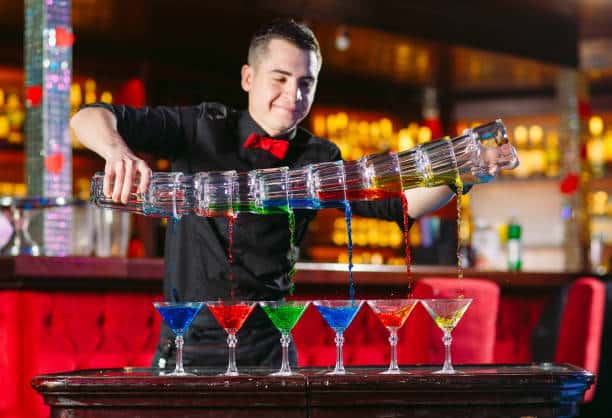
Today’s Spotlight is on Bartenders.
A bartender is a person who formulates and serves alcoholic or soft drink beverages behind the bar, usually in a licensed establishment as well as in restaurants and nightclubs, but also occasionally at private parties. Bartenders also usually maintain the supplies and inventory for the bar.
A bartender mixes and serves alcoholic and non-alcoholic beverages in licensed establishments. They can work in:
- Bars, Pubs, Taverns, Nightclubs, Restaurants, Hotels, Casinos, Private parties.
Bartenders are also known as: Barkeeps, Mixologists, Barmaids.
Bartenders’ duties include:
- Managing drink orders
- Recommending drinks to customers
- Preparing cocktails
- Pouring beers
- Decanting wines
- Keeping the bar organized and clean.
- Working with customers and coworkers
Bartenders need skills in:
- Making and serving drinks
- Keeping the bar organized and clean.
- Working with customers and coworkers
The word “bartender” dates from the early 19th century. It comes from “bar”, which comes from the barrier or counter over which drinks are served, and “tender”, or “seller”.
History
Bartending is an ancient profession that dates back to Asian, Roman, and Greek societies.
The earliest references to bartending can be found in ancient Mesopotamia around 2000 BCE.
In ancient Greece, “symposiarchs” oversaw the mixing and dispensing of wine. They were skilled in diluting wine with water and flavoring it with herbs and spices.
In the UK, the documented story of bartending begins with the sale of ales and wines in the early Middle Ages. Before the mid 1860’s, bartenders were generally seen as a low-class profession generally tended to by women. Innkeepers and their wives would serve whatever local alcohol they could get their hands on.
The rise of the cocktail in the early 20th century was followed by prohibition laws from the Federal government. However, bartending culture remained alive throughout prohibition. Working in underground speakeasies, bartenders continued to provide their patrons with delicious cocktails.
Here are some fun facts about bartending:
- The average age of a bartender is 34 years old.
- The most common ethnicity of bartenders is White (65.0%).
- Bartenders are mostly in-demand in New York, NY.
- The hospitality industry is the highest paying for bartenders.
- Bartenders can work 10-12 hours straight.
- Bartenders clean up after closing time and take inventory.
- Jerry Thomas, an American bartender, is considered “the father of American mixology”.
- According to bartenders, the hardest parts of bartending are:
- Remembering cocktail recipes.
- Dealing with workplace politics.
- Creating cocktails for the menu.
- There are bartender “Olympics”.
- One bar has been selling drinks for more than 1,100 years.
Great bartenders have many qualities that make them stand out. They are:
- Outgoing: They have an outgoing personality that puts customers at ease.
- Knowledgeable: They know about different types of drinks.
- Organized: They are organized and prepared behind the bar.
- Patient: They are patient when faced with lots of orders.
- Confident: They are confident in serving and engaging with customers.
- Eager to learn: They are eager to learn new tips and tricks.
- Disciplined: They keep their mind focused on the work they need to do and allow no distractions.
Other qualities of a great bartender include:
- Communication skills, Curiosity, Presence of mind, Flexibility, Consistency, Trustworthiness.
Related information:
- An experienced bartender can make 60-90 drinks in an hour.
- Bartenders can make 4-6 drinks per minute.
- The International Bartenders Association (IBA) has a list of 77 drinks.
Employment of bartenders is projected to grow 18% from 2021 to 2031. Over 726,936 bartenders currently work in the United States.
Here are some of the world’s most popular cocktails:
- Margarita – The most ordered cocktail in the world, the Margarita is made with tequila, Cointreau, and lime juice. It can be made in a few varieties, including straight up, frozen, or on the rocks.
- Negroni – This iconic cocktail is made with equal parts of gin, vermouth, and Campari. It’s poured over ice and garnished with an orange slice.
- Bloody Mary – This cocktail was invented in 1921 by Fernand Petiot, who was working at a bar in Paris. It’s made with tomato juice and vodka.
Other popular cocktails include:
Cosmopolitan, Daiquiri, Gimlet, Manhattan, Espresso Martini, Mojito, Mai Tai, Mint Julep, Caipirinha, Pina Colada, Californication, Bourbon Old Fashioned, White Russian, Dirty Martini, Porn Star Martini.
Consumption
In 2021, the average person aged 14 or older in the United States consumed 535.5 standard drinks. The average American drinks 1.35 drinks per day, 9.5 drinks per week, and 494 drinks per year.
In 2022, the average U.S. drinker reported consuming four drinks per week. Regular drinkers, defined as those who had at least one drink in the past week, averaged six drinks per week.
A small percentage of adults who drink account for half of the 35 billion total drinks consumed by US adults each year.
Celebrating Bartenders
National Bartender Day is December 1st every year.
There are several days that celebrate bartenders, including:
- World Bartender Day: Celebrated on February 24th.
- Bartender Appreciation Day: Celebrated on December 2nd
- National Bartender Day: Celebrated on the first Friday of December
You can celebrate bartenders by:
- Buying them a drink or two
- Tipping them generously
- Complimenting their skills
- Asking them about their experience
- Asking them non-work questions
You can also start a conversation with a bartender by:
- Saying hi and smiling
- Asking their name
- Commenting on their evening
- Asking them to recommend their favorites.
Let us know in the comments a brief story of your favorite bartender.
0 Comments