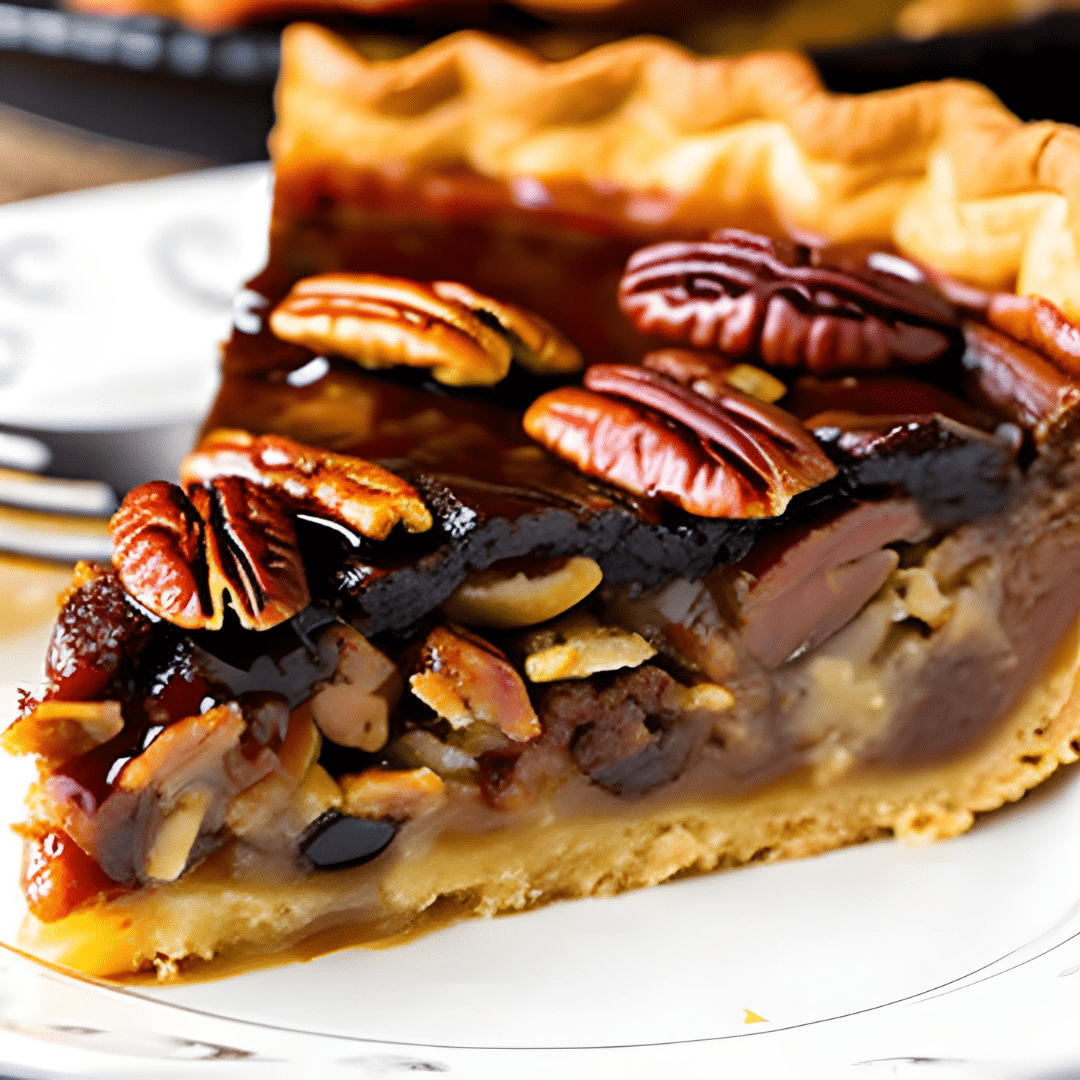
National Pecan Pie Day

Jul 11, 2026 | Food Blog

Today we put the spotlight on pecan pie. But before we take that first bite a little bit of background:

The history of pecan pie can be traced back thousands of years to Native Americans who used the nut’s meat as a filling for their medicine pouches and in recipes like wampum belts. The colonists began using pecans as a food source, though they didn’t begin to bake with them until the mid-1800s.

Legend has it that the French people who settled in New Orleans made the first pecan pie after eating pecans given to them by Native American tribes. Some also claim that pecan pie originated in Alabama in the early 1800s, but there is no written documentation to substantiate it.

The earliest printed pecan recipes began popping up in Texas cookbooks in 1870s and 1880s. The first recipe that most closely resembles what we know today as pecan pie was published in 1898 in a church charity cookbook in St. Louis, but it was sent in by a Texas woman.

Some believe that the pecan pie originated in New Orleans after it was settled by the French. Others claim that pecan pie originated in Alabama in the early 1800s but there is no written documentation to substantiate it.

Texas is famous for its pecan pies. The pecan tree is the state tree of Texas, and 20% of all the pecans in the United States grow in Texas. Pecan pie is the official dessert of Texas.

Pecan pie is called pecan pie because it contains pecans, which are native to the United States. The word “pecan” comes from the Algonquin word “paccan”. Pecans were an essential part of the Native American diet.

Pecan pie is the official dessert of Texas. Texas has officially adopted the pecan tree as their state tree. In fact, 20% of all the pecans in the United States grow in Texas.


Science is Nuts

Pecans rise to the top of a pecan pie because the filling contains more liquid mixture than pecans. The pecans will naturally rise to the top during baking, leaving the jelly filling underneath.

To prevent a hard pecan pie, you can bake the pie until the filling is set and registers 200 degrees on an instant read thermometer. You can also try covering the top of the pie with a piece of aluminum foil for the last 10-15 minutes of the baking time and/or baking the pie on a lower rack.

To prevent a runny pecan pie, you can bake the pie for 60 to 70 minutes at 350F and then leave it to cool and set. You can also try precooking the filling, reducing the juice, experimenting with different thickeners, venting the top crust, trying a lattice or crumb top crust, baking thoroughly, and letting the pie cool completely — preferably overnight.


Here is a Pecan Pie Recipe for You to Try:

Crust Ingredients:

  • 1 unbaked Flaky Pie Crust
  • Egg wash for pie crust: 1 large egg beaten with 1 Tablespoon milk or heavy cream


Filling Ingredients:

  • 2 and 1/2 cups (250g) shelled pecans (pecan halves)
  • 3 large eggs
  • 1 cup (240ml) dark corn syrup*
  • 1/2 cup (100g) packed light or dark brown sugar
  • 1 and 1/2 teaspoons pure vanilla extract
  • 1/4 cup (60g) unsalted butter, melted and slightly cooled
  • 1/2 teaspoon salt
  • 1/2 teaspoon ground cinnamon


The Crust Instructions:

  1. After the pie dough chills, adjust oven rack to the lower third position and preheat to 350°F (177°C).
  2. Roll out the chilled pie crust onto a lightly floured surface. Remember, when rolling out the pie dough, always use gentle force with your rolling pin. Start from the center and work your way out in all directions, rotating the dough with your hands as you go. Roll it out into a circle 12 inches in diameter. Carefully place the dough in a 9×2-inch pie dish. Tuck it in with your fingers, making sure it’s smooth. For a beautiful edge, as shown in the video above, fold the overhanging dough back over the edge and use your hands to mold the edge into a nice thick rim around the pie. Crimp the edges with a fork or use your fingers to flute the edges. Again, you can see me do this in the video above. Brush the edges with egg wash. (To help guarantee a beautiful edge, I always chill the shaped dough in the pie dish for 10 minutes in the refrigerator or freezer before filling.)


The Filling Instructions:

  1. Very roughly chop the pecans– some whole, some lightly chopped is fine. Spread pecans evenly inside pie crust. Whisk the eggs, corn syrup, brown sugar, vanilla, melted butter, salt, and cinnamon together in a large bowl until combined. Pour over pecans.
  2. Bake the pie for 50-55 minutes or until the top is lightly browned. After the first 20 minutes of baking time, place a pie crust shield on top of the pie to prevent the edges from browning too quickly. You can also tent a piece of aluminum foil over the whole pie if it is browning too quickly. Remove the finished pie from the oven and place on a wire rack to cool completely. The pie filling will settle as it cools.
  3. Slice and serve pie warm or at room temperature. Top with whipped cream or ice cream.
  4. Enjoy!


Here are some fun facts about pecan pies:

  • Pecan pie became closely associated with the culture of the Southern United States in the 1940s and 1950s.
  • Pecans are native to the southern United States. Archaeological evidence found in Texas indicates that Native Americans used pecans more than 8,000 years ago.
  • It takes about 78 pecans for one pecan pie.
  • Pecans are the state nut of Texas. The pecan tree is the state tree of Texas.
  • Pecans are a great source of magnesium, potassium, and calcium, which help to lower blood pressure.
  • A 16-ounce bag of pecans can cost almost $11.
  • The USDA says that pecan pies will stay fresh for about three to four days in the refrigerator.
  • Although pecans have many healthy attributes, more doesn’t mean it’s healthier.


There are over 500 different types of pecans. They are named after a wide array of things, mostly Native American tribes, the discoverer or the person who grafted it. Different types of pecans are often distinguished by the size and flavor of the nut.

The majority of pecan production comes from just a handful of varieties. These include the Cape Fear, Desirable, Moreland, Summer, and Paper-Shell varieties.

The Elliott pecan is considered by pecan farmers and researchers as one of the highest-quality cultivars of pecan grown in the United States.

So now it’s your turn. Go and enjoy a nice slice of this Native American tradition. Let us know where you get your favorite pecan pie.

0 Comments

Submit a Comment

Your email address will not be published. Required fields are marked *

Subscribe to our Blog to receive more content like this. Click here to subscribe.

Be sure to watch our shows on QVC+  or our YouTube channel

Give us your feedback on our Social Channels 

FacebookInstagramTik TokLinkedInPinterestTwitter  

National Lasagna Day

National Lasagna Day

Today’s spotlight is on Lasagna.
Lasagna is considered one of the oldest pasta dishes in Italian cuisine. Lasagna has a long history and cultural significance in Italy and other countries. It symbolizes comfort, tradition, and family and is often served as a shared meal at the dinner table. Initially, lasagna was originally reserved for special events and holidays.

Read More

National Chicken Wing Day

National Chicken Wing Day

Today’s Spotlight is on Chicken Wings.

Chicken wings were invented in 1964 at the Anchor Bar in Buffalo, New York. The bar's co-owner, Teressa Bellissimo, cooked leftover wings in hot sauce as a late-night snack for her son and his friends. The story goes that Bellissimo mistakenly ordered a case of chicken wings when she meant to order chicken necks, which her husband used to make the Anchor Inn's famous spaghetti sauce. Bellissimo covered the wings in her own special sauce and served them with a side of blue cheese and celery.

Read More

National Hamburger Day

National Hamburger Day

Today’s food spotlight is on the Hamburger.

There's some controversy over the origin of the hamburger because its two basic ingredients, bread and beef, had been prepared and consumed separately for many years before they were combined. Some have pointed to a recipe for "Hamburgh sausages" on toasted bread, published in The Art of Cookery Made Plain and Easy by Hannah Glasse in 1747. White Castle traces the origin of the hamburger to Hamburg, Germany, with its invention by Otto Kuase. According to legend, Louis Lassen invented the burger in 1900 at his small restaurant in New Haven, Connecticut. He placed a beef patty between two slices of bread and added cheese and condiments, creating the first “hamburger sandwich”.

Read More

National Creme Brûlée Day

National Creme Brûlée Day

Today’s Spotlight is on Crème Brûlée.
Crème brûlée is a custard dessert with a hard caramel top that's rich, creamy, and delicious. It has a slightly caramelized and burnt taste, with a combination of light and airy vanilla custards, the nutty flavor of caramelized sugar, and a sweet and bitter burnt taste. The caramel topping adds a slight burnt sugar flavor and crunch to the dessert.
Some say the contrast between the soft and silky inside and the crackly brown top makes crème brûlée such a great dessert. It's also simple to make, without a long list of ingredients or complex processes.

Read More

Bagelfest Day

Bagelfest Day

Today’s Spotlight in on Bagels.
National Bagelfest Day is celebrated on July 26th each year to recognize the tasty and light bread that is the bagel. The holiday was started in 1986 by Murray Lender, the owner of Lender's Bagels. The first festival was held in Mattoon, Illinois to celebrate the 50th anniversary of Lender's Bagels, a popular brand that has been produced in Mattoon since 1960. The festival became a multi-day event with music, rides, a parade, and a bagel breakfast.

Read More

National Hot Fudge Sundae Day

National Hot Fudge Sundae Day

Today’s spotlight is on the Hot Fudge Sundae.
The prevailing theory is that the first hot fudge sundae was created in Los Angeles, California in 1906. Clarence Clifton Brown, the owner of C.C. Brown's Ice Cream Shop in Los Angeles, is thought to have created the hot and cold concoction. Brown was a candy maker who experimented with several hot fudge recipes before finding the right formula. He opened his ice cream parlor on Hollywood Boulevard in downtown Los Angeles. He had the idea to create a topping that would slowly melt the cold ice cream.
A hot fudge sundae is ice cream topped with hot fudge sprinkles, nuts, whipped cream and a cherry on top.

Read More

National Tequila Day

National Tequila Day

Today’s spotlight is on Tequila!

A drink similar to tequila likely originated around 1000 B.C. among the Olmec people in what is now Southeastern Mexico. Tequila first came into existence between 250 and 300 A.D. when the Aztec Indians produced a fermented agave juice of the agave for their ceremonial wine, "plaque". The liquid was important to Aztec culture because they worshipped two gods, Mayahuel (the goddess of the Maguey) and her husband Patecatl, the god of pulque. The earliest version of tequila was known as pulque and was made from the fermented sap of the agave plant by the Aztec civilization in what is now northern Mexico. Pulque was a milky liquid that was sacred in Aztec culture and often linked with feasting and ritual ceremonies

Read More

National Vanilla Ice Cream Day

National Vanilla Ice Cream Day

Today’s spotlight is on vanilla ice cream.
According to the International Dairy Foods Association, chocolate was the first ice cream flavor invented, and vanilla is the most popular ice cream flavor in the world. The first documented ice cream recipe was by Englishwoman Lady Anne Fanshawe in 1665, which suggested flavoring the "icy cream" with orange blossom water, mace, or ambergris, which was enjoyed by the Greek conqueror Alexander the Great.

Read More

Fortune Cookie Day

Fortune Cookie Day

Today’s spotlight is on Fortune Cookies.

Fortune cookies can symbolize luck, wisdom, fate, and the unknown. The message inside the cookie is for you, and you picked that cookie out of all the others. Fortune cookies are a dessert served primarily in Chinese restaurants. They have a distinctive shape and a hidden paper slip with a fortune inscribed on it.

Some say that fortune cookies can predict what will happen in the future. However, others say that fortune cookies don't have special powers of foresight. If a fortune comes true, it's just coincidence.

Read More

National Daiquiri Day

National Daiquiri Day

Today’s spotlight is on the Daiquiri. Love them or hate them, today is their day.
The daiquiri is a cocktail made with rum, lime juice, and sugar. It is believed to have originated in in 1898 in the town of Daiquiri on the southeastern tip of Cuba near Santiago. Thus, the name comes from the beach where the first Daiquiri was created.

Read More

Pin It on Pinterest