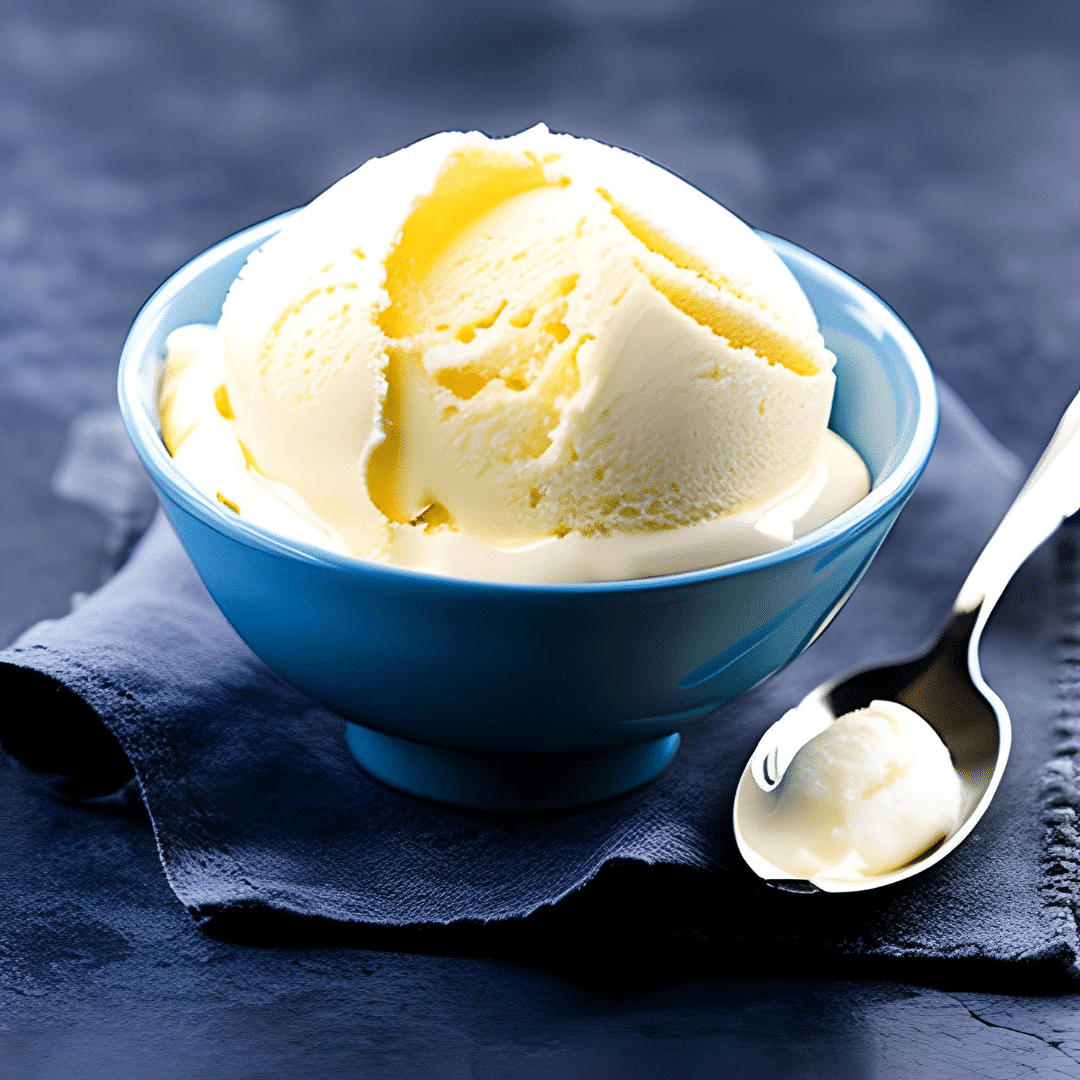
National Vanilla Ice Cream Day

Jul 22, 2026 | Food Blog

Today’s spotlight is on vanilla ice cream.

According to the International Dairy Foods Association, chocolate was the first ice cream flavor invented, and vanilla is the most popular ice cream flavor in the world. The first documented ice cream recipe was by Englishwoman Lady Anne Fanshawe in 1665, which suggested flavoring the “icy cream” with orange blossom water, mace, or ambergris, which was enjoyed by the Greek conqueror Alexander the Great.

The earliest frozen chocolate recipes were published in Naples, Italy in 1693 in Antonio Latini’s The Modern Steward. Chocolate was one of the first ice cream flavors, created before vanilla.

Vanilla doesn’t appear in published ice cream recipes until the 1760s, and then it would have been used very rarely. Vanilla ice cream was introduced in the late 1700s, becoming the most popular flavor in America.

But even before that, in 1602, Queen Elizabeth I’s pastry chef, Hugh Morgan, suggested using vanilla separately from cocoa. Thus, making vanilla something only royalty enjoyed. The French started using vanilla in drinks and foods without cacao and began using it to flavor ice cream. Thomas Jefferson discovered vanilla ice cream in France and brought the recipe to the United States. Thomas Jefferson wrote his own recipe for vanilla ice cream in the 1780s. The recipe is housed at the Library of Congress.  As a result of Jefferson, in the late 1700s, vanilla ice cream became the most popular flavor in America.

A brief History of Vanilla

The Totonacs of Mexico’s east coast are thought to be the first people to cultivate vanilla. The Totonacs grew vanilla planifolia for medicinal or religious purposes, and it wasn’t often used as a flavoring. In 1427, the Aztecs conquered the Totonacs and discovered the flavoring and medicinal value of the black vanilla pod. The Aztecs were the first to use vanilla and cocoa together to flavor their foods and drinks.

The Spanish got vanilla when they conquered the Aztecs. Hernan Cortez was the European “discoverer” of vanilla, and he brought a large supply of vanilla to the Spanish royal court. The Mexican emperor, Montezuma, introduced vanilla to Cortez, who brought it to Europe in the 16th century.

The word vanilla comes from the Spanish word “vaina” which translates to little pod. The vanilla “fruit” was originally grown in Mesoamerica, part of which is where Mexico is located today. The Aztecs cultivated vanilla and called it the “black flower” because the vanilla orchid turns black after maturing and being harvested. Hernán Cortés introduced the spice to Europe in the 1520’s.

For centuries, vanilla was a rare, New World flavor enjoyed mainly by European elites. Today, vanilla is so well-known that its very name means “common”.


About Vanilla Ice Cream

Vanilla ice cream is a sweet frozen dessert made from milk, cream, sugar, and vanilla flavoring. The vanilla flavoring can come from vanilla seeds, pure vanilla extract, vanilla seed paste, or a combination. The vanilla used in extracts and flavorings comes from the beans of the flowering orchid Vanilla planifolia. Nearly 80 percent of the world’s vanilla supply is grown in Madagascar.

The type of vanilla used to flavor ice cream varies by location. Because of the high costs involved with purchasing real vanilla beans, the vast majority of vanilla ice cream is made using “natural Vanilla flavoring” or synthetic vanilla aromas.

Good vanilla ice cream doesn’t use vanilla essences, but instead uses the vanilla seeds scraped out of the pod. Vanilla ice cream is white because it’s made of a cream/milk base.


Vanilla is the most popular ice cream flavor in the world. It’s a complex flavor that can range from sweet to floral. According to Datassential, 81% of consumers love or like vanilla and 94% have tried it.

According to the Food Channel, the top 10 most popular ice cream flavors are:

  • Vanilla, 30%
  • Chocolate, 10%
  • Butter Pecan, 4%
  • Strawberry, 3.7%
  • Chocolate Chip Mint, 3.2%


Here Are Some Facts About Vanilla Ice Cream:

  • Vanilla ice cream is traditionally made from fresh milk, cream, egg yolks, sugar, and vanilla.
  • It takes three gallons of whole milk to make one gallon of ice cream.
  • Vanilla is the number one most popular ice cream flavor in many countries, including the United States, Germany, Italy, New Zealand, China, and Brazil
  • Vanilla ice cream has 21.2 grams of sugar per 100 grams of ice cream, about 12 grams of which is natural sugar.
  • Vanilla ice cream was originally created by cooling a mixture of cream, sugar, and vanilla above a container of ice and salt.
  • Vanilla is a universal flavor that’s used in many things, including cookies, cakes, desserts, sauces, drinks, and savory meals.
  • The average number of licks to finish a scoop of ice cream is 50.


It’s estimated that the world’s annual consumption of ice cream is around 15.4 billion liters. The United States leads the world in ice cream consumption, with an average of 26 liters of ice cream per person consumed per year. New Zealand comes in second, at 23 liters per ice cream per person. Australia rounds out the top 3 at 18 liters per person.

According to a survey by the International Ice Cream Association (IICA), vanilla is the most popular ice cream flavor among Americans. When asked to choose directly between chocolate and vanilla ice cream, 49% of Americans choose vanilla over chocolate.


Here are some statistics about vanilla ice cream consumption:

  • 81% of consumers love or like vanilla, and 94% have tried it.
  • 13% of Americans eat vanilla ice cream.
  • Vanilla is the most popular ice cream flavor among Americans, according to a survey by the International Ice Cream Association
  • Vanilla is #1 in almost every country.
  • More than half of Americans say they do not eat ice cream or limit their consumption due to health concerns.


In 1984, President Ronald Reagan proclaimed July as National Ice Cream Month and established National Ice Cream Day as the third Sunday in July. Reagan wanted to commemorate a treat enjoyed by over 90 percent of the US population. His proclamation also glorified the dairy industry in America. National Vanilla Ice Cream Day started in 2017 as a promotion for the frozen dessert. It’s observed annually in July.

We encourage you to celebrate National Vanilla Ice Cream Day. Eat as much vanilla ice cream as you want without guilt, top it with flavored syrup, whipped cream, fruits, or sprinkles! Let us know in the comments what your favorite ice cream is.

0 Comments

Submit a Comment

Your email address will not be published. Required fields are marked *

Subscribe to our Blog to receive more content like this. Click here to subscribe.

Be sure to watch our shows on QVC+  or our YouTube channel

Give us your feedback on our Social Channels 

FacebookInstagramTik TokLinkedInPinterestTwitter  

National Lasagna Day

National Lasagna Day

Today’s spotlight is on Lasagna.
Lasagna is considered one of the oldest pasta dishes in Italian cuisine. Lasagna has a long history and cultural significance in Italy and other countries. It symbolizes comfort, tradition, and family and is often served as a shared meal at the dinner table. Initially, lasagna was originally reserved for special events and holidays.

Read More

National Chicken Wing Day

National Chicken Wing Day

Today’s Spotlight is on Chicken Wings.

Chicken wings were invented in 1964 at the Anchor Bar in Buffalo, New York. The bar's co-owner, Teressa Bellissimo, cooked leftover wings in hot sauce as a late-night snack for her son and his friends. The story goes that Bellissimo mistakenly ordered a case of chicken wings when she meant to order chicken necks, which her husband used to make the Anchor Inn's famous spaghetti sauce. Bellissimo covered the wings in her own special sauce and served them with a side of blue cheese and celery.

Read More

National Hamburger Day

National Hamburger Day

Today’s food spotlight is on the Hamburger.

There's some controversy over the origin of the hamburger because its two basic ingredients, bread and beef, had been prepared and consumed separately for many years before they were combined. Some have pointed to a recipe for "Hamburgh sausages" on toasted bread, published in The Art of Cookery Made Plain and Easy by Hannah Glasse in 1747. White Castle traces the origin of the hamburger to Hamburg, Germany, with its invention by Otto Kuase. According to legend, Louis Lassen invented the burger in 1900 at his small restaurant in New Haven, Connecticut. He placed a beef patty between two slices of bread and added cheese and condiments, creating the first “hamburger sandwich”.

Read More

National Creme Brûlée Day

National Creme Brûlée Day

Today’s Spotlight is on Crème Brûlée.
Crème brûlée is a custard dessert with a hard caramel top that's rich, creamy, and delicious. It has a slightly caramelized and burnt taste, with a combination of light and airy vanilla custards, the nutty flavor of caramelized sugar, and a sweet and bitter burnt taste. The caramel topping adds a slight burnt sugar flavor and crunch to the dessert.
Some say the contrast between the soft and silky inside and the crackly brown top makes crème brûlée such a great dessert. It's also simple to make, without a long list of ingredients or complex processes.

Read More

Bagelfest Day

Bagelfest Day

Today’s Spotlight in on Bagels.
National Bagelfest Day is celebrated on July 26th each year to recognize the tasty and light bread that is the bagel. The holiday was started in 1986 by Murray Lender, the owner of Lender's Bagels. The first festival was held in Mattoon, Illinois to celebrate the 50th anniversary of Lender's Bagels, a popular brand that has been produced in Mattoon since 1960. The festival became a multi-day event with music, rides, a parade, and a bagel breakfast.

Read More

National Hot Fudge Sundae Day

National Hot Fudge Sundae Day

Today’s spotlight is on the Hot Fudge Sundae.
The prevailing theory is that the first hot fudge sundae was created in Los Angeles, California in 1906. Clarence Clifton Brown, the owner of C.C. Brown's Ice Cream Shop in Los Angeles, is thought to have created the hot and cold concoction. Brown was a candy maker who experimented with several hot fudge recipes before finding the right formula. He opened his ice cream parlor on Hollywood Boulevard in downtown Los Angeles. He had the idea to create a topping that would slowly melt the cold ice cream.
A hot fudge sundae is ice cream topped with hot fudge sprinkles, nuts, whipped cream and a cherry on top.

Read More

National Tequila Day

National Tequila Day

Today’s spotlight is on Tequila!

A drink similar to tequila likely originated around 1000 B.C. among the Olmec people in what is now Southeastern Mexico. Tequila first came into existence between 250 and 300 A.D. when the Aztec Indians produced a fermented agave juice of the agave for their ceremonial wine, "plaque". The liquid was important to Aztec culture because they worshipped two gods, Mayahuel (the goddess of the Maguey) and her husband Patecatl, the god of pulque. The earliest version of tequila was known as pulque and was made from the fermented sap of the agave plant by the Aztec civilization in what is now northern Mexico. Pulque was a milky liquid that was sacred in Aztec culture and often linked with feasting and ritual ceremonies

Read More

Fortune Cookie Day

Fortune Cookie Day

Today’s spotlight is on Fortune Cookies.

Fortune cookies can symbolize luck, wisdom, fate, and the unknown. The message inside the cookie is for you, and you picked that cookie out of all the others. Fortune cookies are a dessert served primarily in Chinese restaurants. They have a distinctive shape and a hidden paper slip with a fortune inscribed on it.

Some say that fortune cookies can predict what will happen in the future. However, others say that fortune cookies don't have special powers of foresight. If a fortune comes true, it's just coincidence.

Read More

National Daiquiri Day

National Daiquiri Day

Today’s spotlight is on the Daiquiri. Love them or hate them, today is their day.
The daiquiri is a cocktail made with rum, lime juice, and sugar. It is believed to have originated in in 1898 in the town of Daiquiri on the southeastern tip of Cuba near Santiago. Thus, the name comes from the beach where the first Daiquiri was created.

Read More

National Caviar Day

National Caviar Day

Today’s foods spotlight is on Caviar.

Caviar is made from the unfertilized fish eggs, or roe, of the female sturgeon. Sturgeon is a prehistoric species native to rivers and lakes in eastern Europe and central Asia. Only female sturgeon are used for caviar production because only female sturgeon produce roe for human consumption.

Traditionally, the term caviar referred only to the roe from wild sturgeon caught in the Caspian and Black Seas. This was the most prized type of caviar. However, overfishing in the region in the 1980s and '90s has depleted wild sturgeon populations, so caviar is now produced around the world. Farm-produced caviar has become popular.

Other forms of fish eggs, such as salmon, trout, and flying fish, are "roe" and are a popular and affordable alternative to caviar.

Read More

Pin It on Pinterest