
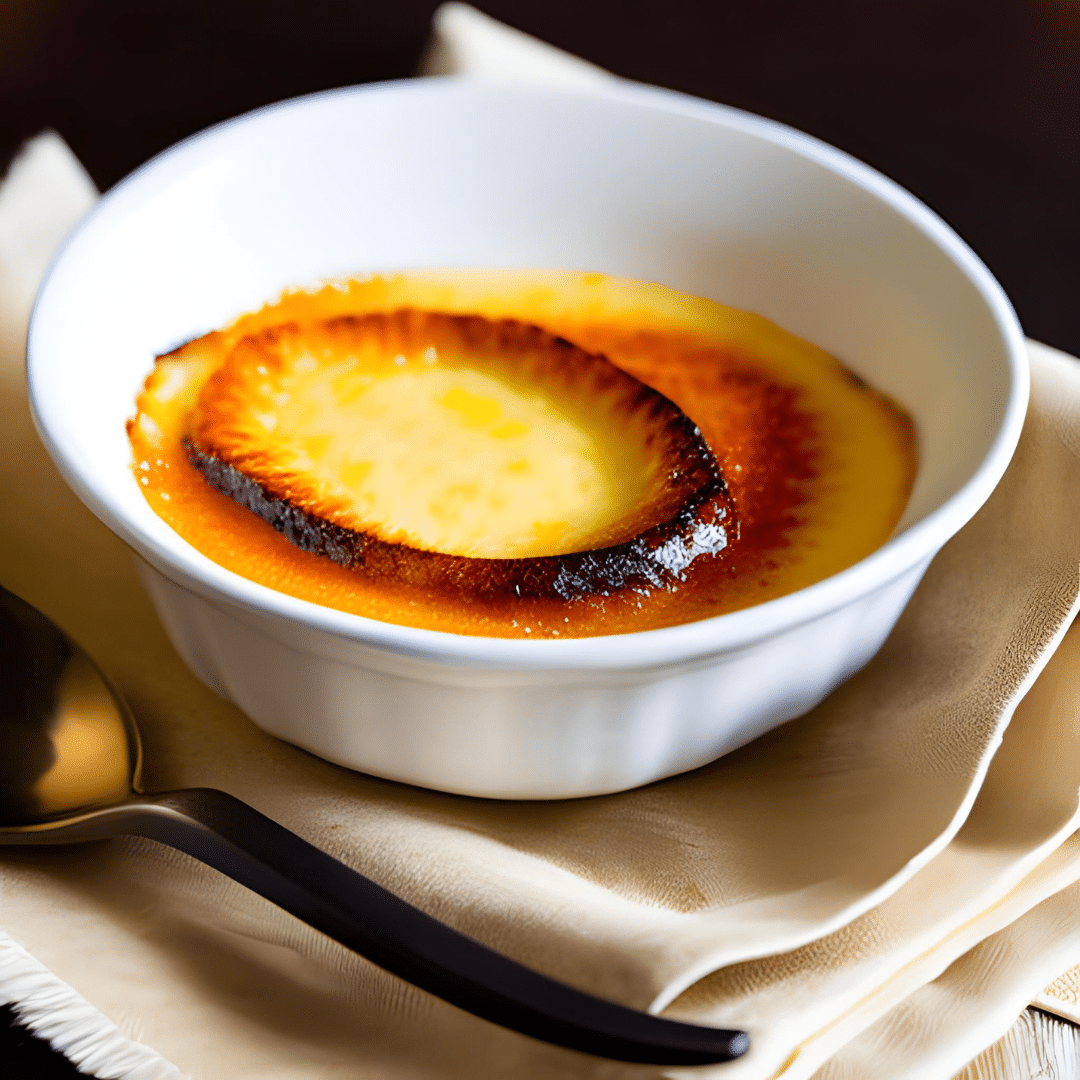
Today’s Spotlight is on Crème Brûlée.
Crème brûlée is a custard dessert with a hard caramel top that’s rich, creamy, and delicious. It has a slightly caramelized and burnt taste, with a combination of light and airy vanilla custards, the nutty flavor of caramelized sugar, and a sweet and bitter burnt taste. The caramel topping adds a slight burnt sugar flavor and crunch to the dessert.
Some say the contrast between the soft and silky inside and the crackly brown top makes crème brûlée such a great dessert. It’s also simple to make, without a long list of ingredients or complex processes.
Crème brûlée is usually made with expensive ingredients, such as heavy cream and eggs, and it’s time-consuming to prepare, as the custard must be cooked slowly and carefully. All of these factors contribute to the high price of this decadent dessert.
Crème Brûlée History.
It’s thought to have originated in 17th century France. The earliest known recipe for crème brûlée appeared in the 1691 French cookbook Le cuisinier royal et bourgeois by chef François Massialot. His recipe was slightly different: a disc of caramelized sugar was placed onto the custard, instead of burning the sugar directly on the dessert.
Crème brûlée was introduced at Trinity College, Cambridge in 1879 as “Trinity Cream” or “Cambridge burnt cream”. The college arms were “impressed on top of the cream with a branding iron”.
The Spanish claim to have invented this dessert in the early 18th century under the name known as crema Catalana. The English also claim that this dessert was their invention from the 17th century, when it was called burnt cream.
The dessert became popular in America in the 1980s. Crème brûlée’s popularity in the US really exploded when NYC’s famed high-end restaurant La Cirque put it on their menu in the 80’s. Nowadays, you can find crème brûlée just about anywhere.
Here are some fun facts about the crème brûlée dessert:
- The name crème brûlée translates from French to mean “burnt cream.”
- The dessert is usually served in individual ramekins.
- The first printed recipe for crème brûlée appeared in the 1691 edition of the French cookbook “Le Cuisinier Royal et Bourgeois” by Francois Massialot, a cook at the Palace of Versailles
- The dessert has its own national day, which falls annually on July 27
While crème brûlée is a rich and creamy dessert that’s high in sugar and calories, it can be part of a healthy diet if consumed in moderation. The custard base of the dessert is made with eggs, milk, and cream, which are nutritious and provide the body with protein, vitamins, and minerals. Crème brûlée also contains polyunsaturated fatty acids, phosphorus, iron, B vitamins, and vitamin A.
To make crème brûlée healthier, you can substitute heavy cream with nonfat Greek Yogurt or non-dairy milk, such as almond or coconut. You can also swap out regular white sugar on top for an all-natural sweetener like Truvia.
Here are some benefits of crème brûlée:
- Contains polyunsaturated fatty acids, phosphorus, iron, B vitamins, and vitamin A
- Can be part of a healthy diet if consumed in moderation.
- Loaded with healthy fats.
- Contains protein, vitamins, and minerals from eggs, milk, and cream in the custard base.
- Contains approximately 400 calories per serving.
- Contains 3.4 g of saturated fat and 107 mg of cholesterol per serving.
Here is a crème brûlée recipe for you to try:
Ingredients:
- 2cups heavy or light cream, or half-and-half
- 1vanilla bean, split lengthwise, or 1 teaspoon vanilla extract.
- ⅛teaspoon salt
- 5egg yolks
- ½cup sugar, more for topping
Instructions:
- Heat oven to 325 degrees. In a saucepan, combine cream, vanilla bean and salt and cook over low heat just until hot. Let sit for a few minutes, then discard vanilla bean. (If using vanilla extract, add it now.)
- In a bowl, beat yolks and sugar together until light. Stir about a quarter of the cream into this mixture, then pour sugar-egg mixture into cream and stir. Pour into four 6-ounce ramekins and place ramekins in a baking dish, fill dish with boiling water halfway up the sides of the dishes. Bake for 30 to 40 minutes, or until the centers are barely set. Cool completely. Refrigerate for several hours and up to a couple of days.
- When ready to serve, top each custard with about a teaspoon of sugar in a thin layer. Place ramekins in a broiler 2 to 3 inches from heat source. Turn on broiler. Cook until sugar melts and browns or even blackens a bit, about 5 minutes. Serve within two hou
National Crème Brûlée Day is observed on July 27 each year. The French dessert has been a classic favorite around the world since it was first introduced. It’s also known as Crema Catalana and Trinity Burnt Creme, depending on where you’re from. So as always, we’d love to hear your favorite Crème Brûlée story in the comments.
0 Comments