
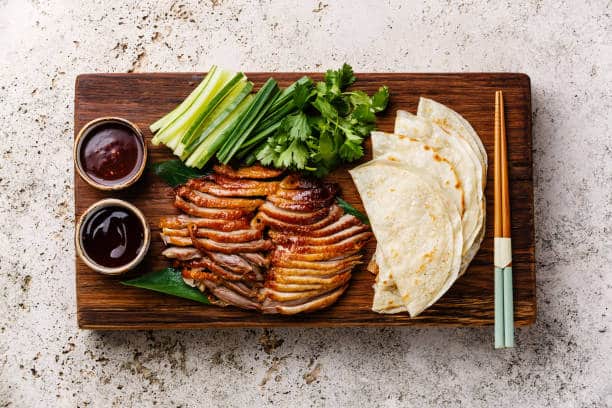
Today’s Spotlight is on Peking Duck.
Peking duck is a traditional Chinese dish from Beijing that has been prepared since the Imperial era back to 400 AD. It’s made with roasted duck meat and crispy skin, and is served with thin pancakes, spring onion, cucumber, and hoisin sauce. The meat is characterized by its thin, crispy skin, with authentic versions of the dish serving mostly the skin and little meat, sliced in front of the diners by the cook.
The dish is named after the Romanized name for Beijing, where it originated. The duck’s skin is so brittle that it shatters like an eggshell. The meat is tender, rich, and slightly sweet. The dish is made with a specific breed of duck called the Imperial Peking. The ducks are force-fed and housed in small cages to ensure tender meat.
Authentic versions of the dish serve mostly skin and little meat. The cook slices the meat in front of the diners. The dish has been prepared since the Imperial era. It gained prominence as a staple on 13th century imperial menus of several royal dynasties.
History
Peking duck’s history dates back to the Yuan Dynasty (1271–1368). It was originally known as “Jinling roast duck”. The dish was sold by street vendors in Hangzhou, near Shanghai. It became a specialty of Nanjing, the first capital of the Ming dynasty.
The imperial court moved to Beijing during the Ming dynasty, bringing roasted duck with it. The dish became a staple on imperial menus. It spread to the nobility during the Qing dynasty, where it was praised in poetry and scholarly writings.
The first restaurant specializing in Peking duck was Bianyifang, which opened in 1416. Chefs in Beijing bred a local variety of duck that was known for its snowy-white feathers, thin skin, and tender flesh. The dish is also known as Beijing duck or Chinese roast duck.
Here are some fun facts about Peking duck:
- The Pekin duck has white feathers, an orange bill, and orange-yellowish feet. Donald Duck was modeled after this breed.
- The Pekin duck is the most popular domestic duck in America.
- The Pekin duck can weigh between 8-11 pounds in captivity.
- The Pekin duck is slaughtered after 65 days.
- The Pekin duck is gutted and filled with boiling water to help a sweet basting syrup penetrate the meat.
- The Pekin duck is dried, coated, and roasted.
- The Pekin duck is baked for about 50 minutes.
- One Pekin duck will feed only two people unless it is cut up into a stew.
Here is a Peking Duck Recipe for you to Try:
Ingredients:
- 1 duck – about 2.5kg/5.5lb
- 2 tablespoon fine salt
For the syrup
2 tablespoon maltose – see note 1
120 ml hot water – about ½ cup
1 teaspoon vinegar – see note 2
For the stuffing
- 2 stalks scallions
- 1 head garlic
- 2 apples – quartered
- 4 star anise
- 4 bay leaves
- 2 pieces cassia cinnamon
For the sauce
- 3 tablespoon sweet bean sauce (Tian Mian Jiang/甜面酱)
- 1 teaspoon sugar
You Also Need
- Peking duck pancakes – homemade or shop-bought
- Scallions – julienned
- Cucumber – peeled and seeds removed, cut into sticks.
INSTRUCTIONS
Prepare the Duck
- Pat dry the duck with kitchen paper then rub the salt over the skin and the cavity. Put the duck over a wire rack with a tray underneath to collect any drips. Leave to rest on the counter for 1 hour.
- Bring about 1½ liters of water (about 6 cups) to a boil, then gently pour it over the entire duck skin (remember to flip over and do the other side). You can use a deep tray to collect the water, or do it inside a sink. If there are feather ends on the skin, remove them with a tweezer.
- In a bowl, mix maltose with hot water and vinegar until completely dissolved. Brush a layer of the mixture over the duck skin. Leave to rest in the fridge for 1 hour then brush another layer.
- Keep the duck refrigerated uncovered (over the rack and inside a tray) for 24 to 48 hours.
Roast the Duck
- One hour before roasting, take the duck out of the fridge to bring it back to room temperature. Put all the stuffing ingredients (scallions, garlic, apples, star anise, cassia cinnamon and bay leaves) into the cavity. Use toothpicks or skewers to seal the openings of the cavity.
- Preheat a fan-assisted oven, aka convection oven, at 200°C/390°F (or 220°C/425°F if using a conventional oven). Put the duck over the middle rack of the oven with the breast side facing up. Place a roasting tray at the bottom of the oven to collect any dripping fat during roasting. Leave to cook for 15 minutes.
- Then lower the temperature to 180°C/350°F (or 200°C/390°F if using a conventional oven). Use aluminum foil to cover the tip of the wings and the end of the legs. Continue cooking for a further 60 minutes or so (see note 4)
- Check the doneness by inserting an instant-read thermometer into the thickest part of the chicken (the inner thigh area near the breast). The temperature should be no lower than 74C°/165F°.
Serve the Duck
- Take the duck out of the oven and leave it to rest on the counter for 15 minutes.
- While waiting, prepare the sauce. Add ½ tablespoon of duck fat collected during roasting to a pan. Add sweet bean sauce and sugar. Mix and simmer over low heat until tiny bubbles appear. Transfer to a small serving dish. Whisk to fully incorporate the sauce and oil.
- Steam the pancakes for 3 minutes to warm up if they’re cold. Slice the duck into pieces.
- When eating, spread a little sauce over a pancake, put the duck, scallions and cucumber in the middle. Wrap up into a cylinder and enjoy.
- Cook a soup (optional)
- After most of the meat has been removed from the duck, boil the carcass in water to make a soup with Napa cabbage or winter melon. Simply add salt and white pepper to season.
- Enjoy!
Here are some tips for making Peking duck:
- Brining the duck helps keep the meat juicy and gives it a tangy flavor.
- Air drying the duck’s skin makes it tougher and crispier.
- Freezing the duck for 24 hours thickens the skin.
- Inserting a meat hook near the neck and hanging the duck in a cool, dry place for 8 hours or overnight adds authenticity.
Consumption
According to Tastewise, Peking duck is consumed 1.3 times per year on average. A whole duck can feed three to four people. Peking duck is often the most expensive item on a Western Chinese restaurant’s menu. It takes a long time to prepare compared to other Chinese dishes.
Celebrating Peking Duck
National Peking Duck Day is celebrated on January 18. This day recognizes China’s national dish. You can also make Peking duck for the holidays. Let us know in the comments if you are a fan of this international favorite dish.
0 Comments