
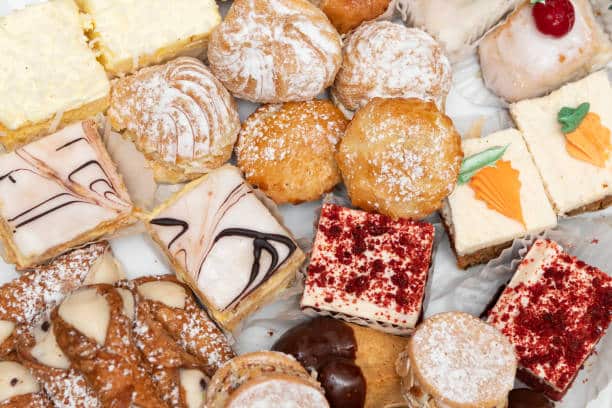
Today’s Spotlight is on Pastries.
Pastry is baked food made with a dough of flour, water and shortening that may be savory or sweetened. Sweetened pastries are often described as bakers’ confectionery. Pastry is a type of baked dough made with flour, water, and shortening. It is often filled with fruit or cream. Pastry is characterized by its flaky and crumbly texture, and rich buttery flavor.
Common pastry dishes include Pies, Tarts, Quiches, Croissants, Pasties.
Pastry is typically made with ingredients such as:
- Flour, Sugar, Milk, Butter, Shortening, Baking powder, Eggs.
Pastry is often used as a base or covering for other foods. It can be consumed alone or with fillings. There are five main types of pastry dough: Flaky, Short crust, Puff, Choux, Filo. Pastries typically contain more sugar and butter than cakes, and they often have a crispy crust.
Here are some types of pastry dough:
- Flaky – A simple pastry that expands when cooked due to the number of layers.
- Short crust – Often used for sweet tarts with sweet fillings.
- Puff – A type of pastry from France. Croissants are a type of puff pastry.
- Choux – Used to make profiteroles.
Other types of pastry dough include:
- Hot water crust – Used to make rich and flavorful pasties.
- Danish – A buttery, flaky pastry made with a lamination similar to croissants and puff pastry.
- Strudel – A variant of phyllo, made from multiple, thin layers of dough.
- Brioche – Used for brioches, Kouglof, and certain types of bread.
What is or is not a Pastry?
A muffin is not considered a pastry. It’s a quick bread. Muffins are made with a batter that’s chemically leavened and baked in a small, deep cup-shaped pan. This gives them a “cupcake” or “mushroom-like” shape.
A donut is a pastry. Donuts are a type of sweet, deep-fried pastry. They’re usually ring-shaped with a hole in the middle. They’re made with yeast and have a higher fat and sugar content than bread.
A brownie is not a pastry. Brownies are dense, fudgy desserts that are often topped with nuts or frosting. They’re made in a pan, cut into individual portions, and are most often eaten with hands, not forks. Brownies are classified as a cookie, more specifically, a bar cookie. They’re not classified as cakes because they’re finger foods, while cake is eaten with a fork.
History
The earliest known pastries were made by the ancient Egyptians. They baked cakes made from wheat and honey, often flavored with fruits and nuts. These cakes were baked on hot stones and were likely the first known example of baking.
The Romans, Greeks, and Phoenicians all had filo-style pastries in their culinary traditions. The Romans created a basic pastry dough that was used as a covering for meat when cooking. The paste was never meant to be eaten and was subsequently discarded.
In the 17th century, pastry baking became extremely popular and several timeless creations such as puff pastry were developed. The introduction of sugar into European cookery resulted in a large variety of new pastry recipes in France, Italy, Spain and Switzerland.
The word “pastry” comes from the French word pastisserie, which referred to any food made with dough, such as a meat pie. The word “pastry” was first used in the mid-15th century. It comes from the Middle English word “paste” and the suffix “-ry”.
The term “pastry” can also refer to:
- A group of cakes
- Skin dough is used to make pastries like puff pastry and pie.
- Pastry dough is used as a base for baked products.
In competitive cooking shows, the word “pastry” can also mean dessert, including ice cream and panna cotta.
Here are some fun facts about pastry:
- The word “pastry” comes from the Middle English word “pasty”.
- The first pastries were made by the ancient Egyptians.
- They baked cakes made from wheat and honey, often flavored with fruits and nuts.
- The Romans created a basic pastry dough that was used as a covering for meat when cooking.
- The Danish, a classic breakfast pastry, was actually a French invention.
- S. pastries tend to be sweeter than European pastries.
- The puff pastry was created in 1540 by Popelini.
- It is believed that the foliated pastry was invented in 1630 by a French painter.
Here are some Guinness World Records involving pastry:
- Largest serving of pastries: 39,550 pastries, made by 2023 Metre Baris Ve Kardeslik B?regi in Bursa, Turkey on June 3, 2012
- Longest pastry: 105 feet long, a manoucheh, a za’atar-topped focaccia that’s a traditional Lebanese breakfast.
- Largest puff pastry: 182.2 kg (401 lbs 11 oz), a bougatsa made by the Serres Chamber of Commerce and Industry in Serres, Greece
- Largest pasty: 1604 lb, created as part of the TV show Monster Munchies
- Largest beef wellington: 25.76 kg, made by Gordon Ramsay and TikTok star Nick DiGiovanni
Here is a Breakfast Pastry Recipe for you to try:
Ingredients:
Pastry Dough
- 1/4 cup (60ml) warm water (between 100-110°F, 38-43°C)
- 2 and 1/4 teaspoons Platinum Yeast from Red Star (1 standard packet)
- 1/4 cup (50g) granulated sugar
- 1/2 cup (120ml) whole milk, at room temperature (between 68–72°F, 20-22°C)
- 1 large egg, at room temperature
- 1 teaspoon salt
- 14 Tablespoons (196g) unsalted butter, cold
- 2 and 1/2 cups (313g) all-purpose flour (spooned & leveled), plus more for generously flouring hands, surface, and dough.
Filling
- 2/3 cup filling (see recipe notes for options & cheese filling)
- Egg Wash
- 1 large egg
- 2 Tablespoons (30ml) milk
Vanilla Icing (Optional)
- 1 cup (120g) confectioners’ sugar
- 2 Tablespoons (30ml) milk or heavy cream
- 1 teaspoon pure vanilla extract
Instructions:
- Make the Pastry Dough: Whisk the warm water, yeast, and 1 Tablespoon (6g) of sugar together in a large bowl. Cover and allow to rest until foamy on top, about 5 minutes. If the surface doesn’t have bubbles on top or looks foamy after 15 minutes (it should if the yeast isn’t expired), start over with a fresh packet of yeast. Whisk in remaining sugar, the milk, egg, and salt. Once these wet ingredients are mixed together, lightly cover and set the bowl aside as you work on the next step.
- Cut the cold butter into 1/4-inch slices and add to a food processor or blender. Top with 2 and 1/2 cups flour. Pulse the mixture 12-15 times, until butter is crumbled into pea-size bits. See photo below for a visual. Using a food processor or blender is best for this dough. Keeping that in mind, if you don’t have one, you can use a pastry cutter to work in the butter.
- Pour the flour mixture into the wet yeast mixture. Very gently fold everything together using a rubber spatula or wooden spoon. Fold *just until* the dry ingredients are moistened. The butter must remain in pieces and crumbles, which creates a flaky pastry. Turn the sticky dough out onto a large piece of plastic wrap, parchment paper, aluminum foil, or into any container you can tightly cover.
- 1st Refrigeration: Wrap the dough/cover up tightly and refrigerate for at least 4 hours and up to 48 hours.
- Roll & Fold: Take the dough out of the refrigerator to begin the “rolling and folding” process. If the dough sat for more than 4 hours, it may have slightly puffed up and that’s ok. (It will deflate as you shape it, which is also ok.) Very generously flour a work surface. The dough is very sticky, so make sure you have more flour nearby as you roll and fold. Using the palm of your hands, gently flatten the dough into a small square. Using a rolling pin, roll out into a 15×8-inch rectangle. When needed, flour the work surface and dough as you are rolling. Fold the dough into thirds as if it were a business letter. (See photos and video tutorial.) Turn it clockwise and roll it out into a 15-inch-long rectangle again. Then, fold into thirds again. Turn it clockwise. You’ll repeat rolling and folding 1 more time for a total of 3 times.
- 2nd Refrigeration: Wrap up/seal tightly and refrigerate for at least 1 hour and up to 24 hours. You can also freeze the dough at this point. See freezing instructions.
- Line two large baking sheets with parchment paper or silicone baking mats. Rimmed baking sheets are best because butter may leak from the dough as it bakes. If you don’t have rimmed baking sheets, when it’s time to preheat the oven, place another baking sheet on the oven rack below to catch any butter that may drip.
- Take the dough out of the refrigerator and cut it in half. Wrap 1 half up and keep refrigerated as you work with the first half. (You can freeze half of the dough at this point, use the freezing instructions below.)
- Shape into rounds: Cut the first half of dough into 8 even pieces. This will be about 1/4 cup of dough per pastry. Roll each into balls. Flatten each into a 2.5-inch circle. Use your fingers to create a lip around the edges. See photos and video tutorial if needed. Press the center down to flatten the center as much as you can so you can fit the filling inside. (Center puffs up as it bakes.) Arrange pastries 3 inches apart on a lined baking sheet. Repeat with the second half of dough.
- Spoon 2 teaspoons of fruity filling or 1 Tablespoon of cheese filling inside each.
- Egg Wash: Whisk the egg wash ingredients together. Brush on the edges of each shaped pastry.
- This step is optional, but I very strongly recommend it. Chill the shaped pastries in the refrigerator, covered or uncovered, for at least 15 minutes and up to 1 hour. See recipe note. You can preheat the oven as they finish chilling.
- Preheat oven to 400°F (204°C).
- Bake for 19-22 minutes or until golden brown around the edges. Some butter may leak from the dough, that’s completely normal and expected. Feel free to remove the baking sheets from the oven halfway through baking and brush the dough with any of the leaking butter, then place back in the oven to finish baking. (That’s what I do!)
- Remove baked pastries from the oven. Cool for at least 5 minutes before icing/serving.
- Make the icing: Whisk the icing ingredients together. If you want a thicker icing, whisk in more confectioners’ sugar. If you want a thinner icing, whisk in more milk or cream. Drizzle over warm pastries and serve.
- Cover leftover iced or un-iced pastries and store at room temperature for 1 day or in the refrigerator for up to 5 days. Or you can freeze them for up to 3 months. Thaw before serving. Before enjoying, feel free to reheat leftover iced or un-iced pastries in the microwave for a few seconds until warmed.
- Enjoy!
Consumption
In 2022, Americans consumed 8.6 billion kilograms of cake and pastry goods. They also purchased over two billion pastries and donuts. On average, pastry dough is consumed 1.22 times every year. Puff pastry is consumed 1.56 times every year.
In 2020, 130.16 million Americans consumed breakfast pastries. This figure is projected to increase to 134.62 million in 2024. The global consumption of bakery products is expected to reach 410 million tons by the year 2027.
Celebrating Pastry
To say the least, pastries are a very popular treat.
Here are some holidays that involve pastries:
- Christmas:
- Bûche de Noël: A French Christmas tradition that dates back to the 19th century.
- Christmas cake: A cylinder-shaped sponge cake that’s a nod to the ancient European tradition of burning a Yule log on a hearth to mark the winter solstice.
- December:
- National Cookie Day
- National Brownie Day
- Gingerbread House Day
- National Cupcake Day
- National Chocolate Covered Anything Day
- National Dessert Day:
- Celebrated on October 14th.
Other dessert holidays include:
- National Cream Puff Day
- Fruitcake Toss Day
- National Whipped Cream Day
- National Walker’s Shortbread Day
- National Peanut Butter Lover’s Day
- National Banana Cream Pie Day
- National Truffles Day
- National Raspberry Tart Day
- National Gingersnap Day
- National Chocolate Wafer Day
With so many opportunities to celebrate pastries, you have few excuses to not celebrate pastry. Let us know in the comments which pastry and holiday you are going to support?
0 Comments