
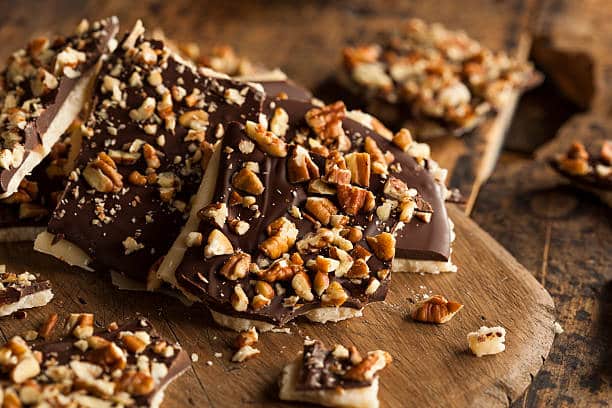
Today’s Spotlight is on English Toffee.
English toffee is a hard candy made by cooking sugar and butter until it caramelizes. The mixture is heated until it reaches the hard crack stage, which is 300–310°F (149–154°C).
In America, English toffee is usually coated in chocolate and almonds. It can also be mixed with nuts or raisins. English toffee is crunchy and buttery, with a little stickiness when chewed. It has a balance of caramelly flavor, chocolate, and nuts. Toffee can be made denser and harder, or lightened by adding baking soda when it’s almost done cooking.
In the United States, “English toffee” is often used to describe toffee that contains nuts and chocolate. However, traditional English toffee is made without nuts.
English toffee uses pure cane sugar, brown sugar, or molasses as its sweet base. It always includes chocolate. Other toffees can be made with: Pretzels, Persimmon pudding, Graham crackers. Toffee can also be made with flour.
As a point of reference, here are some other types of toffee:
- Caramel – Made with sugar, water, and cream. Caramel has a more liquid consistency than toffee.
- Brittle – Made mostly of sugar and is thinner than toffee.
- Butterscotch – Made with butter and sugar, but also contains cream.
Other types of toffee include Almond Roca, Babelutte, Bonfire toffee, Dulce de leche, Fudge.
History
Most food historians agree that toffee originated in Wales. In 1753, Molly Bushell made the first batch of butter toffee in Everton, Liverpool, England.
Toffee became popular in the early 19th century. England and other European countries liked toffee because they had lots of butter. Sugar was also cheap in the Caribbean in the 19th century. Tafia rum, a cheap Caribbean rum, was often used to flavor candies.
English toffee is still popular today because of its unique flavor and regional variations. In 1936, Helen Unger began making English toffee in her home economics class at J. Sterling Morton High School in Cicero, Illinois. She shared her toffee with family and friends during the holiday season.
The origins of the word “toffee” are unknown. Some theories include:
- It comes from the Creole language, where “toffee” is a syrup made from molasses and sugar.
- It comes from southern Britain, where “toffee” refers to something that’s hard to bite into or tough.
- It’s a variation of “taffy”.
- It’s derived from the word “taffya,” which is a West Indian rum.
The Oxford English Dictionary dates the first publication of the word “toffee” to 1825.
Here is an English Toffee Recipe for you to try:
Ingredients:
- 2 cups (4 sticks / 454 g) Challenge unsalted butter
- 2 cups (400 g) granulated sugar
- 2 cups (336 g) semisweet chocolate chips
- 1 cup (109 g) pecans finely chopped.
Instructions
- Line a large, rimmed baking sheet with parchment paper.
- To a medium, heavy-bottom saucepan over medium heat, add butter and sugar. Cook, stirring only occasionally with a wooden spoon until the candy reaches 285°F on a candy thermometer. (It should be a dark amber color.) This will take between 35-45 minutes; don’t rush it. If your temperature is rising too quickly, turn the heat down slightly.
- Pour the candy mixture onto an 11×15 lined baking sheet. While still hot, top with chocolate chips in an even layer. Let it rest for 1-2 minutes to allow the chocolate time to soften and melt. Carefully spread the chocolate into an even layer.
- Sprinkle with pecans and gently press them into the melted chocolate.
- Let it sit for about 1 hour, or until set.
- To serve, break into pieces.
- To store, place pieces in an airtight container at room temperature for up to a week.
- Enjoy!
Here are some fun facts about English toffee:
- Toffee became popular in the early 19th century because of the abundance of cheap sugar from the Caribbean and butter in England.
- In the UK, “English toffee” is also known as “butter crunch”. In Italy, it’s called “mou candies”.
- In the US, “English toffee” is usually coated in chocolate and almonds. However, traditional English toffee is made without nuts.
Here are some tips for making English toffee:
- You can make the toffee denser and harder by adding baking soda when it’s almost done cooking.
- You can store toffee at room temperature for at least two weeks. If your home is warm or you’re planning to give it as a gift, you can store it in the fridge for a couple more weeks.
Consumption
A 30g piece of English toffee has 170 calories. Plain toffee has 27 calories per 7g serving. English toffee is considered a high calorie density food, with 556 calories per 100g.
Here’s some nutritional information for English toffee from different brands:
- Eillien’s Candies Inc. – 200 calories per 38 g serving.
- Cadbury – 11 g total fat, 10 mg cholesterol, 55 mg sodium, 22 g total carbohydrates, 0.5 g dietary fiber, 21 g sugars, and 3 g protein
- GIANNIOS CANDY COMPANY – 13 g fat, 2 g protein, 15 g carbohydrates, 7 g saturated fat, and 9.9 mg cholesterol per serving
- Trader Joe’s English Toffee with Milk Chocolate – 190 calories per 34 g serving, 13 g total fat, 5 g saturated fat, 15 mg cholesterol, 65 mg sodium, 16 g total carbohydrates, and 93 mg potassium.
- Trader Joe’s English Toffee with Nuts – 200 calories per 3 pieces, 15 g fat, 2 g protein, 18 g total carbohydrates, and 17 g net carbs
Celebrating English Toffee
National English Toffee Day is celebrated each year on January 8th. Let us know in the comments your favorite brand of English Toffee, even if you prefer to make it yourself.
0 Comments