Celebrating Bouillabaisse

Dec 13, 2025 | Food Blog

Today’s Spotlight is on Bouillabaisse.

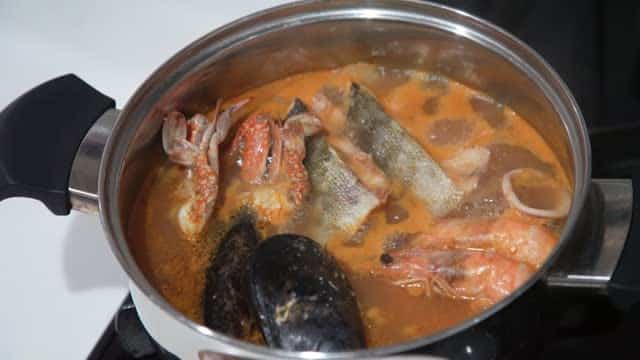
Bouillabaisse is a classic French seafood soup. It’s made with a broth of fish and shellfish, and is often served with a rouille, which is a Provençal mayonnaise-style sauce.

The Marseillaise version uses a variety of fish, while the Provençal version usually uses just one or two species. The Provençal version is also more likely to include saffron and tomatoes.

Bouillabaisse is traditionally served in two courses. The broth is served first, piping hot, with toasted bread rubbed with garlic and topped with rouille. The fish and shellfish are served separately on their own dish.

Here’s how to serve bouillabaisse:

  • Ladle the broth into warmed bowls.
  • Place a thick slice of crusty French bread in each bowl.
  • Rub the bread with garlic and drizzle it with olive oil.
  • Top the bread with rouille sauce.
  • Serve the fish and shellfish separately on their own dish.

Other accompaniments include:

  • Shredded cheese
  • Garlicky aioli
  • Roasted red pepper rouille sauce.


History

Bouillabaisse is thought to have originated in Marseille, France around 600 BC.  The Phoceans, an Ancient Greek people, founded Marseille and ate a simple fish broth known in Greek as “kakavia”.  Fishermen in Marseille made their own version of the dish, using bony rockfish that couldn’t be sold at the market.  The stew was made with whatever was left of the catch of the day. They combined the fish with onions, garlic, tomatoes, and saffron.

Others say that Bouillabaisse originated in the Provence region of France in the 19th century. The name comes from the French words bouillir, which means to boil, and abaisser, to reduce heat.

Some say that bouillabaisse was exported to Marseille by fleeing Ionian Greeks from the city-state of Phocea. Others speculate that it’s a descendant of kakavia, a traditional soup of the ancient Greeks.

One story says that Venus, the Roman goddess of love, invented bouillabaisse to put her husband, Vulcan, to sleep so she could be with her paramour Mars.


Here are some fun facts about bouillabaisse:

  • The name comes from the method of preparation, where the broth is boiled and then different kinds of fish are added one by one.
  • It’s never too hot for bouillabaisse. Michael Hutchings of Michael’s Waterside in Santa Barbara makes a chilly version that is molded like a salad.
  • A traditional bouillabaisse starts with a Provencal soup base. This soup base will have herbs and spices that are available in Provencal including garlic, tomatoes, fennel, thyme, bay, saffron, olive oil, onions, and of course, the fish. It may also have dried orange peel and a hit of wine in it.
  • Bouillabaisse contains 2 g of saturated fat and 93 mg of cholesterol per serving. 227 g of Bouillabaisse contains 68.10 mcg vitamin A, 7.5 mg vitamin C, 7.49 mcg vitamin D as well as 1.63 mg of iron, 74.91 mg of calcium, 638 mg of potassium.


Here is a Bouillabaisse recipe for you to try:

Ingredients:

Sauce Rouille

  • 1 tablespoon hot fish stock or clam broth
  • 2 cloves garlic, peeled.
  • 1 small red-hot pepper
  • 1/2 teaspoon salt
  • 1/4 cup soft white bread, pulled into bits.
  • 1/2 cup olive oil


Bouillabaisse:

3 pounds of at least 3 different kinds of fish fillets (such as sea bass, red mullet, haddock, halibut, cod, conger, or red porgy), cut into 2-inch pieces.

  • 1-pound mussels or clams
  • 1 pound squid or crab
  • 1/4 cup extra virgin olive oil.
  • 1 cup onions thinly sliced.
  • 2 leeks, white and light green parts only, thinly sliced.
  • 1/4 fennel bulb, thinly sliced, or 1 teaspoon fennel seeds.
  • 2 cloves garlic, crushed.
  • 3 large tomatoes roughly chopped.
  • 1 bay leaf
  • 3 sprigs fresh thyme
  • 1/2 teaspoon saffron threads
  • 2 teaspoons salt
  • 1 long, wide strip orange zest
  • 1 cup clam juice or fish stock
  • 1/4 teaspoon freshly ground black pepper.
  • Sliced rustic French bread, plain or toasted.


Instructions:

  1. Make the sauce rouille: Put the hot fish stock or clam broth into the bottom of a blender. Add the garlic and red-hot pepper, salt and bread. Blend until very smooth. With the blender still running, add olive oil slowly and stop the blending as soon as the oil disappears. Set it aside.
  2. Cook the onions, leeks, and fennel: Heat 1/4 cup of olive oil in a large (6 to 8 quart) pot on medium high heat. When the oil is hot, add the onions, leeks, and fennel. Stir to coat the vegetables with the olive oil. Cook on medium heat until softened but not browned, about 10 to 15 minutes.
  3. Add the garlic, tomatoes, salt, and aromatics: Add the crushed garlic, chopped tomatoes, bay leaf, thyme, saffron, salt, and orange zest. Cook until the tomatoes are soft and broken down, about 10 more minutes.
  4. Add the fish: Bring 2 cups of water to a boil. Lay the fish pieces over the vegetable mixture and pour over with 2 cups of boiling water. Add clam juice or fish stock. Bring everything to a boil, reduce to a simmer, and cook, uncovered, for about 5 minutes.
  5. Add the shellfish: Add the mussels, squid, and/or crab, pushing aside the fish so that the shellfish is now covered in liquid, and simmer for 10 minutes more, uncovered. Add freshly ground black pepper, and more salt to taste. Remove the bay leaves, thyme sprigs, and orange zest from the broth.
  6. Serve with bread and rouille: To serve, remove the fish and shellfish to a platter to keep warm. Place a thick slice of crusty French bread (plain or lightly toasted) in each bowl and put a dollop of the rouille sauce on top of the bread. Ladle the soup broth over the bread, and then portion out fish and shellfish onto the bowls.
  7. Enjoy!


Consumption

According to Tastewise, the average person consumes bouillabaisse 1.17 times per year. However, few native Marseillaises eat it, and only at home.


Celebrating Bouillabaisse

National Bouillabaisse Day is celebrated annually on December 14th. This day recognizes the soup or stew that’s made from different types of fish. Let us know in the comments if you enjoy bouillabaisse or if you think there is something fishy about it.

0 Comments

Submit a Comment

Your email address will not be published. Required fields are marked *

Subscribe to our Blog to receive more content like this. Click here to subscribe.

Be sure to watch our shows on QVC+  or our YouTube channel

Give us your feedback on our Social Channels 

FacebookInstagramTik TokLinkedInPinterestTwitter  

Celebrating Peking Duck

Celebrating Peking Duck

Today’s Spotlight is on Peking Duck.
Peking duck is a traditional Chinese dish from Beijing that has been prepared since the Imperial era back to 400 AD. It's made with roasted duck meat and crispy skin, and is served with thin pancakes, spring onion, cucumber, and hoisin sauce. The meat is characterized by its thin, crispy skin, with authentic versions of the dish serving mostly the skin and little meat, sliced in front of the diners by the cook.
The dish is named after the Romanized name for Beijing, where it originated. The duck's skin is so brittle that it shatters like an eggshell. The meat is tender, rich, and slightly sweet. The dish is made with a specific breed of duck called the Imperial Peking. The ducks are force-fed and housed in small cages to ensure tender meat

Read More

Celebrating Hot Buttered Rum

Celebrating Hot Buttered Rum

Today’s Spotlight is on Hot Buttered Rum.
Hot buttered rum is a mixed drink containing rum, butter, hot water or cider, a sweetener, and various spices. It is especially popular in the fall and winter and is traditionally associated with the holiday season. In the United States, the drink has a lengthy history that dates back to colonial days.

Read More

Celebrating Bagels

Celebrating Bagels

Today’s Spotlight is on Bagels.
A bagel is a bread roll that's shaped like a doughnut. It's made from yeasted wheat dough that's shaped into a ring, boiled in water, and then baked. Bagels are often served sliced in half, toasted, and spread with butter or cream cheese. Bagels are traditionally made from yeasted wheat dough that is shaped by hand into a torus or ring, briefly boiled in water, and then baked. The result is a dense, chewy, doughy interior with a browned and sometimes crisp exterior.

Read More

Celebrating Peach Melba

Celebrating Peach Melba

Today’s Spotlight is on Peach Melba.
Peach Melba is a dessert that was invented in the late 1800s by French chef Auguste Escoffier. It's made with poached peaches, raspberry sauce, and vanilla ice cream. The dessert is named after Australian soprano Nellie Melba.
Melba sauce is made from pureed raspberries, red currant jelly, sugar, and cornstarch. It has a smooth, syrupy texture and intense berry flavor.

Read More

Celebrating Marzipan

Celebrating Marzipan

Today’s Spotlight is on Marzipan.
Marzipan is a confection consisting primarily of sugar, honey, and almond meal, sometimes augmented with almond oil or extract. It is often made into sweets; common uses are chocolate-covered marzipan and small marzipan imitations of fruits and vegetables. It's often shaped and painted to look like realistic fruits and vegetables.
Marzipan is a common confection in Europe and has been used for centuries as both a sweet treat and a medium for food art. It's also called almond candy dough.
`

Read More

Celebrating Hot Toddy

Celebrating Hot Toddy

Today’s Spotlight is on the Hot Toddy.
Hot toddy is typically a mixed drink cocktail made with liquor, hot water, spices, sugar or honey, lemon, herbs and served hot. It's popular during the cold months and especially around Christmas. A hot toddy is also known as hot whiskey in Ireland.
Hot toddy recipes vary, and hot toddy is traditionally drunk before retiring for the night, in wet or cold weather or to relieve the symptoms of the cold and flu. The hot Toddy is known to alleviate a sore throat and symptoms from the common cold and flu. The hot toddy is made with: Lemon, Honey, Whiskey.
The ingredients in a hot toddy have cough-suppressing properties. The science behind a hot toddy includes:

Read More

Celebrating Bittersweet Chocolate

Celebrating Bittersweet Chocolate

ittersweet chocolate is a type of dark chocolate that contains a high percentage of cocoa solids and less sugar than other types of chocolate. The FDA requires that bittersweet chocolate contain at least 35 percent cocoa. Most bittersweet bars contain 50 percent, with others having as much as 80 percent cocoa.
Bittersweet chocolate has a rich, intense chocolate flavor that can be quite bitter. It also has subtle fruity flavor notes. Bittersweet chocolate is often used for baking and cooking. You can replace the bittersweet chocolate called for in your recipe with an equal amount of semi-sweet chocolate. The two are actually very similar in taste and composition.

Read More

Celebrating Apricots

Celebrating Apricots

Today’s Spotlight is on Apricots.
An apricot is a fruit, or the tree that bears the fruit, of several species in the genus Prunus. Usually, an apricot is from the species P. armeniaca, but the fruits of the other species in Prunus sect. Armeniaca are also called apricots.
Another description is that apricots are a small, pitted stone fruit that are about the size of a golf ball. They are also known as Armenian plums. Apricots are round and yellow and look similar to a smaller version of a peach. They have soft, velvety skin with a light fuzz.

Read More

Celebrating English Toffee

Celebrating English Toffee

Today’s Spotlight is on English Toffee.
English toffee is a hard candy made by cooking sugar and butter until it caramelizes. The mixture is heated until it reaches the hard crack stage, which is 300–310°F (149–154°C).
In America, English toffee is usually coated in chocolate and almonds. It can also be mixed with nuts or raisins. English toffee is crunchy and buttery, with a little stickiness when chewed. It has a balance of caramelly flavor, chocolate, and nuts. Toffee can be made denser and harder, or lightened by adding baking soda when it's almost done cooking.

Read More

Celebrating Shortbread

Celebrating Shortbread

Today’s Spotlight is on Shortbread.

Shortbread or shortie is a traditional Scottish biscuit usually made from one-part white sugar, two parts butter, and three to four parts plain wheat flour. Shortbread does not contain any leavening, such as baking powder or baking soda.

Shortbread is a cookie, not bread. It's called shortbread because it's made with a dough that's rich in fat.  The traditional ratio is one part sugar to two parts butter. This gives the dough a high fat content, which results in a soft, buttery crumb that melts in your mouth.

Shortbread is made with the following ingredients:

Read More

Pin It on Pinterest