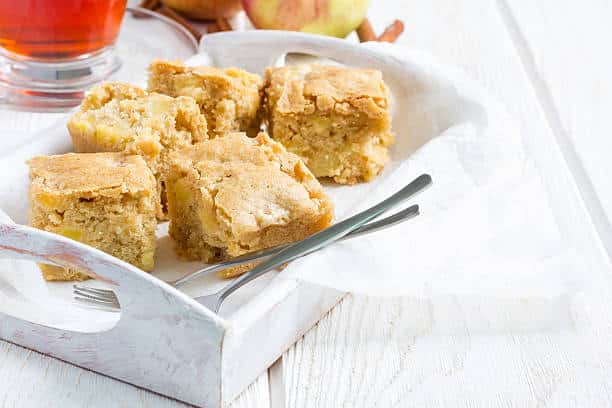
Celebrating Blonde Brownies

Jan 21, 2026 | Food Blog

Today’s Spotlight is on Blonde Brownies.

A blonde brownie, also known as a blondie, is a dessert bar that resembles a brownie but doesn’t contain cocoa powder, but substitutes vanilla in place of cocoa, and contains brown sugar. Blondies are made with: Brown sugar, Eggs, Vanilla extract, Flour, Butter. Blondies are similar to brownies in that they are thick, dense, fudge-like, and chewy. They also have a crinkly top. However, blondies have a richer vanilla and brown sugar flavor.

Blondies are made without cocoa powder, which is the main difference between them and brownies. Brownies usually include white sugar instead of brown sugar.


History

Blondies originated in the USA. Blondies were invented in Upper Sandusky, Ohio.  The first known recipe for brownies was published in 1896 by Fannie Farmer. However, her recipe didn’t include chocolate. The original brownie was a “dense, fudgy, butterscotch-flavored bar”.

Molasses was used to give the original brownie recipes their color. In the mid-1900s, these molasses brownies became known as “blonde brownies” because of their light appearance. Over time, the name shortened to “blondies”.

Blondies were made popular in Hawaii by Kamehameha Schools. They are also known as: Butterscotch brownies, Haole brownies. Recipes for blonde brownies can be found in recipe books dating back into the 1940s and maybe even earlier.

The original brownie recipes in the late 19th century used molasses to give them their color. In the mid-1900s, these brownies became known as “blonde brownies” because of their light appearance. Over time, the name shortened to “blondies”.

Blondies are also known as: Butterscotch brownies, Haole brownies.


Here are some facts about blondies:

  • Blondies are baked in the same way as regular brownies.
  • The original recipe for brownies was published in 1896 by Fannie Farmer. However, her recipe didn’t include chocolate.
  • The original brownie was a “dense, fudgy, butterscotch-flavored bar”.
  • Blondies are often made with coconut, nuts, toffee, or other chunky candy for added texture.


Here is a Blonde Brownie Recipe for you to try:

Ingredient:

  • 8oz (1 Cup) Unsalted Butter
  • 150 grams (¾ Cup) Light Brown Sugar
  • 100 grams (½ Cup) Granulated Sugar
  • 2 Teaspoons Pure Vanilla Extract
  • 1 Large Egg + 1 Large Egg Yolk, at room temperature
  • 250 grams (2 Cups) All-Purpose Flour/ Plain Flour
  • ½ Teaspoon Baking Powder
  • ¼ Teaspoon Salt
  • 1 Teaspoon Cornstarch/ Corn flour


Instructions:

  1. Preheat oven to 350F/180C and line an 8-inch square or 9-inch square baking pan with aluminum foil or parchment paper. If using foil, make sure to spray with non-stick spray then set the pan aside.
  2. In a light-colored medium-sized pot over low-medium heat add the butter and cook to “brown the butter” This process will take anywhere from 5-15 minutes depending on the size of your post, be careful not to burn it as the butter turns from brown to burnt very quickly. Check out this post for an in-depth look at browning butter. You will start to smell a nutty aroma and the butter will become a golden-brown color. Turn off and pour into a heatproof bowl to cool for 5 minutes.
  3. Add the sugars to the butter and mix to combine. Next add the egg, egg yolk, and vanilla whisk together for a minute or two if you want the color of the batter to lighten. Add flour, baking powder, salt, and cornstarch, and gently mix until no flour streaks remain. Pour into the prepared pan.
  4. Bake for 19-22 minutes or until a toothpick inserted comes out clean, you do not want to overbake. Let cool on a wire rack for 20 minutes before gently removing from the pan and slicing into bars. Store leftovers in an airtight container.


Here are some reasons why blondies might be undercooked:

  • Under-aeration: If the batter isn’t aerated enough, it won’t rise and will be dense.
  • Hot oven: The outside of the blondies may brown before the inside is done.
  • Metal pan: The center may be undercooked by the time the edges dry out.
  • Over-baking: Blondies that look like cake have been over-baked.

You can test for doneness with a toothpick or a probe thermometer. A toothpick should come out with some moist crumbs attached. A probe thermometer should read 200-205°F.

You can try these tips to avoid undercooked blondies:

  • Check the oven temperature with an oven thermometer.
  • Bake for less time or at a lower temperature.


Consumption

  • Americans eat about 4 billion brownies a year.
  • Blondies are denser and chewier than cakes.
  • Blondies have a lighter and softer taste than brownies.
  • Blondies are made without cocoa powder and have a rich vanilla flavor.
  • Chocolate is a source of antioxidants and has been found to help lower blood pressure and increase good cholesterol levels.

A serving of 3.5 oz (99g) of blondie cookies contains 370 calories and 15g of total fat.

A serving of chocolate chip blondies contains:

  • 13g of total fat
  • 5g of saturated fat
  • 0mg of cholesterol
  • 160mg of sodium
  • 170mg of potassium
  • 18g of total carbohydrates
  • 8g of dietary fiber
  • 5g of protein


Celebrating Blonde Brownies

National Blonde Brownie Day is celebrated on January 22. Let us know in the comments who makes your favorite blonde brownie.

0 Comments

Submit a Comment

Your email address will not be published. Required fields are marked *

Subscribe to our Blog to receive more content like this. Click here to subscribe.

Be sure to watch our shows on QVC+  or our YouTube channel. 

Give us your feedback on our Social Channels 

Facebook • Instagram • Tik Tok • LinkedIn • Pinterest • Twitter  

Celebrating Chocolate

Celebrating Chocolate

Today’s Spotlight is on Chocolate.
Chocolate is a sweet, brown food made from cocoa beans. It's usually sold in solid bars, but can also be powdered or melted. Chocolate is used as a flavor for desserts, drinks, and other foods.
Chocolate is rich in carbohydrates and is an excellent source of quick energy. It has several health benefits.

Read More

Celebrating Pumpkins

Celebrating Pumpkins

Today’s Spotlight in on Pumpkins.
A pumpkin is a vernacular term for mature winter squash of species and varieties in the genus Cucurbita that has culinary and cultural significance but no agreed upon botanical or scientific meaning. Pumpkin, from a botanist's perspective, is a fruit because it's a product of the seed-bearing structure of flowering plants. Vegetables, on the other hand, are the edible portion of plants such as leaves stems, roots, bulbs, flowers, and tubers.

Read More

Celebrating Pasta

Celebrating Pasta

Today’s Spotlight is on Pasta.
Pasta is a type of food typically made from an unleavened dough of wheat flour mixed with water or eggs, and formed into sheets or other shapes, then cooked by boiling or baking.
Pasta is a type of food made from unleavened dough of wheat flour, water, and sometimes eggs. The dough is formed into different shapes and then cooked by boiling or baking. Pasta can be dried or used fresh.

Read More

Celebrating Boston Cream Pie

Celebrating Boston Cream Pie

Today’s Spotlight is on Boston Cream Pie.
A Boston cream pie is a cake with a cream filling. The dessert acquired its name when cakes and pies were cooked in the same pans, pie tins were more common than cake pans, and the words were used interchangeably. In the late 19th century, this type of cake was variously called a "cream pie", a "chocolate cream pie", or a "custard cake".
The Boston cream pie is a sponge cake. The cake batter was originally baked in a pie crust. At some point, the crust was eliminated, and the batter was poured directly into the pie pan.

Read More

Celebrating Whole Hog BBQ

Celebrating Whole Hog BBQ

Today’s spotlight is on a Whole Hog BBQ.
Whole hog barbecue involves cooking an entire hog in one piece over a pit in the ground. It's a time- and labor-intensive process. Whole hog barbecue is a regional style of barbecue where a pitmaster cooks an entire hog. The hog smoked for hours on a wood pit. The meat is seasoned with sauces like mustard-based, tomato-based, or vinegar-based.
To serve, the skin is cracked along the back, hams, and shoulders. The meat should pull easily from the bone. Guests can choose the type of meat they want, such as:
Loin, Tenderloin, Shoulder, Hams, Belly, Ribs.

Read More

Celebrating Nuts

Celebrating Nuts

Today’s focus is on nuts!
Nuts (tree nuts and peanuts) are nutrient dense foods with complex matrices rich in unsaturated fatty and other bioactive compounds: high-quality vegetable protein, fiber, minerals, tocopherols, phytosterols, and phenolic compounds.
There are over 20 edible nuts in the world. Some of the most common edible nuts include:

Read More

Celebrating Nachos

Celebrating Nachos

Today’s Spotlight is on Nachos.
Nachos is a Mexican culinary dish consisting of tortilla chips or totopos covered with cheese or cheese sauce, as well as a variety of other toppings and garnishes, often including meats, vegetables, and condiments such as salsa, guacamole, or sour cream.
They can also include other toppings and garnishes, such as:

Read More

Celebrating Chicken and Waffles

Celebrating Chicken and Waffles

Today’s Spotlight is on Chicken and Waffles.
Chicken and waffles is a dish that combines chicken and waffles. It's popular in the United States and is served in many restaurants. The dish first appeared in the United States in the 1600s in Pennsylvania Dutch country. The traditional Pennsylvania Dutch version consists of a plain waffle with pulled, stewed chicken on top, covered in gravy.

Read More

Celebrating Seafood Bisque

Celebrating Seafood Bisque

Today’s Spotlight is on Seafood Bisque.
A bisque is a French style of soup that is made from crustaceans, such as lobster, crab, shrimp, and crayfish; their shells are used to make a stock and the meat is incorporated into the finished dish. So, in a way, calling the soup a "seafood bisque" is somewhat redundant.
The main characteristic of a bisque is that it is smooth and has a velvety texture. Most recipes will include wine and cream to give it its signature flavor and texture. But it's not merely the choice of ingredient that makes bisque different from other types of soups. It’s also the technique for utilizing that ingredient, including the parts you can't eat, making a bisque what it is.

Read More

Pin It on Pinterest