
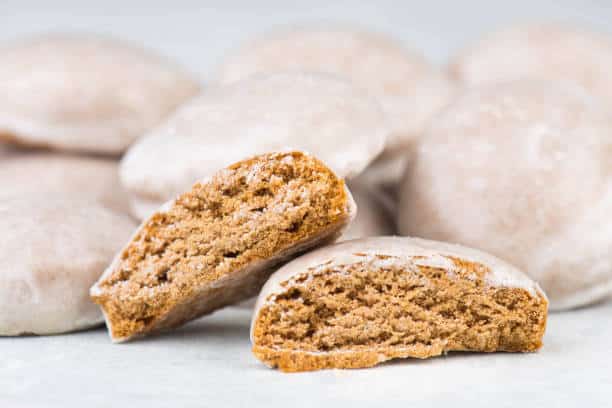
Today’s spotlight is on Pfeffernusse.
Pfeffernüsse are small spice cookies, popular as a holiday treat with Germans and ethnic Mennonites in North America. Similar cookies are made in Denmark, and The Netherlands, as well. They are also known as “peppernuts”. They are a popular holiday treat for Germans and ethnic Mennonites in North America. Similar cookies are made in Denmark and The Netherlands.
The pronunciation of “pfeffernusse” is fef-fer-noos. The IPA pronunciation is /ˈpfɛfə(ɹ)nuːsə/. The German word “pfeffernüsse” means “pepper nut”. The name comes from the pinch of pepper added to the dough before baking. In Denmark, they are called “pebernødder”. In The Netherlands, they are called “pepernoten”.
The name pfeffernüsse literally means “pepper nuts”. The name comes from the addition of ground pepper in the dough and its size being the size of a walnut.
Pfeffernusse are typically tiny and round. They are flavored with a blend of warm spices, including:
- Black pepper, Anise, Cinnamon, White pepper, Allspice, Cloves.
Pfeffernusse recipes differ widely, but they all traditionally call for a blend of spices made up of over half a dozen ingredients. Some recipes go up to a full dozen. Pfeffernusse are dipped into an eggwhite-based glaze after baking. They can be eaten while they are still crisp on the outside and chewy inside, or they can be let to harden for a week and then dunked in coffee before eating.
Pfeffernusse are characteristically a bit of a drier cookie. If you would like them softer, you could:
- Bake them for less time.
- Add a bit less flour.
- Make sure you are doing the overnight resting step.
Pfeffernusse can be stored at room temperature for up to a week in an airtight container.
History
Johann Fleischmann, a confectioner from Offenbach am Main, is believed to have created the recipe for pfeffernüsse in 1753. The cookies became very popular, attracting the interest of many people, including renowned individuals like Felix Mendelssohn. Goethe praised the pastries.
Pfeffernüsse are a traditional German treat. The name literally translates to “pepper nuts,” but they’re really a kind of gingerbread-ish cookie.
The most distinctive ingredient is black pepper. They also contain either anise seeds or anise extract to give it that licorice flavor.
Pfeffernüsse are an important part of the Christmas season for many families. They’re linked to the December 5th feast of Sinterklaas in The Netherlands, when children receive gifts from St. Nicholas. It is celebrated the following day in Germany and Belgium.
Here are some fun facts about pfeffernüsse cookies:
- They’re often sweetened with sugar powder or honey.
- They’re very spicy, thanks to the variety of spices added.
- They’re soft, dense, and chewy.
- They’re often covered in a dusting of icing sugar or an icing sugar glaze.
- They’ve been an integral part of Yuletide celebrations in Europe since the 1850s.
- They’re associated with the Feast of Sinterklaas, celebrated in Germany, the Netherlands, and Belgium.
- They were given to guests during official state receptions.
- Historians believe pfeffernüsse was brought to the USA by early settlers in the 18th Century.
- The name comes from the addition of ground pepper in the dough and its size being the size of a walnut.
Here is a pfeffernüsse cookie recipe for you to try:
Ingredients:
- 2 ¼ cups (280 g) all-purpose flour
- ¾ teaspoon ground cinnamon
- ½ teaspoon ground all spice
- ¼ teaspoon freshly ground nutmeg
- ¼ teaspoon freshly ground black pepper
- ¼ teaspoon ground cloves
- ¼ teaspoon baking soda
- ¼ teaspoon salt
- ½ cup (113 g or 1 stick) unsalted butter, room temperature
- ¾ cup (150 g) firmly packed light brown sugar
- ¼ cup unsulfured molasses
- 1 large egg
- 1 teaspoon anise extract, (or vanilla if you prefer)
- ½ cup (87 g) confectioners’ sugar
Instructions:
- In a bowl, combine flour, cinnamon, all spice, nutmeg, black pepper, ground cloves, baking soda, and salt. Set it aside.
- In a stand mixer, beat butter, brown sugar, and molasses on medium speed until fluffy, about 3 minutes. Beat in egg and anise extract until combined. With mixer on low speed, slowly add flour mixture and beat until just combined.
- Wrap dough in plastic wrap and chill in the refrigerator for at least three hours.
- Position a rack in the middle of an oven and preheat to 350° F. Line two baking sheets with parchment paper and set aside.
- Scoop about a tablespoon of dough and roll into balls 1 1/2 inches in diameter. Place balls on prepared baking sheets about 2 inches apart. Bake until cookies are golden and firm to the touch with slight cracking, about 15 minutes. Transfer cookies to a wire rack to cool slightly, about 5 minutes.
- While cookies are still slightly warm, roll them in confectioners’ sugar and serve.
- Enjoy!
Here’s some nutritional information for pfeffernusse cookies from different brands:
- Trader Joe’s: 2 cookies contain 140 calories, 30g total carbs, 1.5g fat, and 1g protein
- Bahlsen: 3 cookies contain 110 calories, 0g total fat, and 0mg cholesterol
- Stern’s: 3 cookies contain 148 calories, 28.9g total carbs, 2.4g fat, and 2.3g protein
- Lambertz: 22g contain 76 calories, 17g total carbs, 0g fat, and 1.2g protein
- Homemade: 1 cookie contains 52 calories
Here’s some nutritional information for a medium pfeffernusse cookie:
- 53 calories
- 27g total fat
- 255g saturated fat
- 361g polyunsaturated fat
- 563g monounsaturated fat
Celebrating Pfeffernüsse Cookies
National Pfeffernüsse Day is celebrated on December 23. This holiday is a great way to get into the Christmas spirit. Pfeffernüsse are a traditional German cookie that have been part of Christmas celebrations in several European countries since the mid-19th Century. They’re often eaten by the handful.
Pfeffernüsse are linked to the December 5th feast of Sinterklaas in The Netherlands, when children receive gifts from St. Nicholas. It is celebrated the following day in Germany and Belgium.
Let us know in the comments if you have ever tried Pfeffernüsse cookies.
0 Comments