
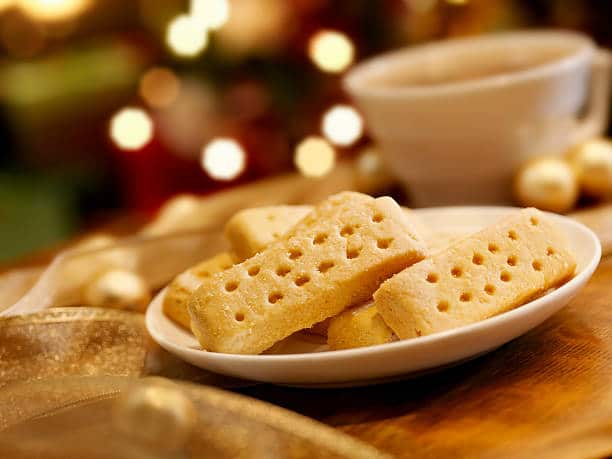
Today’s Spotlight is on Shortbread.
Shortbread or shortie is a traditional Scottish biscuit usually made from one-part white sugar, two parts butter, and three to four parts plain wheat flour. Shortbread does not contain any leavening, such as baking powder or baking soda.
Shortbread is a cookie, not bread. It’s called shortbread because it’s made with a dough that’s rich in fat. The traditional ratio is one part sugar to two parts butter. This gives the dough a high fat content, which results in a soft, buttery crumb that melts in your mouth.
Shortbread is made with the following ingredients:
- One-part white sugar
- Two parts butter
- Three to four parts plain wheat flour
- Other ingredients like ground rice or corn flour
Shortbread doesn’t contain any leavening, such as baking powder or baking soda. Shortbread has holes in it for more than just decoration. Poking holes in the dough helps the heat penetrate the cookie evenly, which helps it bake evenly. It also lets out steam, which helps the shortbread keep its shape.
You can poke holes in shortbread with a fork. You should bake shortbread at a low temperature, around 325°F. Shortbread is done when the surface is a toasty light brown. It should never appear raw or slightly opaque in the middle. If it’s under-baked in the middle, it will probably stick in the pan when you go to unmold it.
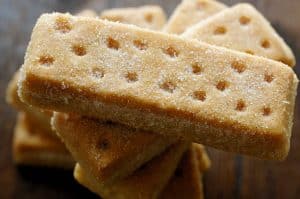
Shortbread biscuits have holes
History
Shortbread originated in Scotland in the 12th century. It was originally made from leftover bread dough that was dried in the oven to form a hard, dry rusk. The word “biscuit” means “twice cooked”. Over time, the yeast in the bread was replaced by butter, and biscuit bread developed into shortbread. Mary, Queen of Scots is often credited with refining shortbread in the 16th century. She was said to enjoy a traditional form of shortbread called Petticoat Tails. The first printed shortbread recipe appeared in 1736 from a Scotswoman named Mrs. McLintock.
Shortbread is associated with Christmas and Hogmanay (New Year’s Eve). In some Scottish wedding traditions, the groom would break a freshly baked piece of shortbread over his new bride’s head. If the shortbread crumbled into several pieces, the marriage would be fruitful.
Here are some more fun facts about shortbread:
- Bakers classified shortbread as bread to avoid paying taxes on biscuits.
- The Scottish tradition of eating shortbread on New Year’s Eve comes from an ancient pagan ritual of eating Yule Cakes.
- The shortbread’s crumbly texture comes from the high fat content of the butter. The fat inhibits the formation of long protein (gluten) strands.
- Shortbread was expensive to make because of the high-quality ingredients. It was usually only served at important occasions, like Christmas, Hogmanay, weddings, and christenings.
- Mary, Queen of Scots is said to have invented modern shortbread in the 16th century by adding sugar to an existing recipe.
- Walkers is known as The World’s Finest Shortbread.
Making Shortbread
Recipe
INGREDIENTS
- 10 tbsp unsalted butter unsalted butter, at room temperature 142g
- 1/2 cup confectioners’ sugar
- 1/2 teaspoon pure vanilla extract
- 1 1/2 cups all-purpose flour 180g
- 1/2 teaspoon kosher salt optional
Instructions
- In a stand mixer fitted with a paddle attachment, beat butter and vanilla extract until creamed.
- Add confectioners’ sugar and salt; mix until combined.
- Scrape bowl down and add flour while beating on low. Scrape bowl once more and mix until combined.
- Shape the dough into a rectangular prism, wrap it in plastic and chill until firm. At least an hour.
- Preheat oven to 350F (177C). Use a sharp knife to cut 1/2-inch thick slices
- Place slices spaced at least an inch apart onto a baking sheet lined with a silicone mat or parchment paper.
- Use a fork or skewer to indent a pattern onto the top.
- Bake for about 10 minutes, rotating baking sheet in the oven halfway through.
- Transfer to a wire sheet to cool.
- Enjoy!
Here are some tips for making good shortbread:
- Use high-quality butter.
- Keep the ingredients simple.
- Don’t overwork the dough.
- Let the dough dry out.
- Use rice flour for a sandy texture.
- Add a pinch of salt to balance the sweetness.
- Use cornstarch to prevent the cookies from becoming too crumbly.
- Start with butter that’s refrigerator cold.
- Chill the dough for at least 30 minutes before baking.
- Bake at 325°F for 35 minutes.
You can also try these tips:
- Beat the butter and sugar until they’re well combined and starting to change color.
- Use soft, room temperature butter.
- If the dough gets soft or sticky, put it in the refrigerator for 10 or 15 minutes.
Consumption
According to Tastewise, the average person consumes 1.62 shortbread cookies per year. Walkers’ shortbread is consumed 1.27 times per year on average. Shortbread is popular in Scotland, but it’s also made in the rest of the United Kingdom, Denmark, Ireland, and Sweden. The Scottish version is the best-known and is widely exported.
Celebrating Shortbread
January 6th is National Shortbread Day. Shortbread is often eaten around Christmas and the New Year, but it’s consumed year-round in many countries. Let us know in the comments if you like Shortbread cookies?
0 Comments