
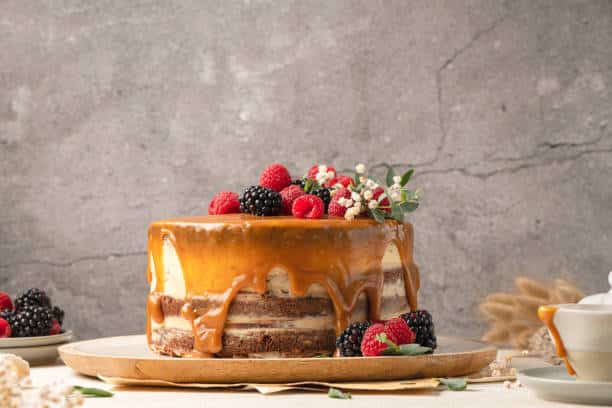
Today’s Spotlight is on Cake.
Cake is a flour confection made from flour, sugar, and other ingredients and is usually baked. In their oldest forms, cakes were modifications of bread, but cakes now cover a wide range of preparations.
A cake is a sweet, baked dessert that’s often topped with frosting or decorations. Cakes are usually made with:
- Flour
- Sugar
- Baking powder or soda
- Eggs
- Liquid flavoring
- Fat, usually butter
- Salt
- A form of liquid, usually milk
Cakes are leavened by beating air into them or using chemical leavening. They are usually shaped by the tin in which they are baked. Cakes are meant to be an indulgence. However, the ingredients they use can be part of a healthy diet if eaten in moderation.
History
The word “cake” is derived from the Old Norse word “kaka”. The precursors of modern cakes (round ones with icing) were first baked in Europe sometime in the mid-17th century.
The earliest known cakes were found in Neolithic villages. These cakes were made from crushed grains that were moistened, compacted, and heated on hot stones. They resembled what we call oatcakes, biscuits, or cookies today.
The ancient Egyptians were the first culture to exhibit baking skills. Their cakes were more bread-like in appearance and sweetened with honey. The Greeks also had an early form of cheesecake. The Romans developed versions of fruitcakes with raisins, nuts, and other fruits.
The earliest versions of cake were flat, compact discs of grain that were dried and compacted together. The closest resemblance to the cakes we enjoy today didn’t appear until the early 18th century.
Cakes were interchangeable with bread until the Middle Ages, when they started being used for special occasions. The Greeks baked moon-shaped cakes and decorated them with lit candles to offer up to Artemis, goddess of the moon, as a tribute on their birthdays.
Here are some fun facts about cake:
- The first evidence of a cake was over 6,000 years old.
- The first known wedding cakes were made of bread.
- The first reference to “birthday cake” came in 1785.
- The number of candles on a cake traditionally represents the years of your life you’re celebrating.
- The older a fruit cake is, the richer the flavor becomes.
- The ancient Greeks called cake plakous, which was derived from the word for “flat”.
- The Romans were said to be the ones who discovered cakes back in the 8th century.
- The ancient Greeks also had an early form of cheesecake.
Here are some world records about cakes:
- Longest cake – The longest cake was 5,300 m (17,388 ft) long and was made by the Bakers Association Kerala in India in January 2020. The cake was 10 cm wide and weighed 27,000 kg.
- Tallest cake – The tallest cake was 33 m (108.27 ft) tall and was made by the Hakasima-Nilasari Culinary School for the Amazing Christmas event.
- Smallest wedding cake – The smallest wedding cake was 1.25 cm tall and weighed 90 grams. It was created by a bakery owner for a wedding involving two nano particle scientists.
- Largest wearable cake – The largest wearable cake weighed 131.15 kg (289 lb 13 oz) and was made by Swiss baker Natasha Coline Kim Fah Lee Fokas.
- Tallest cake pyramid – The tallest cake pyramid was 1.74 m (5 ft 8.5 in) tall and was made by the MTR Rzeszów International Fair in Rzeszów, Poland.
Let Us Eat Cake
Since cake has been around nearly as long as people have been cooking, we thought it fitting to present the oldest cake recipe in the world and one of the oldest recipes in the world, the Linzer Torte comes from over 300 years ago in Austria.
Ingredients:
- 250 g butter
- 250 g flour
- 125 g icing sugar
- 150 g ground hazelnuts (or almonds)
- 2 tbsp breadcrumbs
- 1 egg
- 1 egg yolk
- a generous quantity of cinnamon powder
- a pinch of ground cloves
- grated lemon rind or lemon juice
- wafers for layering, to taste
- egg for coating
- redcurrant jam for coating
- butter for the mold
- flaked almonds
Instructions:
- Combine flour with cubes of butter and lightly rub the mixture between fingers to create crumbs, then add in cinnamon, ground cloves, nuts, a little salt, and lemon juice or lemon rind; for more colorful pastry add an extra egg yolk with the egg.
- Quickly knead all the ingredients to achieve a smooth, shortcrust pastry. Shape the dough into a ball, cover with film and let rest in a cool place for approx. 30 minutes.
- Preheat the oven to 180 °C and prepare a suitably sized spring form cake for baking by greasing its bottom and edges, then dusting it with some breadcrumbs.
- Take a little over half of the dough and, using your knuckles, press the dough into the base of the tin. From the remaining dough create several smaller rolls for the lattice decoration and one big one to go around the edge.
- If you prefer, cover the base of the pastry with wafers, then spread over with smoothly stirred jam while leaving a 1 cm border all around for the edging. Take the big roll that you’ve prepared and place it in the space assigned for the edging and press gently.
- From the thinner rolls form a lattice design on top of the cake. Sprinkle with flakes of almonds to taste and coat with a beaten egg.
- Bake for 50-60 minutes in a preheated oven, take out, leave to cool and ideally, leave to stand for a day wrapped in film. Dust with icing sugar.
- Enjoy!
But the question is, is that the best cake recipe in the world? That is really for you to decide. But… We did find a recipe that promotes itself as the best cake in the world. So, why not make both and compare for yourself.
Kvæfjordkake – Norwegian Verdens Beste – World’s Best Cake?
Ingredients:
Vanilla Sponge Cake
- 6 tbsp (80g) butter, room temperature
- 1/3 cup (70g) sugar
- 3 egg yolks
- 3 tbsp (45ml) milk
- 1 tsp (5g) vanilla extract
- 2/3 cup (80g) flour
- 1 tsp (4g) baking powder
- 1/4 tsp (1g) salt
For Meringue
- 3 egg whites
- 1/4 tsp (1g) salt
- 1 tsp (5ml) lemon juice
- 3/4 cup (150g) sugar
- 1/2 cup (40g) almond slices
Vanilla Pastry Cream
- 2 cups (480ml) milk
- 1/2 cup (100g) sugar
- 1/4 cup (30g) cornstarch
- 1 tbsp (10g) flour
- 3 egg yolks
- pinch of salt
- 2 tsp (10g) vanilla extract
- 1 ¼ cup (300g) whipping cream.
- 1/2 tbsp (5g) gelatin powder
- 2 tbsp (30ml) cold water
For Decoration
- powdered sugar
Instructions:
Prepare the vanilla pastry cream.
- It needs time to cool down before preparing the filling.
- Place milk in a medium saucepan and bring to a simmer.
- Meanwhile whisk the egg yolks with sugar and salt until well combined. Add flour and cornstarch and mix to combine.
- Gradually add milk into the egg mixture and return to heat. Cook, stirring constantly until it boils and thickens.
- Remove from heat and add vanilla extract.
- Pour the cream into a clean bowl, cover with plastic wrap, pressing it directly onto the surface of the pastry cream to prevent forming a skin on the surface. Let cool to room temperature.
Toast the almond flakes.
- Toast the almond flakes in a pan stirring constantly. Set aside until ready to use.
Prepare the cake layers with meringue on top.
- Preheat the oven to 325°F (165°C) and grease the bottom and sides of two 8-inch (20cm) pans and line them with parchment paper.
- Separate 3 egg whites from yolks. Set it aside.
- In a large bowl cream butter with sugar until creamy. Incorporate egg yolks one at a time. Add milk and vanilla extract.
- Sift the flour, baking powder and salt and gently incorporate into the butter mixture.
- Divide the batter evenly into the prepared pans and set aside until the meringue is prepared.
- In a large bowl whip egg whites with salt until foamy and add lemon juice. Gradually incorporate sugar and continue mixing until stiff peaks form.
- Divide meringue on top of the cake batter and spread evenly. Sprinkle on top with toasted almonds.
- Bake for 25-30 minutes until golden brown. Let cool completely.
Prepare the vanilla filling.
- Dissolve gelatin in cold water and let it soak for 5-10 minutes. Dissolve gelatin over low heat, pour over the vanilla pastry cream, and mix to combine.
- In a medium bowl mix whipping cream until stiff peaks form. Gently incorporate into the pastry cream mixture.
Assemble the cake.
- Turn one cake onto a serving platter so the meringue side is facing downwards. Place a cake ring around the cake and line it with an acetate sheet.
- Pour the filling over the cake and smooth the top. Add the second layer of cake with the meringue facing up.
- Cover and refrigerate for 4-6 hours or even overnight.
- Before serving dust with powdered sugar.
- Enjoy and judge!
Cake Consumption
In 2022, Americans consumed 8.6 billion kilograms of cake and pastry goods. The global cake market was valued at USD 42.94 billion in 2019 and is expected to grow at a compound annual growth rate (CAGR) of 3.3% from 2020 to 2027. On average, cake is consumed 3.29 times every year. Birthday cake is consumed 2.42 times every year.
According to the American Bakers Association, cake consumption can increase by as much as 40% in a single year. According to Mintel, 65% of people consumed at least one individual cake in the past year.
Chocolate is the most popular cake flavor. 39% of people eat it about half the time. 21% choose other flavors besides chocolate most of the time. 4% only ever choose other cake flavors. 5% don’t ever eat cake at all.

Chocolate birthday cake
Celebrating Cake
Cake is likely there for all of your important celebrations, so why not be there for cake’s celebrations.
Here are some holidays that involve cake:
- National Cake Day: Celebrated in the United States on November 26.
- World Baking Day: Celebrated on the third Sunday in May.
- National Dessert Day: Celebrated on October 14.
- National Gingerbread Day: Celebrated on December 12.
Some other holidays that involve cake include:
- Yule Log on Christmas
- Strawberry shortcake on the 4th of July
- King’s Cake on Mardi Gras
- Pumpkin pin on Thanksgiving
Let us know in the comments about your favorite cake and who makes it.
0 Comments