
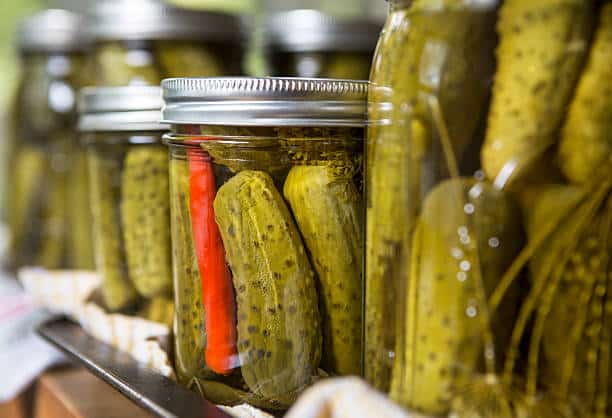
Today’s Spotlight is on Pickles.
A pickled cucumber – commonly known as a pickle in the United States and Canada and a gherkin in Britain, Ireland, South Africa, Australia, and New Zealand – is a usually small or miniature cucumber that has been pickled in a brine, vinegar, or other solution and left to ferment.
A pickle is a food that has been preserved in a vinegar solution or naturally fermented with a salt brine. Pickles can be made from:
- Vegetables, such as cucumbers
- Fruits, such as strawberries and rhubarb
- Proteins, such as eggs
The pickling process involves:
- Soaking the food in a solution of vinegar, water, salt, and various seasonings
- Adding spices and herbs, such as dill, garlic, or mustard seeds
Vinegar helps preserve pickles and contributes to their slightly sour taste. In the United States and Canada, a pickled cucumber is commonly known as a pickle. In Britain, Ireland, South Africa, Australia, and New Zealand, it’s known as a gherkin.
Fermented foods like pickles are probiotic superfoods. They’re packed with good bacteria that can support the health of your gastrointestinal microbiome.
Here are some types of pickles:
- Dill pickles – The most popular variety of cucumber pickles. There are three basic types: cured, fresh pack, and refrigerated.
- Kosher pickles – A popular variety of dill pickles. They’re named for the extra garlic added to the briny mix.
- Sour pickles – Made with various herbs and spices, including garlic, dill, horseradish, mustard seeds, and peppercorns. They’re crunchy and tart, with a salty bite that depends on how long they ferment.
- Gherkin pickles – Refer to the type of cucumber used, and not to the flavor. They’re small cucumbers, no more than 3 inches in length.
- Hungarian pickles – One of the most important steps in making them is to give them ample sun exposure to help them ferment. They’re often called Hungarian sun pickles or Hungarian summer pickles.
- Polish pickles – There are two primary styles of Polish pickles. The ogórek kiszony/kwaszony is similar to the kosher dill style but contains a different blend of spices and seasonings and is preserved in wooden barrels.
- Brined pickles – Named for how they’re made, a mixture of salt and water but no vinegar. They naturally take on a sour flavor due to the fermentation that occurs from Lactobacillus bacteria, a probiotic strain.
History
Pickling has been around for thousands of years. The earliest known examples of pickles are cucumbers that were pickled in the Tigris Valley around 2030 BC. The word “pickle” comes from the Dutch pekel or northern German pókel, which means “salt” or “brine”.
Pickling with vinegar likely originated in ancient Mesopotamia around 2400 BCE. It continued to develop in the Middle East region before spreading to the Maghreb, Sicily, and Spain.
Pickling was used to preserve and enhance the flavor of meat, fish, and vegetables. The Ancient Egyptians ate fish preserved with brine.
Pickles have been a staple in cultures around the globe. They’re renowned for their heartiness, health benefits, and delicious taste.
The word “pickle” comes from the Dutch word pekel or the northern German word pókel, which both mean “salt” or “brine”. These are two important components in the pickling process.
Here are some more fun facts about pickles:
- Pickles are considered “negative calorie foods” because the calories burned while eating them are more than the food itself.
- Pickle juice contains electrolytes, which can help rehydrate after exercise.
- Pickles are high in vitamin K, which is important for blood clotting, bone support, and protecting blood cells, veins, and arteries.
- Indian pickles are a rich source of antioxidants, essential vitamins, and minerals.
- America was named after a pickle peddler.
- Mason jars were invented for pickling.
- Shakespeare is credited with coining the term “in a pickle”.
Here’s some information about the nutritional value of dill pickles:
- Calories: 4.8 calories per 48 g serving
- Fat: 0 g per serving
- Protein: 0 g per serving
- Carbohydrates: 1 g per serving
- Sugar: 0 g per serving
- Dietary fiber: 0 g per serving
- Sodium: 326 mg per serving
- Potassium: 46.2 mg per serving
Pickles are low in calories and fat and are a good source of essential nutrients like vitamin K and antioxidants. They can also help you maintain a healthy weight, provide fiber, support hydration, and ward off muscle cramps.
However, pickles can be high in sodium, so moderation is key, especially for those watching their salt intake. The acidity of pickles can also be harsh on the stomach.
Consumption
Americans eat about 20 billion pickles each year. That’s enough pickles to stretch to the moon and back—twice. The average American eats 8.5–9 pounds of pickles a year. 75% of the American population eats pickles. American households purchase pickles every 53 days. More than 67 percent of all households eat pickles.
The global pickles market is worth $11.1 billion. Germany is the country that consumes the most pickles.
Celebrating Pickles
National Pickle Day is celebrated on November 14. The holiday has been around since the late 1990s. It was created to celebrate pickles as one of mankind’s favorite foods.
On National Pickle Day, pickle lovers eat their favorite preserved pickle. This could be a dill, gherkin, cornichon, brined, kosher dill, Polish, Hungarian, lime, bread and butter, Swedish and Danish, or Kool-Aid pickle.
The purpose of National Pickle Day is to give the pickle a little bit of love. After all, it’s a food that people generally don’t think about but is probably being served right this moment at a restaurant near you.
Let us know in the comments what your favorite kind of pickle is.
0 Comments