
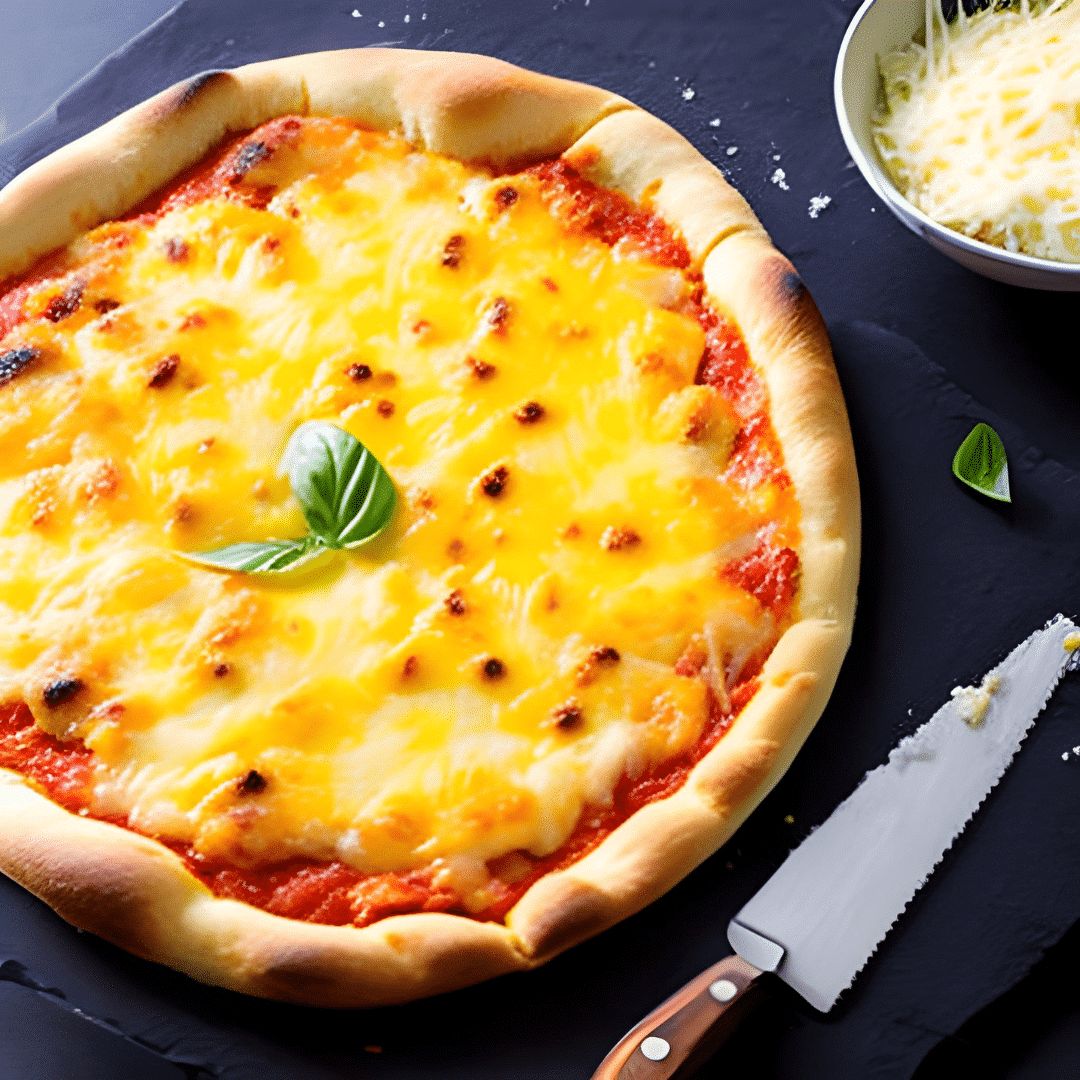
Today’s food spotlight is on the cheese pizza.
Pizza is a dish of Italian origin made of a flat, round, crispy, leavened dough topped with a layer of sauce and a layer of one or more toppings. The toppings can include meat, seafood, vegetables, fruit, and cheese. The dish is baked quickly and served hot.
In Italy, the word “pizza” refers to a tomato pie. The word “pizza” may have roots in Latin, from the term “pinsa” which translates to flatbread. The word “pizza” may also come from the Greek word “pitta” which means “spread” or “dough”. In Italy, “pizza” is a singular word that represents only one dish. The word “pizza” is not used to describe an actual pie in Italy.
Today we are highlighting cheese pizza, but it has been asked if a pizza is still a pizza without cheese. The answer is yes. Pizza without cheese can still be called pizza. Pizza means flatbread, and traditional pizza did not have cheese. Pizza without cheese is called pizza marinara. Pizza marinara is a classic Neapolitan pizza that includes tomatoes, garlic, oregano, and extra-virgin olive oil. Pizza can also be made without tomato sauce, such as pizza ortolana, which includes a medley of fresh vegetables.
Some other terms that Italians use to describe pizza include:
- Crostata: Used to describe savory and sweet pies.
- Torta: Used to describe savory and sweet pies.
- Sfincione: Also known as focaccia with toppings.
- Neapolitan pizza: A type of pizza that originated in Naples, Italy.
- Margherita: The most famous pizza in the world.
According to one source, the minimum legal definition of pizza is “crust, tomato, salt, and oil”. The maximum definition includes those ingredients plus one kind of cheese and garlic. The FDA defines pizza as a food item that is usually consumed by more than one person.
History
Pizza has been a basic part of the Italian diet since the Stone Age. The origins of pizza can be traced back thousands of years to flatbreads with toppings that were popular with ancient Egyptians, Greeks, and Romans.
The word “pizza” comes from the Latin word “pinsa” which translates to “flatbread”. In Italy, the word “pizza” refers to a tomato pie. Pizza was first called “pie” when Italian immigrants arrived in the United States in the late 1800s. Pizza had similarities to a pie, with a crust, sliced triangle portions, and its circular shape.
In 1522, tomatoes were brought back to Europe from Peru in the New World. Originally thought to be poisonous, tomatoes eventually found their way into the diets of poorer people of Naples, as they placed the tomatoes onto their yeast dough, thus creating the first simple pizza. These early pizzas were quite popular because these workingmen usually had only flour, olive oil, lard, cheese, and herbs with which to feed their families.
The first Italian pizza restaurant, Antica Pizzeria Port’Alba, began baking pizzas in 1738. Modern pizza evolved from similar flatbread dishes in Naples, Italy, in the 18th or early 19th century. The first simple pizza was created when poorer people of Naples added tomatoes to their yeast dough. In 1889, pizzamaker Raffaele Esposito created the “Pizza Margherita” for the Queen consort of Italy, Margherita of Savoy.
The first printed reference to pizza in America is in a 1904 article in The Boston Journal. The article claims that brothers Giovanni and Gennero Bruno brought the first pizza to Boston. The brothers came to America from Naples, Italy in 1903. Gennaro Lombardi, an Italian immigrant, applied for the first restaurant license to sell pizza at a grocery store on Spring Street in Manhattan in 1905.
Pizza was brought to America by Italian immigrants in the late 19th century. It didn’t gain mass appeal until the 1940s.
Here are some world records associated with cheese pizza:
- Most varieties of cheese on a pizza – Benoît Bruel of Déliss Pizza in Lyon, France made a pizza with 254 types of cheese.
- Largest pizza – Pizza Hut cooked the world’s largest pizza, which was made with individual squares of dough spread out in the Los Angeles Convention Center.
- Longest pizza – A group of US and Italian companies made the world’s longest pizza, which stretched for 1,930.39 meters.
- Largest cheese (sheep’s milk) – Comune di Loculi in Italy made the largest cheese from sheep’s milk, which weighed 598.5 k.
- Eating a pizza
- – Kelvin Medina from the Philippines ate a whole 12-inch pizza in 23.62 seconds.
- – Geoffrey Esper holds the record for eating the most 9-inch pizzas, with 19.25 pizzas in 10 minutes.
Here is a cheese pizza recipe for you to try:
Pizza Dough Ingredients:
- 1/2 recipe homemade pizza dough (or 1 lb. store-bought pizza dough)
- 1 Tablespoon (15ml) olive oil, divided.
- 1 Tablespoon (8g) cornmeal
- 1/2–3/4 cup (127-190g) pizza sauce, depending how much you like (homemade or store-bought)
- 8 ounces sliced mozzarella cheese
- 1 and 1/2 cups (6oz or 168g) shredded mozzarella cheese
- 2–3 Tablespoons (10-15g) grated parmesan cheese
- dried basil or Italian seasoning, to taste
Directions:
- Dough: Prepare pizza dough through step 3. If using store-bought frozen pizza dough, make sure it’s thawed.
- Preheat oven to 475°F (246°C). Allow it to heat for at least 15–20 minutes as you shape the pizza in the next step. If using a pizza stone, place it in the oven to preheat as well. Lightly grease a large baking sheet or pizza pan with 1/2 Tablespoon of olive oil. Sprinkle lightly with cornmeal, which gives the crust extra crunch and flavor.
- Shape the dough: When the homemade dough is ready, punch it down to release any air bubbles. Divide the dough in half and freeze half the dough for another time—see freezing instructions in the pizza dough recipe. On a lightly floured work surface using lightly floured hands or rolling pin, gently flatten the dough into a disc. Place on prepared pan and using lightly floured hands, stretch and flatten the disc into a 12-inch circle, about 1/2-inch thick. If the dough keeps shrinking back as you try to stretch it, stop what you’re doing, cover it lightly and let it rest for 5–10 minutes, then try again. Once shaped into a 12-inch circle, lift the edge of the dough up to create a lip around the edges. I simply pinch the edges up to create the rim. If using a pizza stone, place the dough directly on a baker’s peel dusted with cornmeal. Cover dough lightly with plastic wrap or a clean kitchen towel and allow it to rest for a few minutes as you gather the pizza toppings.
- Top & bake the pizza: Using your fingers, push dents into the surface of the dough to prevent bubbling. Brush the remaining olive oil all over the dough. Top the dough with the pizza sauce, then the sliced mozzarella, the shredded mozzarella, and grated parmesan. Sprinkle lightly with basil or Italian seasoning.
- Bake for 14–15 minutes or until the crust is golden brown. Remove from the oven.
- Slice hot pizza and serve immediately. Cover leftover pizza tightly and store in the refrigerator for up to 1 week. Freezing and reheating instructions below.
Americans consume about 3 billion pizzas each year. That’s 46 slices of pizza per person per year. The United States accounts for about one-third of global pizza consumption. Cheese pizza is one of the most popular types of pizza. About 61% of Americans prefer thin crust pizza.
National cheese pizza day is celebrated on September 5th each year. Give yourself a treat and celebrate this day with a homemade cheese pizza. Let us know in the comments who makes your favorite cheese pizza, especially if that you.
0 Comments