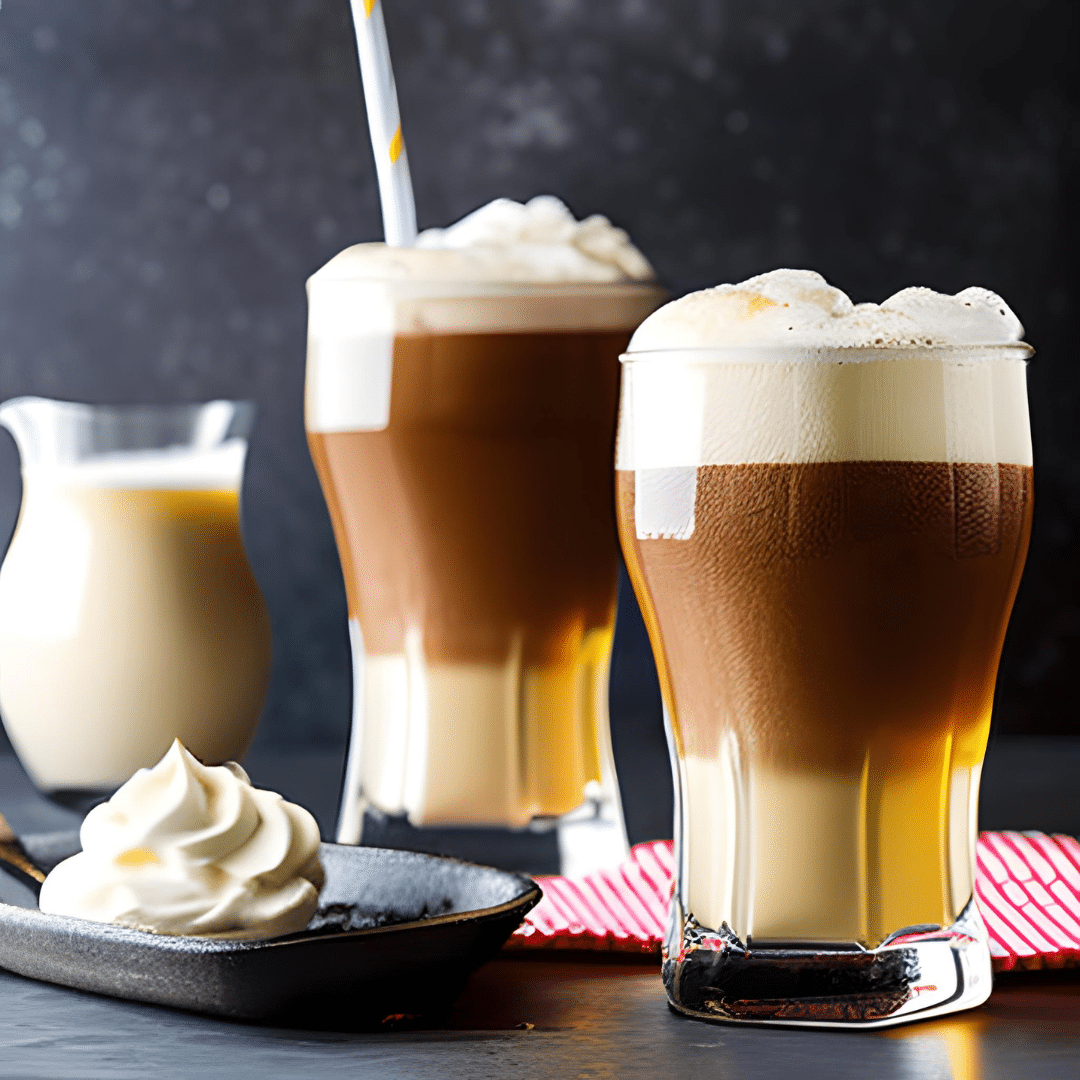
National Root Beer Float Day

Aug 5, 2026 | Food Blog

Today’s spotlight is on Root Beer Floats!

The root beer float is traditionally made with vanilla ice cream and root beer, but it can also be made with other ice cream flavors. It’s sometimes referred to by the nicknames “brown cow” or “black cow”. Root beer floats were a popular dessert drink in 1950s diners.

History

Frank J. Wisner, owner of Colorado’s Cripple Creek Brewing, is credited with creating the first root beer float on August 19, 1893. The idea for the drink came to Wisner when he noticed that the snowy peaks on Colorado’s Cow Mountain looked like ice cream floating in soda. He combined root beer and vanilla ice cream, and called it the “Black Cow”, or more popularly known today as a root beer float. Wisner was the owner of the Cripple Creek Cow Mountain Gold Mining Company and liked producing a line of soda waters for the nearby town.

Root beer is carbonated by dissolving carbon dioxide gas in water. While it’s still in the capped bottle, the CO2 is kept in solution by pressure. Once the bottle is opened, a number of factors control whether the gas fizzes out or stays dissolved, such as temperature.

Here’s some science behind root beer floats:

  • When carbonated root beer comes into contact with ice cream, carbon dioxide bubbles are released
  • The soda also frees air bubbles trapped in the ice cream
  • The fat in the ice cream coats the bubbles, protecting them and allowing them to expand
  • This reaction between a liquid and a solid creates the foam you see on root beer floats
  • The soda on the outside is warmer than the ice cream when poured over it, which can melt some of the ice cream and dilute the soda
  • Sometimes the ice cream can be cold enough to freeze parts of the soda onto the ice cream, causing a “crispy” shell

Here is a Root Beer Float Recipe for you to try:

Ingredients:

  • Vanilla ice cream
  • Root beer


Directions:

  1. Spoon a scoop or two of vanilla ice cream into a tall glass. Slowly pour root beer into the glass, allowing the foam to rise and then recede before adding more root beer.


Serve with straws and spoons.


The U.S. is the largest consumer of root beer in the world. Root beer is native to the U.S. and became popular during the prohibition period in the early 19th century. The main flavoring agent of root beer, sassafras, is banned in the U.S. because of the presence of safrole, a carcinogenic ingredient.

Some brands of root beer are produced in or imported by other countries, including Australia.


Here are some world records for root beer floats:

  • Largest root beer float: 2562.5 gallons of root beer, created in 1999 for A&W’s 80th anniversary.
  • Longest line of soda floats: 1,020 soda floats, achieved by A&W Root Beer, Admiral Beverages Company, and M&M Distributing in Salt Lake City, Utah in 2019
  • Most floats given away: 16,000 floats given away at the 2020 Root Beer Float Bash
  • Root beer has a distinct and complex flavor that makes it taste almost like a dessert.


National Root Beer Float Day is celebrated annually on August 6th to honor the frothy drink that features ice-cold root beer and a scoop of ice cream. The day is dedicated to America’s favorite carbonated beverage. Let us know in the comments if you have had a root beer float.

0 Comments

Submit a Comment

Your email address will not be published. Required fields are marked *

Subscribe to our Blog to receive more content like this. Click here to subscribe.

Be sure to watch our shows on QVC+  or our YouTube channel. 

Give us your feedback on our Social Channels 

Facebook • Instagram • Tik Tok • LinkedIn • Pinterest • Twitter  

Celebrating Pasta

Celebrating Pasta

Today’s Spotlight is on Pasta.
Pasta is a type of food typically made from an unleavened dough of wheat flour mixed with water or eggs, and formed into sheets or other shapes, then cooked by boiling or baking.
Pasta is a type of food made from unleavened dough of wheat flour, water, and sometimes eggs. The dough is formed into different shapes and then cooked by boiling or baking. Pasta can be dried or used fresh.

Read More

Celebrating Boston Cream Pie

Celebrating Boston Cream Pie

Today’s Spotlight is on Boston Cream Pie.
A Boston cream pie is a cake with a cream filling. The dessert acquired its name when cakes and pies were cooked in the same pans, pie tins were more common than cake pans, and the words were used interchangeably. In the late 19th century, this type of cake was variously called a "cream pie", a "chocolate cream pie", or a "custard cake".
The Boston cream pie is a sponge cake. The cake batter was originally baked in a pie crust. At some point, the crust was eliminated, and the batter was poured directly into the pie pan.

Read More

Celebrating Whole Hog BBQ

Celebrating Whole Hog BBQ

Today’s spotlight is on a Whole Hog BBQ.
Whole hog barbecue involves cooking an entire hog in one piece over a pit in the ground. It's a time- and labor-intensive process. Whole hog barbecue is a regional style of barbecue where a pitmaster cooks an entire hog. The hog smoked for hours on a wood pit. The meat is seasoned with sauces like mustard-based, tomato-based, or vinegar-based.
To serve, the skin is cracked along the back, hams, and shoulders. The meat should pull easily from the bone. Guests can choose the type of meat they want, such as:
Loin, Tenderloin, Shoulder, Hams, Belly, Ribs.

Read More

Celebrating Nuts

Celebrating Nuts

Today’s focus is on nuts!
Nuts (tree nuts and peanuts) are nutrient dense foods with complex matrices rich in unsaturated fatty and other bioactive compounds: high-quality vegetable protein, fiber, minerals, tocopherols, phytosterols, and phenolic compounds.
There are over 20 edible nuts in the world. Some of the most common edible nuts include:

Read More

Celebrating Nachos

Celebrating Nachos

Today’s Spotlight is on Nachos.
Nachos is a Mexican culinary dish consisting of tortilla chips or totopos covered with cheese or cheese sauce, as well as a variety of other toppings and garnishes, often including meats, vegetables, and condiments such as salsa, guacamole, or sour cream.
They can also include other toppings and garnishes, such as:

Read More

Celebrating Chicken and Waffles

Celebrating Chicken and Waffles

Today’s Spotlight is on Chicken and Waffles.
Chicken and waffles is a dish that combines chicken and waffles. It's popular in the United States and is served in many restaurants. The dish first appeared in the United States in the 1600s in Pennsylvania Dutch country. The traditional Pennsylvania Dutch version consists of a plain waffle with pulled, stewed chicken on top, covered in gravy.

Read More

Celebrating Seafood Bisque

Celebrating Seafood Bisque

Today’s Spotlight is on Seafood Bisque.
A bisque is a French style of soup that is made from crustaceans, such as lobster, crab, shrimp, and crayfish; their shells are used to make a stock and the meat is incorporated into the finished dish. So, in a way, calling the soup a "seafood bisque" is somewhat redundant.
The main characteristic of a bisque is that it is smooth and has a velvety texture. Most recipes will include wine and cream to give it its signature flavor and texture. But it's not merely the choice of ingredient that makes bisque different from other types of soups. It’s also the technique for utilizing that ingredient, including the parts you can't eat, making a bisque what it is.

Read More

Celebrating Meatloaf

Celebrating Meatloaf

Today’s Spotlight is in Meatloaf.

Meatloaf is a traditional dish made from ground meat, such as beef, pork, or poultry, mixed with other ingredients like breadcrumbs, onions, and eggs. It is then formed into the shape of a loaf, then baked or smoked. The final shape is either hand-formed on a baking tray or pan-formed by cooking it in a loaf pan.

Read More

Celebrating Pasta

Celebrating Pasta

Today’s spotlight is on Pasta.
Pasta is a type of food made from a dough of wheat flour, water, and eggs. It's formed into different shapes and then cooked by boiling or baking. Pasta is often associated with Italian cuisine. Pasta is a good source of energy and can provide fiber if it's made from whole grain. Fiber can help with stomach problems and may help lower cholesterol.

Read More

Pin It on Pinterest