
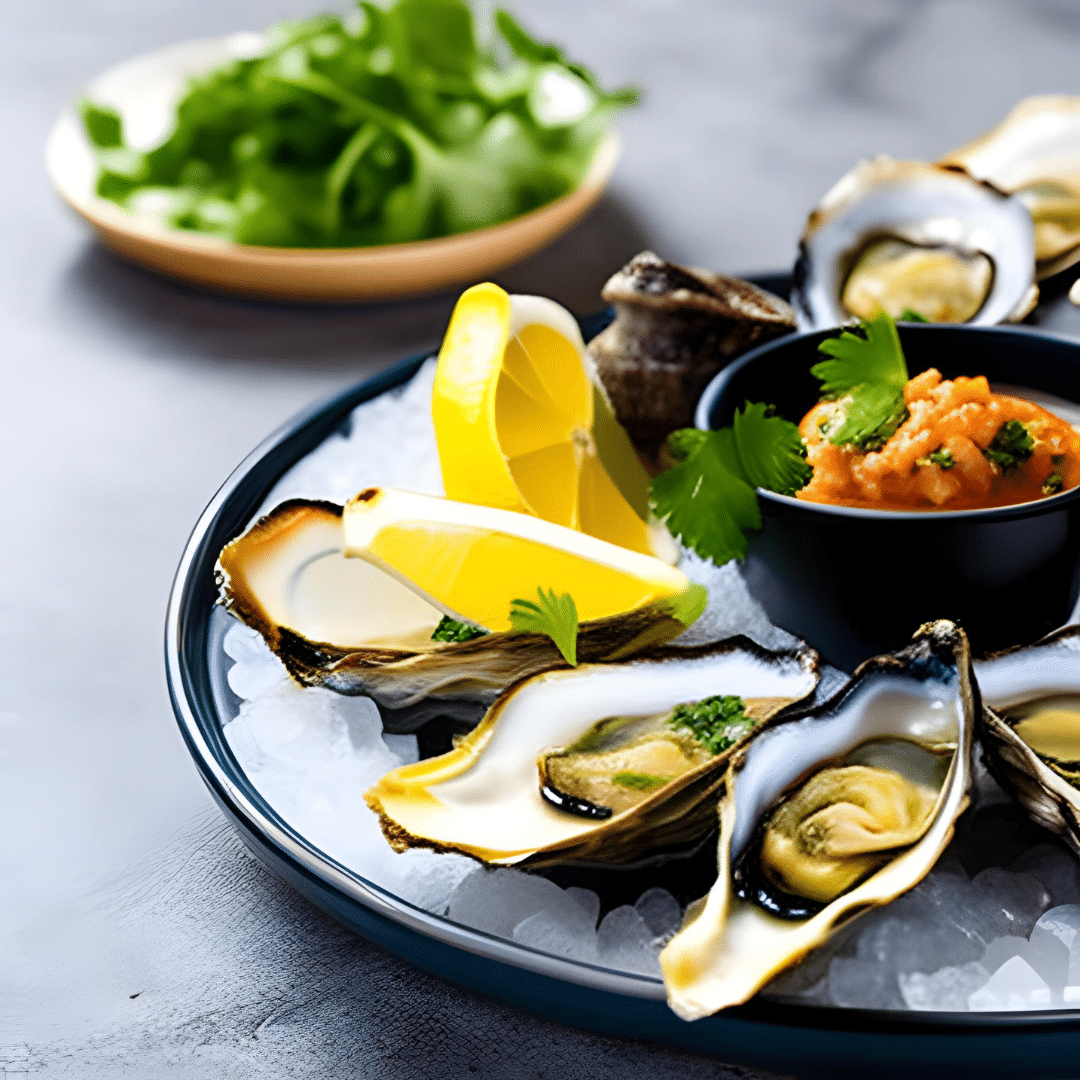
Today’s food spotlight is on Oysters.
Oysters are a type of bivalve, which are marine and freshwater mollusks with long, flat bodies and shells made up of two hinged parts. Oysters are plump, mineral rich, saltwater mollusks that live at the bottom of shallow coastal waters, often adhering to rocks or other objects. They use their gills and cilia to process water and feed. Oysters have a small heart and internal organs, but no central nervous system.
Oysters belong to the family Ostreidae and the phylum Mollusca, which also contains other well-known invertebrates, such as snails, squid, and octopi. Oysters are often consumed and in some places are considered a delicacy. Some types of pearl oysters are harvested for the pearl produced within the mantle. Windowpane oysters are harvested for their translucent shells, which are used to make various kinds of decorative objects.
History
The earliest evidence of humans eating oysters dates back to 164,000 years ago when shellfish and barnacles were found in a seaside cave in South Africa. A researcher from Arizona State University found shellfish and barnacles, along with primitive tools and other artifacts, in a seaside cave in South Africa.
Oysters are believed to have originated in ancient Rome, where they were considered a luxury food item. They were a delicacy for the wealthy class during the Greek and Roman empires. The Greeks were the first to cultivate oysters.
Oysters are also native to France and have been consumed there since the Roman Era. Throughout the Middle Ages and the Renaissance, oysters were harvested for food, but it wasn’t until the 17th century that oyster cultivation began at seaside farms in France.
When production surged in the mid to late 1800s, all economic levels enjoyed oysters because they cost less than poultry and other meats. Love of oysters even inspired early Americans to transform them into culinary desserts.
Here’s some information about the history of oysters:
- The first oysters appeared in the Triassic period, over 200 million years ago, when dinosaurs ruled the earth.
- Oysters are believed to have originated in ancient Rome, where they were considered a luxury food item.
- Oysters became more widely available over time and were eventually consumed by people all over Europe.
- The first oyster farms began to develop in the 17th century in the saltwater marshes of the Atlantic Coast.
- Oyster populations in Virginia’s waters of Chesapeake Bay were lightly exploited until the early 1800s.
- Oyster reefs are one of the most imperiled marine habitats on Earth, with 85% to 90% of wild reefs lost over the past century.
The quote “He was a bold man that first ate an oyster” is often credited to Jonathan Swift, an 18th-century Irish satirist. The quote means that the first person to eat an oyster must have been brave (or dying of hunger) because oysters look nasty.
Swift apparently overcame his own fear of oysters and went on to write a poem about them. He and Benjamin Franklin both praised the courage of the first person to eat an oyster.
Here are some reasons why people started eating oysters:
- Originating in ancient Rome: Oysters were considered a luxury food item in ancient Rome, where they were often served at banquets and feasts.
- Important source of protein: Oysters were an important source of protein for many civilizations.
- Became more widely available: Over time, oysters became more widely available and were eventually consumed by people all over Europe.
- Became affordable: In the mid-1800s, oysters became affordable for people of all classes.
- Were easy to procure: For many early humans, oysters were a dietary staple because they were easy to procure.
- Were roasted over an open fire: Unlike other animals, humans ate oysters by roasting them over an open fire, letting their shells pop open in the heat.
- Were rich in omega-3 fatty acids: Oysters are rich in omega-3 fatty acids, which are essential to the human body and have anti-inflammatory properties.
Oysters became expensive because of overharvesting in the US and Europe in the 20th century. This made it difficult to maintain the oyster stock needed to meet demand. The popularity of oysters put an increasing demand on wild oyster stocks, which increased prices. This scarcity converted oysters from their original role as a working-class food to their current status as an expensive delicacy.
Oysters were also popular in bars because they were seen as a cheap food to serve alongside liquor and beer. From 1880 to 1910, oysters were harvested in massive quantities, creating an ample supply of oysters. This intensive exploitation did irreparable environmental damage.
In Greek mythology, Aphrodite, the goddess of love, emerged from the sea on an oyster shell. She then gave birth to Eros, the god of romantic love. This led to the notion that oysters are an aphrodisiac. Some ancient cultures believed that oysters resembled female genitalia, which led them to believe that oysters imparted sexual prowess.
Giacomo Casanova, the 18th-century Venetian, reportedly ate dozens of oysters at a time to stir arousal before his trysts. He wrote in his memoir, “My Life,” that he ate 50 oysters every morning, which contributed to his high libido and ability to bed over 200 women.
Some say that oysters being a light, protein rich food, their perceived exclusivity and elegant presentation, and their somewhat suggestive looks and texture might play a role in them being perceived as being especially suitable for romantic encounters.
However, some controversy remains as to whether oysters are an aphrodisiac.
Here are some reasons why oysters have long been considered an aphrodisiac:
- Oysters are rich in zinc, which may help maintain healthy levels of dopamine in the body.
- Oysters contain D-aspartic acid, an amino acid that may boost testosterone production.
- Some ancient cultures believed that oysters resembled female genitalia, leading them to believe that they imparted sexual prowess.
- 18th-century Venetian Giacomo Casanova reportedly ate dozens of oysters at a time to stir arousal before his legendary trysts.
- Although the effect oysters have on libido has never been scientifically proven, additional human studies are needed to evaluate whether foods rich in zinc, such as oysters, directly affect dopamine levels and libido.
Oysters also support overall health, which can improve sexual health. They are also high in essential nutrients like omega-3 fatty acids. No scientific studies have been conducted to show that they can stimulate desire.
There are over 200 species of oysters worldwide. Only five species are commercially harvested, grown, and sold in the United States. The Eastern oyster, found primarily in the Gulf of Mexico and the Chesapeake Bay region, historically accounts for roughly 75 percent of total U.S. harvests.
Other large oyster farming areas in the US include the bays and estuaries along the coast of the Gulf of Mexico from Apalachicola, Florida, in the east to Galveston, Texas, in the west.
Here are some fun facts about oysters:
- Oysters can filter 1.3 gallons of water per hour
- A single oyster can filter 50 gallons of water every day.
- Oysters can change their sex.
- Oysters can live up to 20 years.
- Oysters are shaped by their beds.
- Oysters have gills and breathe like fish.
- Oysters are meatier in months with “r” in their names.
- Eating four oysters a day gives you a daily supply of copper, iodine, iron, magnesium, manganese, phosphorus, and zinc.
- The largest oyster ever found was 14 inches long and weighed 3.5 pounds.
- The word “oyster” comes from the Old French word “oistre”.
Around 2 billion oysters are eaten every year. According to the Oyster Recovery Partnership, Americans eat roughly 2.5 billion oysters annually.
The per capita consumption of oysters has been on a downward trend, standing at about 0.24 pounds in 1990, 0.23 pounds in 2000, 0.21 in 2010, and 0.20 in 2018.
The Gulf Coast region harvested about 9.1 million pounds of oysters in 2020, followed by the Atlantic states with 5.6 million pounds and the Pacific coast region with 5.2 million pounds.
National Oyster Day is celebrated annually on August 5. The day honors the different species of bivalve molluscs that can be eaten, which are considered a delicacy around the world. Oysters have been consumed by humans for centuries. You can celebrate National Oyster Day by enjoying some delectable preparations available at restaurants across the country.
Let us know in the comments how you feel about oysters.
0 Comments