
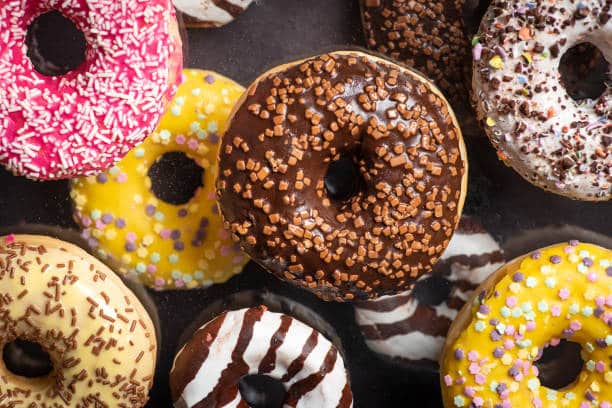
Today’s Spotlight is on donuts.
A donut is a small, fried, sweetened dough cake that is typically shaped into a ring or ball. They are popular in many countries and can be homemade or purchased in bakeries, supermarkets, food stalls, and franchised specialty vendors.
Donuts are usually deep-fried from flour dough. After being fried, they can be:
- Spread chocolate or icing on top.
- Cover with powdered sugar or fruit.
- Glazed with sugar icing.
- Filled with light fruit fillings or custards.
Donuts have holes in the middle so that the insides and outsides can cook evenly. If the dough stayed in the oil for a longer time, the outsides would become burnt.
Donuts can be classified into 10 distinct types:
- Yeast donuts – These donuts are made with yeast leavening agents and are known for their porous structures.
- Cake donuts – These donuts are made with a cake batter and have a denser, more cake-like texture than yeast donuts.
- Glazed donuts – These donuts can be made with either yeast or cake donuts and are coated with a thin glaze.
- Old-fashioned donuts – These donuts are traditionally categorized as cake donuts and are often coated in a delicate glaze.
- Boston cream donuts – These donuts are hollowed out yeast donuts filled with custard and topped with chocolate frosting.
- French cruller – These donuts are crunchy on the outside and flaky on the inside.
- Jelly donuts – These donuts are typically coated in powdered sugar, regular sugar, or glaze.
- Long John donuts – These donuts are either coated entirely with glaze or top-coated with icing.
- Zeppole -These donuts are like filled doughnuts with the top blown off.
History
In 15th century Germany, where sugar was scarce, doughnuts were often cooked savory with fillings like meat or mushrooms. The Pilgrims and Dutch settlers brought doughnuts to America. The early doughnuts were similar to modern donuts, but they didn’t have the iconic ring shape. They were balls of sweetened dough fried in pork fat. The center of the cake didn’t cook as fast as the outside, so they were sometimes stuffed with fruit, nuts, or other fillings that didn’t require cooking.
Food historians generally agree that the modern donut originated from the Dutch settlers’ “olykoeks” “oil-ly cake”). The Dutch settlers brought these “oil cakes” to America in the 17th and 18th centuries. The word “donut” came from a woman who added nuts to the dough before frying it.
The word “doughnut” may have originated in northeastern England around 1750. The first recipe for doughnuts appeared in print around this time and called for frying dough the size of a walnut.
The first recipe for donuts appeared in print in northeastern England around 1750. The recipe called for frying dough the size of a walnut. Donuts have holes because they are dense and full inside. The heat used to cook them wouldn’t be able to reach the middle of a disc-shaped donut without a hole.
The earliest “doughnuts” actually didn’t have holes. The inventor of the donut hole is thought to be a sailor on a ship in 1847. He didn’t like how the fried cakes were always doughy and greasy in the middle. He decided to punch a hole in the middle of the raw dough so that it would cook more evenly.
Donut vs Doughnut
Both “donut” and “doughnut” are correct spellings. “Doughnut” is the original spelling and is more common internationally. “Donut” is an Americanized, shortened version of “doughnut”.
“Doughnut” is more common in the United States and internationally. “Donut” is more common in American English.
The Oxford English Dictionary (OED) and Your Dictionary use both spellings. The AP Stylebook lists “doughnut” as the preferred spelling.
“Donut” has been around since at least the late 19th century. “Doughnut” is the official dictionary spelling.
Here are some fun facts about donuts:
- Krispy Kreme was the first national donut chain.
- The Salvation Army started National Doughnut Day.
- There are 10 people in the United States with the last name “Doughnut” or “Donut”.
- Washington Irving was the first writer to describe donuts in print.
- Voodoo Doughnut used to sell “medicinal” donuts.
- A glazed donut has about 240 calories, of which 120 are from fat.
- A Krispy Kreme raspberry jam-filled donut has about 300 calories, and a Krispy Kreme chocolate iced donut has about 350 calories.
The largest donut ever made was an American-style jelly donut that weighed 1.7 tons, was 16 feet in diameter, and 16 inches high in the center. It was made in Utica, New York on January 21, 1993 by representatives from Hemstrought’s Bakeries, Donato’s Bakery, and radio station WKLL-FM.
Other large donuts include:
- A 102.5-kilogram pink frosted doughnut made by Chef Nick DiGiovanni and Lynn Davis.
- The World’s Largest Doughnut, which was made from over 90,000 doughnuts, half a tonne of pink icing, and 30 kg of sprinkles.
- The largest doughnut mosaic (logo), which measured 83.91m² (903.19ft²) and contained 14,400 freshly made doughnuts.
Here is a donut recipe for you to try:
Donut Ingredients:
- 1 cup (240ml) whole milk, warmed to about 110°F (43°C)
- 2 and 1/4 teaspoons (7g) instant or active dry yeast (1 standard packet)
- 1/3 cup (65g) granulated sugar, divided.
- 2 large eggs
- 6 Tablespoons (85g) unsalted butter, melted and slightly cooled.
- 1 teaspoon pure vanilla extract
- 1/4 teaspoon ground nutmeg
- 1/2 teaspoon salt
- 4 cups (500g) all-purpose flour (spooned & leveled), plus more as needed.
- 1–2 quarts vegetable oil
Donut Glaze Ingredients:
- cups (240g) confectioners’ sugar, sifted.
- 1/3 cup (80ml) heavy cream, half-and-half, or whole milk
- 1/2 teaspoon pure vanilla extract
Instructions:
- Prepare the dough: Whisk the warm milk, yeast, and 1 Tablespoon sugar together in the bowl of your stand mixer. Loosely cover and allow to sit for 5–10 minutes until foamy and frothy on top. *If you do not own a stand mixer, you can do this in a large mixing bowl, and in the next step, mix the dough together with a large wooden spoon/rubber spatula. It will take a bit of arm muscle. A hand mixer works, but the sticky dough repeatedly gets stuck in the beaters. Mixing it by hand with a wooden spoon or rubber spatula is a better choice.
- Add the remaining sugar, the eggs, butter, vanilla, nutmeg, salt, and 2 cups (about 250g) flour. Beat on low speed for 1 minute. Scrape down the sides of the bowl with a rubber spatula as needed. Add remaining flour and beat on medium speed until the dough comes together and pulls away from the sides of the bowl, about 2 minutes. If needed, add more flour, 1 Tablespoon at a time, until the dough pulls away from the sides of the bowl. Don’t add too much flour, though. You want a slightly sticky dough.
- Knead the dough: Keep the dough in the mixer fitted with a dough hook attachment and beat on low speed for an additional 5–7 minutes or knead by hand on a lightly floured surface for 5–7 minutes. After kneading, the dough should be smooth and elastic, but still feel a little soft. Poke it with your finger—if it slowly bounces back, your dough is ready to rise. If not, keep kneading.
- Let Dough Rise: Lightly grease a large bowl with oil or nonstick spray. Place the dough in the bowl, turning it to coat all sides in the oil. Cover the bowl and allow the dough to rise in a relatively warm environment for 1.5–2 hours or until it doubles in size. (For a tiny reduction in rise time, see my answer to Where Should Dough Rise? in my Baking with Yeast Guide.)
- Shape Doughnuts: When the dough is ready, punch it down to release the air. Remove dough from the bowl and turn it out onto a lightly floured surface. Using a rolling pin, roll the dough out until it is 1/2 inch thick. Using a 3–3.5-inch doughnut cutter, cut into doughnuts. Re-roll the scraps and cut more. *If you don’t have a doughnut cutter, you can use 1 large + 1 smaller circle cookie cutter (large should be about 3 and 1/2 inches).
- Line 1 or 2 baking sheets with parchment paper or silicone baking mats. Place doughnuts and doughnut holes on each. Loosely cover and allow to rest for 30 minutes as you heat the oil. They will rise a bit as they rest. Place a cooling rack over another baking sheet.
- Pour oil into a large heavy-duty pot fitted with an oil thermometer. Turn stove on to medium heat. Heat oil to 375°F (191°C). Add 2–3 doughnuts at a time and cook for 1 minute on each side. Carefully remove with a metal slotted spatula or metal slotted spoon. Be sure to lower stove’s temperature if oil temperature is rising; you want it to stay at 375°F (191°C). Wear kitchen gloves if oil is splashing. Place fried doughnuts onto prepared rack. Repeat with remaining doughnuts, then turn off heat. (See Note for doughnut holes.)
- Make the glaze: Whisk all the glaze ingredients together. Dip each warm doughnut (don’t wait for them to cool!) into the glaze, making sure to coat both sides. Place back onto prepared rack, as excess glaze drips down. After about 20 minutes, the glaze will set.
- Doughnuts are best enjoyed the same day. You can store leftover doughnuts in an airtight container at room temperature or in the refrigerator for another day or two.
- Enjoy!
Consumption
Americans consume over 10 billion donuts every year. It turns out it’s no secret that donuts are the most delicious indulgence, at least in the U.S.A. An average American eats at least 63 donuts every year.
Tom’s Donuts in Angola, Indiana set the Guinness World Record for the most freshly baked donuts sold in eight hours. On Saturday, May 28, 2022, Tom’s Donuts sold 8,558 donuts. The record was witnessed by Mike Marcotte from Guinness World Records.
Hundreds, if not thousands, of people came to Lake James to help set the record. People started lining up as early as four in the morning, and Tom’s Donuts stopped selling around 2pm.
Celebrating Donuts
There are two national holidays in the United States that celebrate doughnuts:
- National Donut Day: Celebrated on the first Friday of June
- National Doughnut Day: Celebrated on November 5th
The holidays are a continuation of Doughnut Day, when members of the Salvation Army provided doughnuts and coffee to service members during World War I. The Salvation Army created the first donut day event in Chicago in 1938 as a fundraiser to help those in need during The Great Depression.
The Salvation Army still uses this day to conduct charity events in the United States. Some stores, like Krispy Kreme, Dunkin’ Donuts, and Lamar’s, offer deals on National Doughnut Day.
Let us know in the comments what your favorite kind of donut is.
0 Comments