
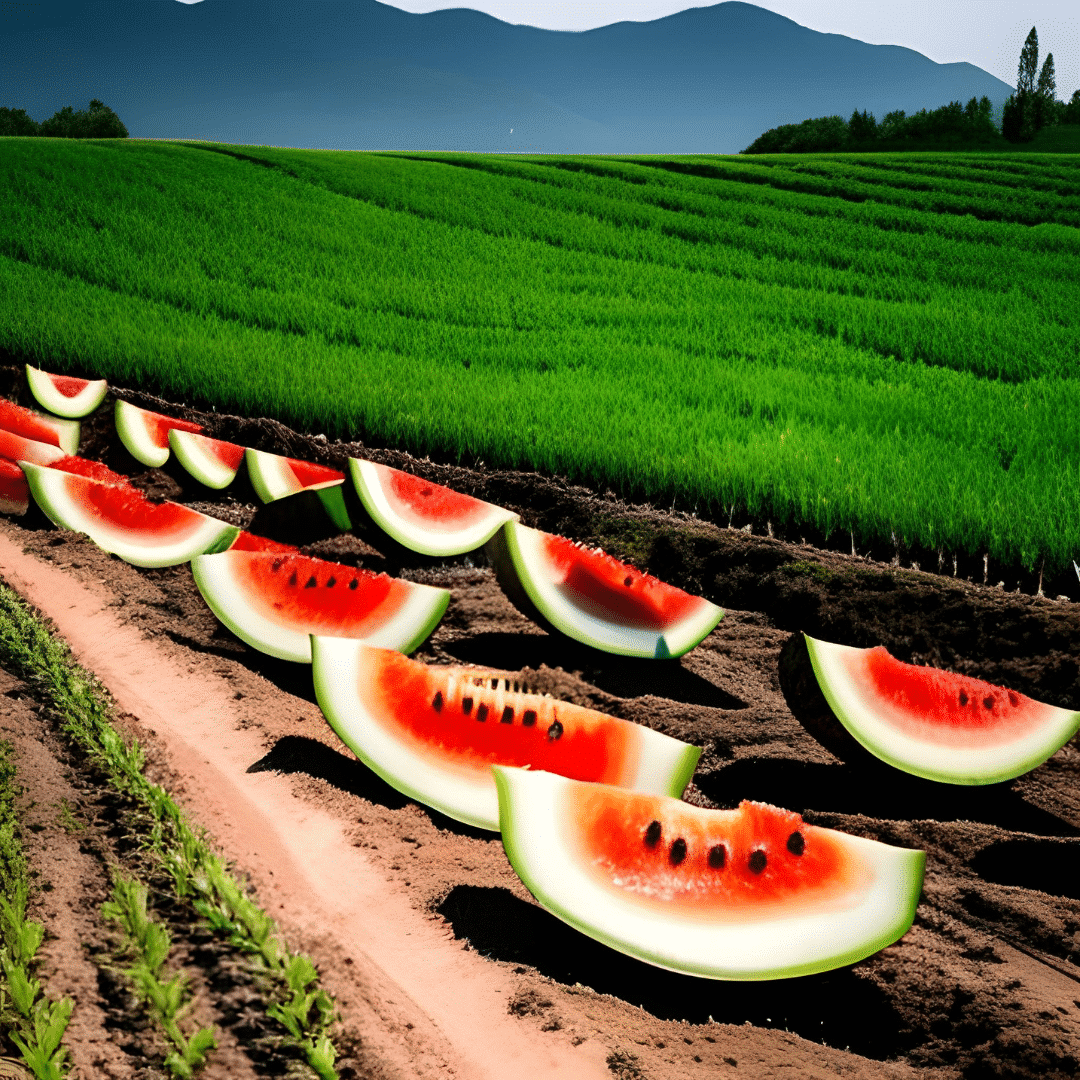
Today’s focus is on Watermelons.
Watermelons are a large, sweet fruit that are related to cantaloupes, zucchinis, pumpkins, and cucumbers. They are members of the gourd family (Cucurbitaceae) and are botanically classified as Citrullus lanatus. Watermelons are native to southern Africa and are cultivated around the world. They are usually eaten raw and are often used as a table dessert.
Watermelons are a berry with a hard rind and no internal divisions. They are botanically called pepos. The fruit is usually deep red to pink and has many black seeds, although seedless varieties exist. The sweet, juicy flesh is 92% water and contains vitamin A and some vitamin C. Watermelons are also a great source of antioxidants.
The rind of a watermelon can be preserved as a pickle or cooked to make it edible. Watermelons can also be consumed as a juice or an ingredient in mixed beverages.
Here are some details about wild watermelons:
- Wild watermelons are small, hard, and round fruits that can fit in the palm of your hand.
- They grow along long green vines in barren areas of Africa and the Middle East
- They can grow in sandy, nutritionally poor soil.
- They have yellow flowers that develop into green fruits.
- The fruits can have a tiger stripe pattern and eventually develop into a more yellow solid yellow fruit.
- When they dry out and are old, they become a pale gray fruit.
- Inside, they have white flesh with half-moon shapes.
- They are indigenous to tropical Africa.
- One berry grows directly off each individual leaf.
- The skins are fairly thin and have a touch of matte/mustiness to them, like blueberries, that rubs off.
- The center of a watermelon berry is also very plump with juice, like a blueberry.
- Wild watermelons are rarely noshed raw, but some humans still eat wild Citrullus, despite the off-putting pulp.
History
The history of watermelon dates back to South Africa, where the first watermelons appeared around 5,000 years ago. The tough, drought-tolerant ancestor of watermelon was prized by indigenous people in the Kalahari Desert region for its ability to store water. Watermelons spread from South Africa and were cultivated in ancient Egypt by 2000 BC. The sweet dessert watermelons spread across the Mediterranean world during Roman times.
Watermelons were also popular in many Indigenous communities, where watermelon seeds were roasted and eaten as snacks or processed into butters. Early explorers used watermelons as canteens.
The official name of watermelon is Citrullus Lanatus, and it’s a member of the botanical family Cucurbitaceae, which includes cucumbers, pumpkins, and squash.
The closest relative to the domesticated watermelon is the Kordofan melon from Sudan in Northeast Africa. The fruit is believed to have originated in the Kalahari region or northeastern Africa and was first cultivated in Egypt more than 5,000 years ago.
The Moors introduced watermelons to Europe in the 13th century. Watermelon vines were introduced to the New World by European colonists and enslaved people from Africa. Some food historians believe that African slaves helped introduce the watermelon into the United States. By 1629, watermelons were being grown in Massachusetts. By 1650, watermelons were being cultivated in Peru, Brazil, and Panama. The first watermelons were grown in Florida in the 16th century by Spanish settlers. Native Americans were growing watermelon before French settlers arrived. Written records indicate that watermelons were cultivated by Florida Native American Indians before 1664.
Here are some fun facts about watermelons:
- Watermelons are 92% water.
- The first recorded watermelon harvest was in Egypt nearly 5,000 years ago.
- Early explorers used watermelons as canteens because of their high-water content.
- The word “watermelon” first appeared in the English dictionary in 1615.
- Watermelons take about 90 days to grow from planting to harvesting.
- You can eat the entire watermelon, including the rind.
- There are over 1,200 varieties of watermelon grown worldwide.
- Watermelons are a healthy food because they are high in fiber and vitamins A and C and are a good source of potassium.
- Watermelons are a type of berry called a pepo.
- The Japanese developed the seedless watermelon in 1939.
- Up to 85% of watermelons sold in the USA are seedless varieties.
National Watermelon Day is celebrated annually on August 3rd. It’s a non-official American holiday that celebrates the summer fruit. You can celebrate National Watermelon Day by visiting a pick-your-own watermelon patch or buying one from a local farmer’s market. Slice it up and share it with your family or neighbors. Also try making a fruit salad or cutting it into wedges. No matter how you slice it, watermelons are a delicious part of summer.
Let us know in the comments how you like to enjoy your watermelon.
0 Comments