Cotton Candy Day

Jul 30, 2026 | Food Blog

Today’s food focus is on the carnival favorite Cotton Candy.

Cotton candy was first created in 1897 by dentist William Morrison and with the help of candy maker John C. Wharton. Cotton candy is 100% sugar. The two invented an electric machine that heated sugar in a spinning bowl with tiny holes that spun heated sugar through a screen. The sugar caramelized and turned into light strands creating the floss-like texture that we know and love. The duo premiered cotton candy at the World’s Fair in 1908, where it was priced at 25 cents, which was a hefty price at the time. The original name for cotton candy was “Fairy Floss”.

The origins of cotton candy trace back centuries, all the way to Renaissance Italy. Back then, chefs melted and spun sugar manually, pulling the candy into thin strands using forks and draping it over broom handles. The old-fashioned way of making cotton candy was to melt sugar in a pan and then use a fork to make strings of sugar over an upside-down bowl. The sugar would then dry in strings and be served as a dessert.

The name “cotton candy” comes from another dentist (I am seeing a pattern here), Josef Lascaux, who decided to make the treat for his dental clients after seeing Morrison’s success.


Here are some fun facts about cotton candy:

  • Cotton candy is fat free and gluten free: It’s also healthier than most desserts.
  • Cotton candy is lighter than other sweets but It’s not great for your teeth.
  • Cotton candy has many names: It’s also called spun sugar, floss candy, fairy floss, and suikerspin, which translates to “sugar spider”.
  • A thread of cotton candy is thinner than a human hair: The longest cotton candy was 1,400 meters long, which is about the length of 13 football fields.
  • A typical bag of cotton candy contains less sugar and calories than a can of soda.
  • A stick of cotton candy has about 110 calories.
  • Wherever the water touches, it completely dissolves the fluffy cotton candy into a very small bit of gooey sugar water.
  • 76% of restaurants offer cotton candy on their menus.
  • Cotton candy is available in 50 different flavors.


Cotton candy machines are available at many retailers and on Amazon. Here is a cotton candy recipe for you to try:

Ingredient:

  • 2 ¼ cups of white granulated sugar
  • ½ cup of water
  • ½ cup of corn syrup
  • 1 pinch of salt
  • Non-stick cooking spray
  • Food Coloring


Instructions:

  1. Cover your working surface with a large plastic wrap or tarp. This activity can also be done outside — it may get messy!
  2. Spray a wire cooling rack lightly with nonstick cooking spray.
  3. In a large saucepan over medium heat, combine the sugar, corn syrup, water and salt. Stir until the sugar is melted.
  4. Using a candy thermometer, carefully measure the liquid’s temperature. Heat to 320 degrees.
  5. Once the liquid reaches the desired temperature, pour the molten sugar into a heat-resistant bowl. Add any food coloring or flavoring extract and stir well with the cut whisk.
  6. Working quickly, dip the special whisk into the molten sugar syrup and drizzle it quickly back and forth over the tray, letting small wisps of the liquid fall down. Repeat, drizzling the whisk back and forth until you have several strands that begin to form a nest of sugar.
  7. Gather the wisps in your hand and form little balls around the lollipop sticks or cones. Serve immediately.
  8. Enjoy!


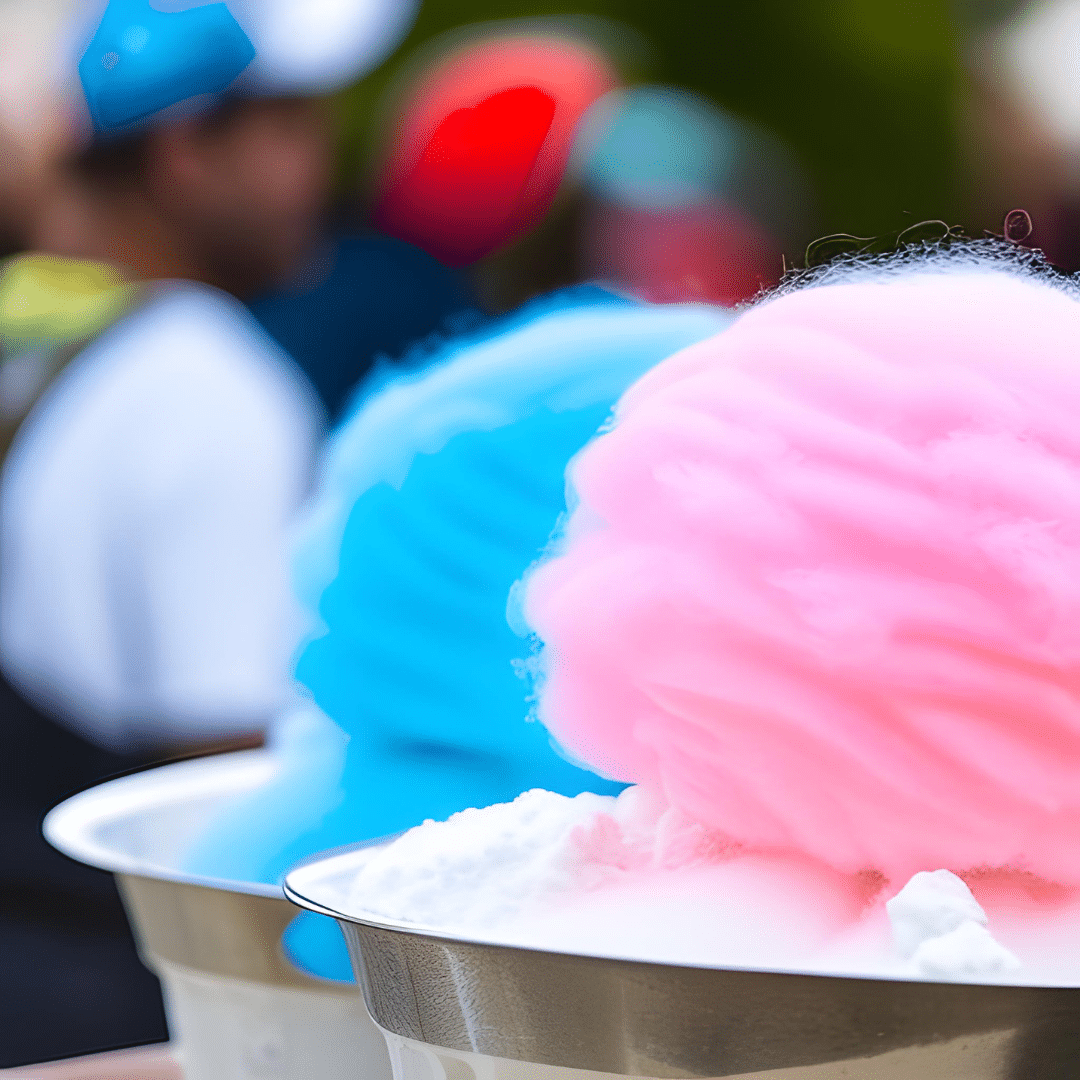
Pink and blue are the most popular colors for cotton candy. The evolution of cotton candy has resulted in many colors and unique flavor combinations. The colors of cotton candy do not contribute to the flavor.

Here are some popular cotton candy flavors:

  • Strawberry: The most popular prepackaged cotton candy flavor for children of all ages (56%)
  • Blue raspberry: The flavor most often associated with blue cotton candy.
  • Pink vanilla: A widely available flavor originally formulated by the Gold Medal brand.
  • Other common flavors: Bubblegum, blueberry, orange, vanilla, and grapes
  • Creative flavors: Birthday cake, chocolate strawberry, passionfruit, and piña colada


The global cotton candy maker market was valued at US$ 107.2 Billion in 2022. On average, cotton candy is consumed 1.48 times per year. Market research firm Datassential found that cotton candy is found on 1.4% of U.S. menus, a 37% increase over the past four years. Cotton candy is trending in the dairy, bakery, and restaurant industries.


So why not celebrate National Cotton Candy Day? Let us know in the comments, your favorite story about cotton candy.

0 Comments

Submit a Comment

Your email address will not be published. Required fields are marked *

Subscribe to our Blog to receive more content like this. Click here to subscribe.

Be sure to watch our shows on QVC+  or our YouTube channel

Give us your feedback on our Social Channels 

FacebookInstagramTik TokLinkedInPinterestTwitter  

National Smores Day

National Smores Day

Today’s spotlight is on a fireside favorite – S’mores.
S'mores are a confection made of toasted marshmallows and chocolate sandwiched between two graham crackers. They are a traditional camping snack that are popular in the United States and Canada. S'mores are traditionally cooked over a campfire and warmed over an open flame until melted and gooey.

Read More

National Rice Pudding Day

National Rice Pudding Day

Today’s Spotlight is on Rice Pudding.
Rice pudding is a creamy mixture of rice and milk and other ingredients such as cinnamon, vanilla and raisins. It's cooked until it's thick and soft. It can be sweet or savory. Variants are used for either desserts or dinners. When used as a dessert, it is commonly combined with a sweetener such as sugar. American rice pudding often uses leftover rice and can be baked in the oven or cooked on the stove.

Read More

Sneak Some Zucchini onto Your Neighbor’s Porch Day

Sneak Some Zucchini onto Your Neighbor’s Porch Day

Today’s Spotlight is on Zucchini (and your neighbors)!
There are a lot of odd holidays but this one has got to be one of my favorites. Sneak Some Zucchini Onto Your Neighbor's Porch Day is celebrated on August 8th every year. The holiday encourages people to sneak their extra zucchinis onto the porches of unsuspecting community members. The day celebrates the bounty of the summer's zucchini harvest by demonstrating generosity, desperation, and cunning.

Read More

Raspberries and Cream Day

Raspberries and Cream Day

Today’s food spotlight is aimed at Raspberries and Cream.
Raspberries and cream is a simple treat that combines fresh, ripe berries with sweetened, hand-whipped cream. It's a good option for anyone with a sweet tooth.
Raspberries are the fruit of several shrubs in the rose family. They are usually red but can also be black or yellow. When ripe, they separate from the receptacle and are rounder and smaller than blackberries. The name "raspberry" may have come from "raspise", which means "a sweet rose-colored wine". The name may also be related to the Old English word "rasp", which means "rough berry".

Read More

National Root Beer Float Day

National Root Beer Float Day

Today’s spotlight is on Root Beer Floats!
The root beer float is traditionally made with vanilla ice cream and root beer, but it can also be made with other ice cream flavors. It's sometimes referred to by the nicknames “brown cow” or “black cow”. Root beer floats were a popular dessert drink in 1950s diners.

Read More

Oyster Day

Oyster Day

Today’s food spotlight is on Oysters.
Oysters are a type of bivalve, which are marine and freshwater mollusks with long, flat bodies and shells made up of two hinged parts. Oysters are plump, mineral rich, saltwater mollusks that live at the bottom of shallow coastal waters, often adhering to rocks or other objects. They use their gills and cilia to process water and feed. Oysters have a small heart and internal organs, but no central nervous system.

Read More

Chocolate Chip Cookie Day

Chocolate Chip Cookie Day

Today’s spotlight is on Chocolate Chip Cookies #yum

If you have been living under a rock somewhere, a chocolate chip cookie is a drop cookie that features chocolate chips or chocolate morsels as its distinguishing ingredient. Chocolate chip cookies originated in the United States in 1938, when Ruth Graves Wakefield chopped up a Nestlé semi-sweet chocolate bar and added the chopped chocolate to a cookie recipe.

The original name of the chocolate chip cookie was "Toll House Crunch Cookie". The recipe was created by Ruth Wakefield, who ran the Toll House restaurant in Whitman, Massachusetts. Wakefield included the cookie in her 1938 cookbook, Toll House “Tried and True" Recipes. The cookie was intended to accompany ice cream.

Read More

Grab Some Nuts Day

Grab Some Nuts Day

Today is Grab Some Nuts Day.
All of this evidence shows that nuts have been a staple in the human diet since the beginning of history. The oldest walnut remains were discovered in Iraq, and they are believed to be from 50,000 B.C. The Greeks and Romans were fond of the walnut, and they were considered food for Gods by early Romans.

Read More

National Watermelon Day

National Watermelon Day

Today’s focus is on Watermelons.
Watermelons are a large, sweet fruit that are related to cantaloupes, zucchinis, pumpkins, and cucumbers. They are members of the gourd family (Cucurbitaceae) and are botanically classified as Citrullus lanatus. Watermelons are native to southern Africa and are cultivated around the world. They are usually eaten raw and are often used as a table dessert.
Watermelons are a berry with a hard rind and no internal divisions. They are botanically called pepos. The fruit is usually deep red to pink and has many black seeds, although seedless varieties exist. The sweet, juicy flesh is 92% water and contains vitamin A and some vitamin C. Watermelons are also a great source of antioxidants.

Read More

Ice Cream Sandwich Day

Ice Cream Sandwich Day

Today’s Spotlight is on the Ice Cream Sandwich.
An ice cream sandwich is a frozen dessert made of ice cream between two biscuits, wafers, cookies, or other baked goods. The ingredients can vary by region, with Ireland using wafers and the United States commonly using cookies. The current form of the ice cream sandwich is vanilla ice cream between two chocolate cookies.
Ice cream sandwiches have many nicknames, including giant sandwich, chipwich, cream between, vanilla slice, and slider. You can also make an ice cream sandwich cake by layering ice cream sandwiches between whipped topping, fudge, caramel, nuts, and M&M's.

Read More

Pin It on Pinterest