Celebrating Peanut Clusters

Mar 8, 2026 | Food Blog

Today’s Spotlight is on Peanut Clusters.

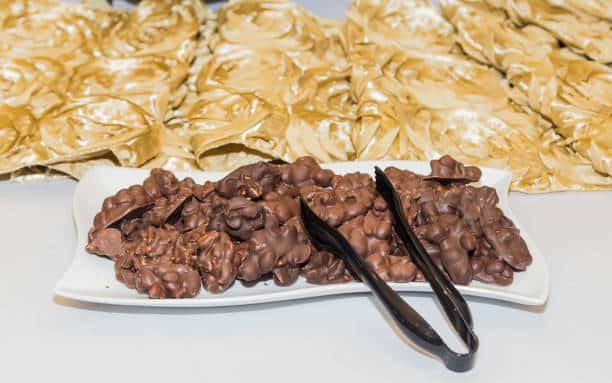
Peanut clusters come in many forms but in a nutshell, (see what I did there) Peanut Clusters are one or more chocolate covered peanuts. The ideal being one big cluster of bitesize chunks of roasted peanuts, chocolate and some caramel nougat.


History

Peanut clusters are one of the oldest confectioneries in America, with industrial production dating back to 1912. The iconic recipe has inspired many spin-offs and is credited for popularizing peanuts in North America.

Here are some other peanut cluster products and their histories:

  • Bun Bar = The Bun Bar was introduced in the 1920s by the Wayne Bun Candy Company in Fort Wayne, Indiana. The original Bun candy bar contained a mixture of nougat, caramel, and peanuts, all covered in milk chocolate. The Wayne Bun Candy Company copyrighted the Vanilla Cream Bun in 1947, and the Bun Bar as we know it was officially born. The Bun candy is still widely distributed and popular in the U.S. The Bun Bar has maple, vanilla, and sea salt caramel flavored centers. The brand was bought by Clark Bar, and in 1998, by Pearson, who invented the Nut Cluster.
  • GooGoo Cluster – The Goo Goo Cluster was invented in 1912 by Howard Campbell Sr. and Porter Moore at the Standard Candy Company in Nashville, Tennessee. The candy bar was originally made in a copper kettle and sold individually out of glass jars on select drugstore counters. The Goo Goo Cluster was the world’s first combination candy bar. At the time it was created, other candy bars were made exclusively with chocolate, caramel, or taffy. The Goo Goo Cluster contains marshmallow nougat, caramel, and roasted peanuts covered in milk chocolate. The candy was originally named “Goo Goo” because a teacher recommended that Mr. Campbell name his treat “Goo Goo” because it was so good, people would ask for it from birth. It is considered the first combination candy bar, made up of several different types of candy rather than an all-chocolate chocolate bar.
  • Goobers – The Blumenthal Chocolate Company introduced Goobers, the first chocolate-covered peanut candy, in 1925. The company was based in North Carolina, where “goober” is a southern nickname for peanuts. The company also marketed the candy as “Goober Peas”. The Blumenthal family sold the company in 1969, and it was renamed the Ward Candy Company. Ward Foods acquired Blumenthal in 1969, and Chicago-based Terson Company acquired Ward Foods in 1981. Nestlé acquired the brand from Terson Company in 1984. Goobers have often been eaten as a movie snack and have been sold in movie packs. The original chocolate covered peanut candies were called Goobers, which were first sold in 1925.
  • Peanut M&Ms – One of the more well-known chocolate-covered nuts. Peanut M&Ms were introduced in 1954 by the Mars company. They were the first new type of M&M released.  Peanut M&Ms are made of a single peanut in a chocolate-coated candy shell.  They are shaped differently than regular M&Ms because they have a peanut at the center. Peanut M&Ms were originally only tan in color to represent the color of the roasted peanuts being used in the product. In 1960, they added green, yellow, and red colors. Peanut M&Ms are the second most popular flavor of M&M’s. The spokes candy for this flavor of M&M’s is Yellow.

Technically a Snickers Bar should be on this list with a host of other peanut candy bar favorites. Let us know in the comments what candy bars you think would qualify.

Here are some facts about peanut clusters:

  • A peanut cluster contains 73 calories, 7g total carbs, 6.3g net carbs, 4.7g fat, and 1.8g protein.
  • The Goo Goo Cluster is a disk-shaped candy bar that contains marshmallow nougat, caramel, and roasted peanuts covered in milk chocolate.
  • Astronaut Allen B. Sheppard brought peanuts with him to the moon.
  • Some peanut clusters are made with roasted Spanish peanuts blended with chocolate.
  • Other peanut clusters are made with jumbo roasted peanuts combined with rich melted milk chocolate.


Here is a Peanut Cluster Recipe for you to try:

Ingredients:

  • 2 pounds white candy coating coarsely chopped.
  • 1 package (12 ounces) semisweet chocolate chips
  • 1 package (11-1/2 ounces) milk chocolate chips
  • 5 cups salted dry roasted peanuts.

Instructions:

  1. In a heavy saucepan over low heat, cook and stir candy coating and chips until melted and smooth. Cool for 10 minutes; stir in peanuts.
  2. Drop rounded tablespoonfuls onto waxed paper-lined baking sheets. Refrigerate until firm, about 45 minutes.


Celebrating Peanut Clusters

National Peanut Cluster Day is celebrated on March 8. Peanut clusters are a combination of chocolate and peanuts, which creates a sweet and salty treat.

Here are some ways to celebrate National Peanut Cluster Day:

  • Indulge in peanut clusters.
  • Enjoy the combination of sweet and salty.


You can also celebrate National Peanut Day on September 13.

Here are some ways to celebrate National Peanut Day:

  • Make your own peanut butter.
  • Bake with peanuts.
  • Go out for peanuts.
  • Create a trail mix.
  • Read the “Peanuts” comic strip.

0 Comments

Submit a Comment

Your email address will not be published. Required fields are marked *

Subscribe to our Blog to receive more content like this. Click here to subscribe.

Be sure to watch our shows on QVC+  or our YouTube channel. 

Give us your feedback on our Social Channels 

Facebook • Instagram • Tik Tok • LinkedIn • Pinterest • Twitter  

Celebrating Pumpkins

Celebrating Pumpkins

Today’s Spotlight in on Pumpkins.
A pumpkin is a vernacular term for mature winter squash of species and varieties in the genus Cucurbita that has culinary and cultural significance but no agreed upon botanical or scientific meaning. Pumpkin, from a botanist's perspective, is a fruit because it's a product of the seed-bearing structure of flowering plants. Vegetables, on the other hand, are the edible portion of plants such as leaves stems, roots, bulbs, flowers, and tubers.

Read More

Celebrating Pasta

Celebrating Pasta

Today’s Spotlight is on Pasta.
Pasta is a type of food typically made from an unleavened dough of wheat flour mixed with water or eggs, and formed into sheets or other shapes, then cooked by boiling or baking.
Pasta is a type of food made from unleavened dough of wheat flour, water, and sometimes eggs. The dough is formed into different shapes and then cooked by boiling or baking. Pasta can be dried or used fresh.

Read More

Celebrating Boston Cream Pie

Celebrating Boston Cream Pie

Today’s Spotlight is on Boston Cream Pie.
A Boston cream pie is a cake with a cream filling. The dessert acquired its name when cakes and pies were cooked in the same pans, pie tins were more common than cake pans, and the words were used interchangeably. In the late 19th century, this type of cake was variously called a "cream pie", a "chocolate cream pie", or a "custard cake".
The Boston cream pie is a sponge cake. The cake batter was originally baked in a pie crust. At some point, the crust was eliminated, and the batter was poured directly into the pie pan.

Read More

Celebrating Whole Hog BBQ

Celebrating Whole Hog BBQ

Today’s spotlight is on a Whole Hog BBQ.
Whole hog barbecue involves cooking an entire hog in one piece over a pit in the ground. It's a time- and labor-intensive process. Whole hog barbecue is a regional style of barbecue where a pitmaster cooks an entire hog. The hog smoked for hours on a wood pit. The meat is seasoned with sauces like mustard-based, tomato-based, or vinegar-based.
To serve, the skin is cracked along the back, hams, and shoulders. The meat should pull easily from the bone. Guests can choose the type of meat they want, such as:
Loin, Tenderloin, Shoulder, Hams, Belly, Ribs.

Read More

Celebrating Nuts

Celebrating Nuts

Today’s focus is on nuts!
Nuts (tree nuts and peanuts) are nutrient dense foods with complex matrices rich in unsaturated fatty and other bioactive compounds: high-quality vegetable protein, fiber, minerals, tocopherols, phytosterols, and phenolic compounds.
There are over 20 edible nuts in the world. Some of the most common edible nuts include:

Read More

Celebrating Nachos

Celebrating Nachos

Today’s Spotlight is on Nachos.
Nachos is a Mexican culinary dish consisting of tortilla chips or totopos covered with cheese or cheese sauce, as well as a variety of other toppings and garnishes, often including meats, vegetables, and condiments such as salsa, guacamole, or sour cream.
They can also include other toppings and garnishes, such as:

Read More

Celebrating Chicken and Waffles

Celebrating Chicken and Waffles

Today’s Spotlight is on Chicken and Waffles.
Chicken and waffles is a dish that combines chicken and waffles. It's popular in the United States and is served in many restaurants. The dish first appeared in the United States in the 1600s in Pennsylvania Dutch country. The traditional Pennsylvania Dutch version consists of a plain waffle with pulled, stewed chicken on top, covered in gravy.

Read More

Celebrating Seafood Bisque

Celebrating Seafood Bisque

Today’s Spotlight is on Seafood Bisque.
A bisque is a French style of soup that is made from crustaceans, such as lobster, crab, shrimp, and crayfish; their shells are used to make a stock and the meat is incorporated into the finished dish. So, in a way, calling the soup a "seafood bisque" is somewhat redundant.
The main characteristic of a bisque is that it is smooth and has a velvety texture. Most recipes will include wine and cream to give it its signature flavor and texture. But it's not merely the choice of ingredient that makes bisque different from other types of soups. It’s also the technique for utilizing that ingredient, including the parts you can't eat, making a bisque what it is.

Read More

Celebrating Meatloaf

Celebrating Meatloaf

Today’s Spotlight is in Meatloaf.

Meatloaf is a traditional dish made from ground meat, such as beef, pork, or poultry, mixed with other ingredients like breadcrumbs, onions, and eggs. It is then formed into the shape of a loaf, then baked or smoked. The final shape is either hand-formed on a baking tray or pan-formed by cooking it in a loaf pan.

Read More

Pin It on Pinterest