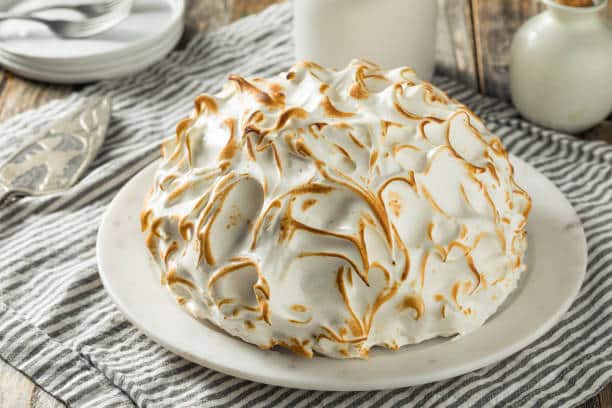
Celebrating Baked Alaska

Jan 31, 2026 | Food Blog

Today’s Spotlight is on Baked Alaska.

Baked Alaska, also known as Bombe Alaska, omelet norvégienne, omelet surprise, or omelet sibérienne depending on the country, is a dessert consisting of ice cream and cake topped with browned meringue.

Baked Alaska is a dessert made of ice cream, cake, and meringue:

  • A layer of sponge cake
  • A layer of frozen ice cream
  • A coating of toasted marshmallow meringue

The dessert is baked quickly at high heat until lightly browned. The toasted meringue insulates the ice cream layer so that it remains frozen.

Baked Alaska is also called:

  • Omelet á la norvégienne
  • Norwegian omelet
  • Omelet surprise
  • Glace au four (ice cream in oven)

Early versions of this dessert used pie crusts instead of meringue. In the 18th – 19th century similar desserts were called Bombes.


History

The dessert was introduced in 1867 at Antoine’s, a Creole restaurant in New Orleans. The restaurant’s chef, Antoine, named the dish Baked Alaska to honor the United States acquisition of Alaska from the Russian Empire earlier that year.

The dessert may have been introduced by Charles Ranhofer, a Parisian pastry chef working at New York’s famous Delmonico’s restaurant. Ranhofer may have introduced the dessert to celebrate the purchase of Alaska from Russia, or to poke fun at New York senator William H. Seward’s purchase of Alaska from the Russians. The purchase was widely ridiculed at the time.

French food writer Baron Leon Brise stated in 1866 that French chef Balzac introduced the dessert to France.

The name “baked Alaska” was supposedly coined in 1876 at Delmonico’s, a restaurant in New York City. The name was coined to honor the acquisition by the United States of Alaska from the Russian Empire in March 1867.


Here are some fun facts about baked Alaska:

  • The original dessert is attributed to physicist Benjamin Rumford in 1804.
  • The dessert’s origins are still debated, but it’s thought to have begun with the work of American-born scientist Sir Benjamin Thompson. Thompson served as a spy and informant for the British Army during the American Revolution.
  • The dessert is often attributed to Charles Ranhofer, the chef at Delmonico’s in New York City. In 1867, Ranhofer served a dessert called “Alaska, Florida” in honor of the recent Alaska Purchase.


Here is a Baked Alaska Recipe for you to try:

Ingredients:

For the Filling:

  • 2 pints ice cream any flavors (946mL)
  • 1½ quarts ice cream any flavor (1.42L)
  • 1 loaf pound cake


For the Meringue:

  • 4 egg whites room temperature
  • ¼ teaspoon cream of tartar
  • 1 cup superfine sugar (200g)


Instructions

For the Filling:

  1. Place the ice cream in the fridge for 20 to 30 minutes or soft enough to very easily scoop, but not runny.
  2. While the ice cream softens, very lightly coat an 8- to 9-inch-wide bowl with oil. Line with plastic wrap, leaving several inches of overhang around the edges.
  3. Slice the pound cake into ½-inch-thick pieces.
  4. When the ice cream is soft, place alternating scoops of the various ice cream flavors in the lined bowl, reserving half of the 1.5-quart flavor. Press a piece of plastic wrap to the top of the ice cream scoops and gently press down to fill in any gaps between the scoops. Smooth out the top. Freeze for 15 to 20 minutes or until the top is mostly firm. Return the remaining ice cream to the fridge while the bowl freezes.
  5. Once mostly firm, remove the plastic and spread the remaining ice cream over the mixed scoops. Place pound cake slices on top, making sure they fit snugly together. Cut some of the pound cake to fill in any gaps, as needed. (There will probably be some cake leftover.) Fold the excess plastic wrap up over the cake to cover and freeze until solid, about 2 to 4 hours or up to 1 week.


For the Meringue:

  1. When ready to serve, place the egg whites and cream of tartar in the bowl of a stand mixer with the whip attachment. Beat on medium speed until frothy and doubled in volume, about 2 minutes. Very slowly add in the sugar while beating. Once added, continue beating until stiff and glossy, about 6 more minutes.


For the Assembly:

  1. Remove the bowl of ice cream from the freezer and unwrap the bottom. Place a large plate on top and flip to invert, using the excess parchment to help release the ice cream from the bowl. Once inverted, carefully remove the plastic from the ice cream.
  2. Spread or pipe the meringue all over the ice cream, making sure that it is completely covered and touching the plate, creating a seal. Using a kitchen torch, brown the meringue. Serve immediately.
  3. Enjoy!


Consumption

According to Tastewise, baked Alaska is consumed 1.1 times every year on average.


Celebrating Baked Alaska

February 1st is dedicated to celebrating Baked Alaska; however, you can certainly celebrate it any time you want. Let us know in the comments your favorite Baked Alaska story.

0 Comments

Submit a Comment

Your email address will not be published. Required fields are marked *

Subscribe to our Blog to receive more content like this. Click here to subscribe.

Be sure to watch our shows on QVC+  or our YouTube channel. 

Give us your feedback on our Social Channels 

Facebook • Instagram • Tik Tok • LinkedIn • Pinterest • Twitter  

Celebrating Chocolate

Celebrating Chocolate

Today’s Spotlight is on Chocolate.
Chocolate is a sweet, brown food made from cocoa beans. It's usually sold in solid bars, but can also be powdered or melted. Chocolate is used as a flavor for desserts, drinks, and other foods.
Chocolate is rich in carbohydrates and is an excellent source of quick energy. It has several health benefits.

Read More

Celebrating Pumpkins

Celebrating Pumpkins

Today’s Spotlight in on Pumpkins.
A pumpkin is a vernacular term for mature winter squash of species and varieties in the genus Cucurbita that has culinary and cultural significance but no agreed upon botanical or scientific meaning. Pumpkin, from a botanist's perspective, is a fruit because it's a product of the seed-bearing structure of flowering plants. Vegetables, on the other hand, are the edible portion of plants such as leaves stems, roots, bulbs, flowers, and tubers.

Read More

Celebrating Pasta

Celebrating Pasta

Today’s Spotlight is on Pasta.
Pasta is a type of food typically made from an unleavened dough of wheat flour mixed with water or eggs, and formed into sheets or other shapes, then cooked by boiling or baking.
Pasta is a type of food made from unleavened dough of wheat flour, water, and sometimes eggs. The dough is formed into different shapes and then cooked by boiling or baking. Pasta can be dried or used fresh.

Read More

Celebrating Boston Cream Pie

Celebrating Boston Cream Pie

Today’s Spotlight is on Boston Cream Pie.
A Boston cream pie is a cake with a cream filling. The dessert acquired its name when cakes and pies were cooked in the same pans, pie tins were more common than cake pans, and the words were used interchangeably. In the late 19th century, this type of cake was variously called a "cream pie", a "chocolate cream pie", or a "custard cake".
The Boston cream pie is a sponge cake. The cake batter was originally baked in a pie crust. At some point, the crust was eliminated, and the batter was poured directly into the pie pan.

Read More

Celebrating Whole Hog BBQ

Celebrating Whole Hog BBQ

Today’s spotlight is on a Whole Hog BBQ.
Whole hog barbecue involves cooking an entire hog in one piece over a pit in the ground. It's a time- and labor-intensive process. Whole hog barbecue is a regional style of barbecue where a pitmaster cooks an entire hog. The hog smoked for hours on a wood pit. The meat is seasoned with sauces like mustard-based, tomato-based, or vinegar-based.
To serve, the skin is cracked along the back, hams, and shoulders. The meat should pull easily from the bone. Guests can choose the type of meat they want, such as:
Loin, Tenderloin, Shoulder, Hams, Belly, Ribs.

Read More

Celebrating Nuts

Celebrating Nuts

Today’s focus is on nuts!
Nuts (tree nuts and peanuts) are nutrient dense foods with complex matrices rich in unsaturated fatty and other bioactive compounds: high-quality vegetable protein, fiber, minerals, tocopherols, phytosterols, and phenolic compounds.
There are over 20 edible nuts in the world. Some of the most common edible nuts include:

Read More

Celebrating Nachos

Celebrating Nachos

Today’s Spotlight is on Nachos.
Nachos is a Mexican culinary dish consisting of tortilla chips or totopos covered with cheese or cheese sauce, as well as a variety of other toppings and garnishes, often including meats, vegetables, and condiments such as salsa, guacamole, or sour cream.
They can also include other toppings and garnishes, such as:

Read More

Celebrating Chicken and Waffles

Celebrating Chicken and Waffles

Today’s Spotlight is on Chicken and Waffles.
Chicken and waffles is a dish that combines chicken and waffles. It's popular in the United States and is served in many restaurants. The dish first appeared in the United States in the 1600s in Pennsylvania Dutch country. The traditional Pennsylvania Dutch version consists of a plain waffle with pulled, stewed chicken on top, covered in gravy.

Read More

Celebrating Seafood Bisque

Celebrating Seafood Bisque

Today’s Spotlight is on Seafood Bisque.
A bisque is a French style of soup that is made from crustaceans, such as lobster, crab, shrimp, and crayfish; their shells are used to make a stock and the meat is incorporated into the finished dish. So, in a way, calling the soup a "seafood bisque" is somewhat redundant.
The main characteristic of a bisque is that it is smooth and has a velvety texture. Most recipes will include wine and cream to give it its signature flavor and texture. But it's not merely the choice of ingredient that makes bisque different from other types of soups. It’s also the technique for utilizing that ingredient, including the parts you can't eat, making a bisque what it is.

Read More

Pin It on Pinterest