
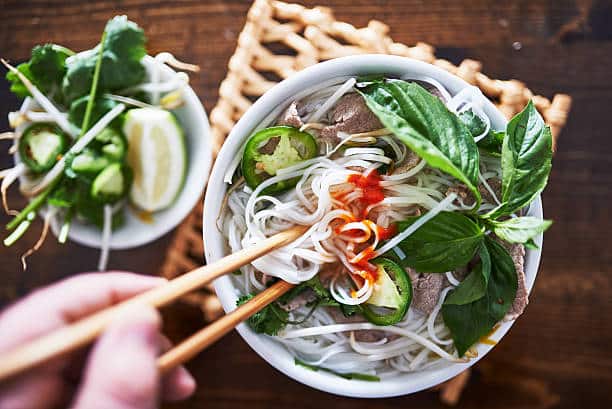
Today’s Spotlight is on Pho.
Pho is a Vietnamese soup dish consisting of broth, rice noodles, herbs, and meat. Phở is a popular food in Vietnam where it is served in households, street-stalls, and restaurants country-wide. Residents of the city of Nam Định were the first to create Vietnamese traditional phở.
Pho is a Vietnamese soup made with broth, rice noodles, and meat. It’s the national dish of Vietnam.
Pho is pronounced “fuh”. It’s made with:
- Broth, usually made with beef bones.
- Rice noodles
- Meat, usually beef, but it can also be chicken, fish, pork, or tofu.
- Fresh garnishes, such as bean sprouts, herbs, limes, and chiles
Pho is nutritious and high in protein, but it’s also high in sodium and calories. It may help reduce inflammation and improve joint health.
Pho is different from ramen. The noodles in pho are soft and translucent, while the noodles in ramen are firm and chewy.
History
Pho’s origins are poorly documented. Most historians agree that pho was invented in the late 19th and early 20th century in northern Vietnam during French colonial times. Pho was heavily influenced by both Chinese and French cooking. Rice noodle and spices were imported from China. The French popularized the eating of red meat.
Some theories about pho’s origins include:
- Pho was an adaptation of the French one-pot beef and vegetable stew pot-au-feu.
- Pho originated when Vietnamese villagers added French beef to the bánh đa cua.
- Pho originated from a Cantonese dish called “ngau yuk phan”.
- Pho is derived from “buffalo meat soup” (using vermicelli) of Vietnam.
- The word “pho” is a corruption of the French “feu” or “fire”.
- Pho was from Vân Cù village in Nam Dinh province.
- Pho was popularly rose in Hanoi due to a surplus of beef bones.
Pho became popular as a street food in Vietnam. It was popularized throughout the world by refugees after the Vietnam War.
Here are some fun facts about pho:
- The word “pho” might come from the French word “feu”, which means “fire”.
- The original pho dish is not Pho Hanoi.
- The flavors of pho vary by region.
- Pho is rich in calcium, iron, and phosphorus, which are essential for maintaining healthy teeth.
- Vietnamese cooking uses very little oil.
- Pho represents the history of Vietnam and its push for self-determination.
- Pho was popularized throughout the world by refugees after the Vietnam War.
Here is a Pho Recipe for you to try:
Ingredients:
AROMATICS:
- 2 large onions, halved.
- 150g / 5oz ginger, sliced down the center.
SPICES
- 10-star anise
- 4 cinnamon quills
- 4 cardamon pods
- 3 cloves (the spice cloves!)
- 5 tbsp coriander seeds
BEEF BONES (NOTE 1):
- 5kg / 3lb beef brisket
- 1kg / 2lb meaty beef bones
- 1kg / 2lb marrow bones (leg, knuckle), cut to reveal marrow.
- 5 liters / 3.75 quarts water (15 cups)
SEASONING:
- 2 tbsp white sugar
- 1 tbsp salt
- 40 ml / 3 tbsp fish sauce
NOODLE SOUP – PER BOWL:
- 50g / 1.5 oz dried rice sticks (or 120g/4oz fresh) (Note 3)
- 30g / 1 oz beef tenderloin, raw, very thinly sliced (Note 4)
- 3 – 5 brisket slices (used for broth)
TOPPINGS:
- Beansprouts, handful
- Thai basil, 3 – 5 sprigs
- Coriander/cilantro, 3 – 5 sprigs (or more basil)
- Lime wedges*
- Finely sliced red chilli*
- Hoisin sauce*
- Sriracha* (for spiciness)
Instructions
AROMATICS
- Heat a heavy based skillet over high heat (no oil) until smoking.
- Place onion and ginger in pan cut side down. Cook for a few minutes until it’s charred, then turn. Remove and set aside.
- Toast Spices lightly in a dry skillet over medium high heat for 3 minutes.
REMOVE IMPURITIES:
- Rinse bones & brisket then cover with water in large stock pot.
- Boil for 5 minutes, then drain.
- Rinse each bone and brisket under tap water.
BROTH:
- Wipe pot clean, bring 3.5 litres / 3.75 quarts water to boil.
- Add bones and brisket, onion, ginger, Spices.
- Add onion, ginger, Spices, sugar and salt – water should just barely cover everything.
- Cover with lid, simmer for 3 hours.
- Remove brisket (should be fall-apart tender), cool then refrigerate for later.
- Simmer remaining soup UNCOVERED for 40 minutes.
- Strain broth into another pot, discard bones and spices. Should be about 2.5 litres / 2.65 quarts (10 cups), if loads more, reduce.
- Add fish sauce, adjust salt and sugar if needed. Broth should be beefy, fragrant with spices, savory and barely sweet.
ASSEMBLE:
- Prepare rice noodles per packet, just prior to serving.
- Place noodles in bowl. Top with raw beef and brisket.
- Ladle over about 400 / 14 oz hot broth – will cook beef to medium rare.
- Serve with Toppings on the side.
- Enjoy!
Consumption
On average, pho is consumed 1.55 times every year. However, pho’s popularity has decreased by 9.11% over the past year. Pho is the national dish of Vietnam. It’s also one of the 100 most popular dishes in the world. In the United States, there are 6,340 pho restaurants.
A medium bowl of pho contains:
- 3–4 ounces of meat
- 6 ounces of noodles
- 20 ounces of broth
- Fresh herbs, onions, peppers, and bean sprouts
Celebrating Pho
January 31 is National Pho Day. Pho is often reserved for special occasions because it takes a lot of time, effort, and ingredients to make from scratch. Some say that pho is a Vietnamese holiday tradition.
Here are some pho-related holiday items:
- Pho ornament: An original design made in the USA of thick acrylic and glitter ribbon.
- Pho card: A funny pho Christmas card with an enamel pin
- Pho holiday ornament: A bowl of pho ornament
- You can also make your own pho for the holidays.
Let us know in the comments if you are a friend of Pho.
0 Comments