
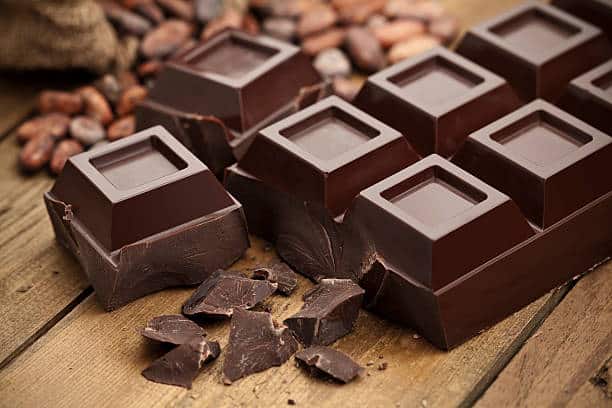
Today’s Spotlight is on Chocolate.
Chocolate is a sweet, brown food made from cocoa beans. It’s usually sold in solid bars, but can also be powdered or melted. Chocolate is used as a flavor for desserts, drinks, and other foods.
Chocolate is rich in carbohydrates and is an excellent source of quick energy. It has several health benefits.
Chocolate can be described as:
- Taste: Warm, complex, sweetness balanced with bitterness, fresh
- Mouthfeel: Creamy, melting, smooth, greasy, waxy, grainy, powdery, or drying
- Texture: Smooth, chewy, coarse, unrefined
Chocolate can vary in color. It can be ivory, golden, shades of copper brown, deep reddish, or charcoal brown. The color depends on the type of chocolate, the percentage of cacao in the chocolate, the presence and quantity of milk or cream, and the source of the beans from which the chocolate was made.
History
Chocolate’s history began over 4,000 years ago in Mesoamerica, present-day Mexico. The Olmecs, one of the earliest civilizations in Latin America, were the first to turn the cacao plant into chocolate. They drank their chocolate during rituals and used it as medicine.
The Maya, Toltec, and Aztec people also prepared a beverage from the fruit of the cocoa bean. The Maya considered chocolate to be the food of the gods, held the cacao tree to be sacred, and buried dignitaries with bowls of chocolate.
The word “chocolate” itself is believed to be derived from the Aztec word “xocoatl,” which referred to the bitter drink consumed by the Aztec people.
The Maya Empire was the first to ferment, dry, roast, and grind cocoa beans into a paste. They mixed this paste with a combination of water, cornmeal, chili, and other spices like vanilla, cinnamon, and even magnolia to make a frothy chocolate beverage in 450 BCE.
The Spanish kept the chocolate recipe a secret for almost 100 years to maintain their monopoly on the cocoa trade. The Spanish invaded Mexico in the 16th century and brought cocoa beans back to Spain. The Aztecs offered the beans to Don Cortes in 1523. The Spanish processed the beans in monasteries and served the chocolate only to the nobility.
The Spanish kept the recipe a secret because:
- They wanted to maintain their monopoly on the cocoa trade.
- They wanted to prevent the rest of Europe from finding out.
- They wanted to restrict the processing of cocoa beans to monks in monasteries.
The Spanish kept the recipe a secret for almost 100 years. Eventually, the secret was leaked to the rest of Europe.
Solid chocolate bars weren’t invented until the 19th century.
Here are some interesting facts about chocolate:
- Chocolate is a fruit.: The tree that chocolate is produced from is called Theobroma cacao, which means “food of the gods”.
- Chocolate has 3 times more flavor compounds than red wine.: Chocolate has 600 flavor compounds, while red wine has just 200.
- Eating dark chocolate every day reduces the risk of heart disease by 1/3.: Flavonoids found in cocoa products have antioxidant, anti-inflammatory, and anti-clotting effects.
- The smell of chocolate increases theta brain waves, which trigger relaxation.
- White chocolate isn’t really chocolate.: White chocolate was invented by the Nestlé company in Switzerland. The first white chocolate bar debuted in 1930.
Here are some facts about white chocolate:
- White chocolate is made with cocoa butter, milk solids, sugar, lecithin, and flavorings.
- According to the FDA, white chocolate must contain at least 20% cocoa fat, 3.5% milk fat, and 14% milk solids.
- White chocolate is the most fragile form of chocolate.
- White chocolate lacks chocolate flavor because it doesn’t contain chocolate liquor.
- White chocolate has very little caffeine compared to regular chocolate.
- White chocolate can help regulate fat in the body, which can reduce bad cholesterol.
- Nestlé started producing white chocolate commercially in 1936 to use excess milk powder during World War I.
- The flavor of white chocolate can vary between brands.
Here are some fun facts about chocolate drinks:
- The Mayans are believed to have made the first hot chocolate drink around 2,000 years ago.
- The Aztecs made a cocoa drink by 1400 AD.
- Doctors used hot chocolate as medicine to treat some diseases until the late 1800s.
- Milk chocolate originated in Jamaica.
- Hot chocolate is made from ground or shaved cacao, while hot cocoa is made from cocoa powder that has the fat stripped away.
- Chocolate milk can be made by stirring chocolate syrup into plain milk, or by adding cocoa and sugar to milk.
Here is a recipe if you want to make chocolate at home:
Chocolate Bars Close up
Ingredients:
- 1/4 cup (40 g) cacao butter (see notes)
- 1/4 cup (25 g) cocoa powder (I used Dutch processed)
- 1 1/2-2 Tbsp (30-40 g) pure maple syrup (room temperature, not cold)
- 1/2 tsp vanilla extract (optional)
Instructions:
- First, melt the cacao butter (finely chop it if it’s in big pieces) over a double boiler, stirring/whisking often. Once melted, remove it from the heat.
- To prepare a double boiler, add a couple of inches of water to a small-medium saucepan and top it with a heat-proof bowl, ensuring the water doesn’t come in contact with the bowl, then bring the water to a gentle simmer over medium to medium-low heat.
- Stir in the cocoa powder, maple syrup, and vanilla extract (if using) and whisk until lump-free.
- Pour the homemade chocolate mixture into the silicone mold of your choice (using a silicone spatula helps to get it all out of the bowl) and leave it to set for several hours in the fridge or 20-30 minutes in the freezer.
- When ready, release the homemade chocolate bar from the mold.
- Enjoy!
Consumption:
In 2022, the world consumed approximately 8.13 million tons of chocolate. The average person eats about 1 kg of chocolate per year. The United States consumes almost half of the world’s chocolate supply, eating 2.8 billion pounds of chocolate each year. The average American eats about 9.5 lbs of chocolate per year.
In 2020, the global chocolate production volume was approximately 4.69 million metric tons. In the 2021/2022 cocoa season, around 4.9 million tonnes of cocoa were produced worldwide. Global cocoa production is expected to reach over five million tons in the 2022/2023 crop year.
Côte d’Ivoire and Ghana are the two largest cocoa growing countries, accounting for over 60% of global cocoa production. Indonesia is the largest producer country in Asia.
Here are some other chocolate statistics:
- The global chocolate market size was estimated at $113.16 billion in 2021.
- The Swiss lead the world in chocolate consumption, eating 19.4 pounds of chocolate per capita per year.
- The average cost of a chocolate bar in 2023 is up 8%.
- 40% of chocolate shopping is done online.
- In 2021, sales of premium chocolates grew 23% over the three years prior.
The global chocolate industry is worth an estimated $100-130 billion USD per year. In 2023, the global chocolate industry had a market size of $62.4 billion. The global chocolate market is expected to grow at a compound annual growth rate (CAGR) of 3.7% from 2022 to 2030 to reach USD 156.74 billion by 2030.
The global chocolate confectionery market generated a revenue of approximately 0.99 trillion U.S. dollars worldwide in 2021. The Statista Digital Market Outlook estimates that the generated revenue in this market is expected to increase in the coming years reaching a value of 1.33 trillion dollars in 2027.
The largest chocolate company in the world is Mars Wrigley Confectionery, with a net sales of $20.0 billion.
Celebrating Chocolate
National Chocolate Day is celebrated close to Halloween on October 28th. World Chocolate Day, sometimes referred to as International Chocolate Day, or just Chocolate Day, is an annual celebration of chocolate, occurring globally on July 7, which some suggest being the anniversary of the introduction of chocolate to Europe in 1550. The observance of World Chocolate Day dates back to 2009. Chocolate is highly celebrated.
Here are some chocolate holidays:
- World Chocolate Day: Celebrated on July 7th, this holiday commemorates the introduction of chocolate to Europe in 1550. Some celebrate on September 13th, which is Milton Hershey’s birthday.
- National Chocolate Day: Celebrated on October 28th, this holiday honors chocolate as a culinary invention.
- National Chocolate Chip Day: Celebrated on May 15th, this holiday honors chocolate in chip form.
Other chocolate holidays include:
- National Sacher Torte Day – December 5th
- National Chocolate Brownie Day – December 8th
- National Cocoa Day – December 12th
- National Chocolate-Covered Anything Day – December 16th
- National Chocolate Parfait Day – May 1st
- National Truffle Day – May 2nd
- National Chocolate Custard Day – May 3rd
- National Butterscotch Brownie Day – May 9th
- National Nutty Fudge Day – May 12th
Chocolate is so important to people that it also has its own WEEK.
American Chocolate Week is celebrated during the third full week of March every year. In 2024, it will be celebrated from March 17 to 23. American Chocolate Week is an annual celebration of chocolate. It’s a week for chocolate enthusiasts, connoisseurs, and everyone in between to savor the rich and decadent flavors of chocolate in all its forms. American Chocolate Week begins on the Sunday of the 3rd full week of March. In 2022, it fell on March 20th.
Let us know in the comments how and when you prefer to celebrate chocolate, even if it’s daily!
0 Comments