Celebrating Pasta

Oct 24, 2025 | Food Blog

Today’s Spotlight is on Pasta.

Pasta is a type of food typically made from an unleavened dough of wheat flour mixed with water or eggs, and formed into sheets or other shapes, then cooked by boiling or baking.

Pasta is a type of food made from unleavened dough of wheat flour, water, and sometimes eggs. The dough is formed into different shapes and then cooked by boiling or baking. Pasta can be dried or used fresh.

Some types of pasta include:

Spaghetti, Macaroni, Noodles, Ravioli, Fettuccine, Lasagna.

Pasta is a versatile pantry staple. You can boil it and dress it up with sauce and protein. All wheat pasta contains gluten, including Spaghetti, Fettuccine, Macaroni, Lasagna, Ravioli.

Whole-wheat pasta is a nutritious option. According to the USDA, every cup of cooked pasta (140 grams) contains:

  • 43 g of carbohydrate
  • 3 g of fiber
  • 8 g of protein

Here are some popular types of pasta:

  • Spaghetti: A long, thin noodle that can be paired with many sauces.
  • Lasagna: A traditional Italian dish made with layers of pasta, meat or vegetables, and cheese.
  • Ravioli: A type of pasta.
  • Linguine: A flattened spaghetti.
  • Penne: A type of pasta.


Other types of pasta include:

  • Farfalle – Also known as bowtie pasta, it’s good for holding sauce and is often used in pasta salads.
  • Fusilli – Also called corkscrew pasta, it’s thick and has long spirals.
  • Rigatoni – A large, tube-shaped pasta with ridged edges.
  • Bucatini – A long noodle similar to spaghetti, but thicker and with a hole through the center.
  • Angel hair pasta – Also called Capellini, it’s thin and delicate.


History

The origins of pasta are unclear. Some say it originated in Italy, but others believe it was brought to Italy by Marco Polo after his travels to China in the late 13th century. The earliest known pasta was made from rice flour and was common in the east.

The first pasta dish was made in Sicily in 1154. It was closer to a lasagna than traditional noodles because it had a meat stuffing.

Pasta became a staple in Rome and Florence by the 14th century. It became available in dried forms and sold in shops in later centuries. By the 19th century, it had achieved a presence and stature in Italian cuisine that continues to evolve to the present day.

Pasta arrived in Northern France and Germany in the 12th century via the Jews. At the same time, the Arab-Andalusian influence brought pasta to Spain and Sicily.

The word “pasta” comes from Italian.  It’s rooted in Greek and Latin. In Latin, it means “barley porridge”. In Greek, it means “dough pastry cake”. In Italian, it means “paste”. The word “pasta” was first used in English in 1873. Before it was called “pasta”, it was called “maccaronaro”. “Maccaronaro” means “kneading dough with energy”.

Pasta is a symbol of Italian cuisine. It’s affordable, versatile, and has a long shelf life. It’s also nutritious and can be paired with other foods. Pasta has been present in Italy for a long time. In the Middle Ages, the first professional pasta shops opened in Southern Italy. After World War II, pasta became more widespread.

Pasta is a key ingredient in Italian cuisine. It’s made from wheat, which has been a main cereal in Italy for a long time. Italian pasta is made with durum wheat flour, which doesn’t spike blood sugar levels as much as refined white flour. Pasta is also economical. Italian cuisine uses small amounts of cheap, easy-to-find ingredients. For example, tripe and pigs trotters are often considered “waste” products.


Here are some interesting facts about pasta:

  • There are over 600 different shapes of pasta.
  • The word “pasta” translates to “paste” in Italian.
  • Thomas Jefferson made pasta popular in America.
  • Italians eat the most pasta.
  • The average Italian eats 26 kg of pasta annually.
  • Italy produces 1,432,990 tons of pasta a year and exports 1.7 million tons a year.
  • One cup of cooked pasta is the size of your fist.
  • The world’s largest bowl of pasta weighed 7,900 kg.
  • The names of many pasta shapes are pretty unappetizing.
  • Pasta dough used to be made by foot.
  • Top quality pasta is made from Durum Wheat.


Here is a pasta recipe for you to try.

Ingredients:

  • 2 cups all-purpose flour spooned & leveled.
  • 3 large eggs
  • ½ teaspoon sea salt
  • ½ tablespoon extra-virgin olive oil


Instructions:

  1. Place the flour on a clean work surface and make a nest. Add the eggs, olive oil, and salt to the center and use a fork to gently break up the eggs, keeping the flour walls intact as best as you can. Use your hands to gently bring the flour inward to incorporate. Continue working the dough with your hands to bring it together into a shaggy ball.
  2. Knead the dough for 8 to 10 minutes. At the beginning, the dough should feel pretty dry, but stick with it! It might not feel like it’s going to come together, but after 8-10 minutes of kneading, it should become cohesive and smooth. If the dough still seems too dry, sprinkle your fingers with a tiny bit of water to incorporate. If it’s too sticky, dust more flour onto your work surface. Shape the dough into a ball, wrap in plastic wrap, and let rest at room temperature for 30 minutes.
  3. Dust 2 large baking sheets with flour and set aside.
  4. Slice the dough into four pieces. Gently flatten one into an oval disk. Run the dough through the Pasta Roller Attachment or a pasta maker three times on level 1 (the widest setting).
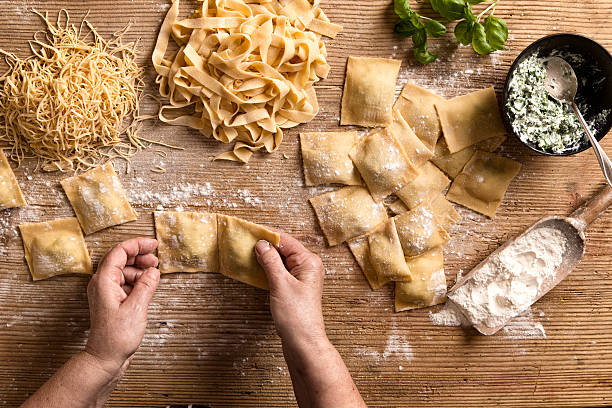
  5. Set the dough piece onto a countertop or work surface. Fold both short ends in to meet in the center, then fold the dough in half to form a rectangle (see photo above).
  6. Run the dough through the pasta roller three times on level 2, three times on level 3, and one time each on levels 4, 5, and 6.
  7. Lay half of the pasta sheet onto the floured baking sheet and sprinkle with flour before folding the other half on top. Sprinkle more flour on top of the second half. Every side should be floured so that your final pasta noodles won’t stick together.
  8. Repeat with remaining dough.
  9. Run the pasta sheets through the Pasta Cutter Attachment (pictured is the fettuccine cutter). Repeat with remaining dough. Cook the pasta in a pot of salted boiling water for 1 to 2 minutes.
  10. Enjoy!

Consumption

Italy is the country that eats the most pasta in the world. In 2022, the average Italian ate 23 kilograms of pasta per year.

Other countries that eat a lot of pasta include:

  • Tunisia: 17 kilograms per capita
  • Venezuela: 15 kilograms per capita
  • Greece: 12 kilograms per capita
  • Chile: 9.4 kilograms per capita
  • The USA: 8.8 kilograms per capita
  • Argentina and Turkey: 8.7 kilograms per capita each

Most Italians eat pasta every day. A typical portion is about a cup, and the meal includes a small portion of meat and a large portion of vegetables and salad.


Celebrating Pasta

World Pasta Day is celebrated on October 25th every year. The day celebrates the versatility, taste, and health benefits of pasta. World Pasta Day was established in 1995 by 40 pasta producers from around the world. The first celebration took place in Naples, Italy in 1998. Since then, the event has been held in different cities around the world.

The Italian Food Union organizes World Pasta Day. The day draws attention to the merits of pasta, including: Great taste, Healthfulness, Simple convenience.

0 Comments

Submit a Comment

Your email address will not be published. Required fields are marked *

Subscribe to our Blog to receive more content like this. Click here to subscribe.

Be sure to watch our shows on QVC+  or our YouTube channel

Give us your feedback on our Social Channels 

FacebookInstagramTik TokLinkedInPinterestTwitter  

National Peaches and Cream Day

National Peaches and Cream Day

National Peaches and Cream Day is celebrated annually in the United States. This day commemorates the day in 1869 when druggist Thomas H. Brewer mixed together the first batch of the delicious fruit combo of juicy peaches and creamy milk or cream. He called it "Cream Peach".
National Peaches and Cream Day is thought to have started in the early 1900s as a way to promote the dairy and fruit industries. Whatever the reason for its creation, we are sure glad that this day exists so that we can all enjoy some peach-y goodness!

Read More

National Vanilla Milkshake Day

National Vanilla Milkshake Day

National Vanilla Milkshake Day is celebrated on June 20 and it's all about celebrating the original vanilla milkshake. It's made by blending milk, ice cream, and vanilla for a classic style beverage.

The vanilla milkshake has an interesting history. In 1885, the term “milkshake” showed up in print for the first time. The word milkshake combines the word 'milk', from the Old English 'milc' or 'meoluc', and the word 'shake', from the Old English 'sceacan' meaning 'move quickly back and forth'. The concoction of cream, eggs, and whiskey was often served with other alcoholic tonics such as lemonades and soda waters. Who has been holding out on this recipe? Don’t worry, we have it for you here:

Read More

National Martini Day

National Martini Day

Today is National Martini Day. National Martini Day is thought to have started in the 1940s, when the popularity of the martini drink began to rise. It's likely that people began celebrating the day as a way to honor the classic cocktail.

The martini is believed to have originated in the United States in the late 1800s by a bartender in either New York or San Francisco, however no one is certain. It was created by mixing gin and vermouth, an Italian fortified wine. The earliest known martini recipe was found in the 1888 book, "The Bartender's Guide" by Jerry Thomas. The recipe called for one-third gin and two-thirds French vermouth with a dash of orange bitters.

Read More

International Picnic Day

International Picnic Day

Today is International Picnic Day. International Picnic Day is believed to have originated in the late 18th century when an open-air meal enjoyed by friends became popular among the upper classes in France. It is thought to have been started by King Louis XVI and Marie Antoinette. The trend quickly spread throughout Europe, and eventually around the world. Today, many countries celebrate International Picnic Day to commemorate this long-standing tradition.

Picnics originated in the late 1700s as a way for the upper classes in Europe to enjoy an outdoor meal with friends. These gatherings typically featured elaborate arrangements of food and décor, often with musicians or performers to entertain the guests. Picnics were a way to socialize and enjoy nature and good company.

Read More

National Apple Strudel Day

National Apple Strudel Day

Today is National Apple Strudel Day. National Apple Strudel Day was started by a group of pastry chefs in Austria in the late 1990s. They wanted to honor the country's traditional food, and they decided to dedicate a day to the celebration of the iconic dessert. The chefs chose this day, and the holiday has been celebrated ever since.

Strudel has been a staple of Austrian cuisine for centuries, and it remains a favorite today. The history of apple strudel dates back to the 16th century, when it became popular in Austria, Germany, and Hungary. The traditional strudel is filled with apples, raisins, cinnamon, and sugar and can be served as a dessert or a snack.

Read More

National Lobster Day

National Lobster Day

National Lobster Day was started by the Lobster Institute at the University of Maine in 1974. The Lobster Institute is a non-profit organization dedicated to research, education, and outreach of lobster and the lobster industry. The day was created to celebrate the lobster industry and the iconic seafood.

And as fate would have it, National Lobster Day is observed during the peak of the lobster season. In the United States, the peak of the season usually starts in late May and runs through late October or early November.

Read More

National Strawberry Shortcake Day

National Strawberry Shortcake Day

Today is National Strawberry Shortcake Day a holiday to honor the classic strawberry shortcake dessert and its place in American food culture.

Strawberry shortcake has a long and storied history. The dessert is believed to have its origins in Britain, where it was served as early as the 16th century.

The earliest known recipe for strawberry shortcake appears in the book The Accomplisht Cook by Robert May, which was published in 1685. This recipe is for a dessert made with a mixture of flour, butter, eggs, cream, and sugar, which is rolled out into a shortbread-like dough and then topped with strawberries and cream. The recipe was most likely an adaptation of the traditional British trifle.

Read More

National Cupcake Lovers Day

National Cupcake Lovers Day

National Cupcake Lovers Day began as an online celebration in 2009. It was created by the founders of Cupcake Lovers, a website dedicated to cupcake recipes, reviews, and more. Since then, it has grown into an international day of celebration, with people around the world celebrating the joy of cupcakes on the same day each year.


Were cupcakes originally made in cups?

Yes, cupcakes were originally made in individual molds, rather than muffin tins. The name "cupcake" comes from the fact that the batter was poured or dropped into cups or molds. The cakes were then baked in the oven, and after cooling, they were removed from the molds.

Read More

National Jerky Day

National Jerky Day

Today is National Jerky Day.

This holiday was created by the National Jerky Association in order to celebrate the popular snack. The goal was to bring together jerky lovers everywhere to celebrate the nutritious and delicious snack.

Jerky has been around since ancient times. It was first made by Native Americans and was used as a way to preserve meat. Native Americans would dry strips of meat over a fire or in the sun to make jerky. The meat would be cut into thin strips and then salted and spiced before being left to dry. This process allowed them to preserve the meat and keep it edible for long periods of time. As the meat dried, it would become tough and chewy.

Read More

Corn on the Cob Day

Corn on the Cob Day

The holiday of Corn on the Cob Day has been celebrated since at least the 1950's.

Corn, or maize, is a member of the grass family and is believed to have been domesticated in Mexico around 9,000 years ago. Corn was an important part of the diets of many Native American tribes, including the Iroquois, Algonquian, and Pueblo tribes. By the time of European colonization, corn had spread throughout the Americas and was cultivated extensively by many tribes. Corn was introduced to Europe by explorers in the 15th century, and by the 17th century, it had become a common crop in many parts of Europe.

Read More

Pin It on Pinterest