
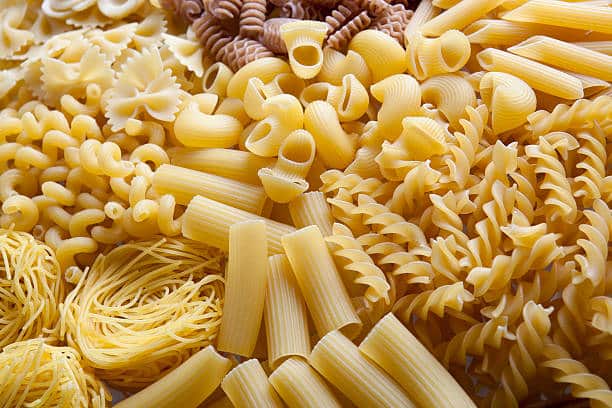
Today’s spotlight is on Pasta.
Pasta is a type of food made from a dough of wheat flour, water, and eggs. It’s formed into different shapes and then cooked by boiling or baking. Pasta is often associated with Italian cuisine. Pasta is a good source of energy and can provide fiber if it’s made from whole grain. Fiber can help with stomach problems and may help lower cholesterol.
Here are some types of pasta:
Spaghetti, Macaroni, Noodles, Lasagne, Ravioli, Linguine, Penne, Fusilli, Farfalle, Pappardelle, Orecchiette, Rigatoni, Trofie, Gigli.
Pasta can be categorized into five main types: long, short, sheet, filled, and dumpling.
Here are some examples of pasta:
- Spaghetti – Long, thin noodles that can be paired with many sauces.
- Penne – Cylinder-shaped pasta with ends cut at a bias.
- Farfalle – Bowtie-shaped pasta with a frilled edge.
- Fusilli – Thick, long spirals that are also called corkscrew pasta.
- Rigatoni – Large, tube-shaped pasta with ridged edges.
Other types of pasta include:
Macaroni, Maccheroncelli, Mafaldine, Maltagliati, Linguine, Mafalde, Pappardelle.
History
Pasta’s origins date back to the Shang Dynasty in China, which lasted from 1700–1100 BC. The first written references to pasta or noodles date back about 3200 years in Chinese texts. Pasta was also a part of the ancient Greek diet in the first millennium BC. Some say that Marco Polo brought pasta to Italy from China in the 13th century.
However, it’s more likely that Arab traders introduced pasta to Sicily in the 8th and 9th centuries. These traders carried dried strands of durum wheat and water for sustenance during long voyages. The first pasta factories appeared in Naples, where the climate was ideal for drying.
The earliest recorded pasta is testaroli, which is a dish from the southern Liguria and northern Tuscany regions of Italy. Testaroli is made from a batter that is cooked on a hot flat surface.
The earliest pasta shapes were simple sheets that were treated more like bread dough. The earliest forms of pasta that are now recognized by people around the world, such as linguine and spaghetti, were first produced in Italy in the ninth century.
Lasagne is one of the earliest known pasta shapes. It traces its origins to ancient Rome by way of ancient Greece. The ancient Etruscans, Romans, and Greeks in the peninsular called it “lagana”.
Food historians estimate that pasta took hold in Italy as a result of extensive Mediterranean trading in the Middle Ages. References to pasta dishes, such as macaroni, ravioli, gnocchi, and vermicelli, became more frequent across the Italian peninsula from the 13th century.
Dried pasta was first recorded in Sicily in the 12th century. It was ideal for transportation and storage. The first pasta factories were in Naples, where the climate was ideal for drying. Dried pasta became popular in the 1300s for its nutritional value and long shelf life. It was originally reserved for the elite but became a staple of the common man around the 17th century.
Here are some fun facts about pasta:
- The word “pasta” comes from the Italian word for paste, which is a combination of flour and water.
- The earliest pasta was similar to vermicelli, which means “little worms” in Italian.
- The word “spaghetti” comes from the Italian word spago, which means “string”.
- The earliest pasta was made from millet, a grain that has been used in East Asia longer than rice or wheat.
- There are more than 600 pasta shapes produced worldwide.
- There’s a shape for every sauce.
- Thomas Jefferson made pasta popular in America.
- October 25th is World Pasta Day.
- Al dente pasta tastes better and keeps you full longer.
- One cup of cooked pasta is the size of your fist.
- Italians eat the most pasta.
- In 2022, a survey showed that Italian citizens ate an average of 23 kilograms of pasta a year.
Here is a Pasta Recipe for you to Try:
Ingredients:
- 1 pound bucatini , spaghetti or other favorite noodle
- 1 garlic cloves
- ½ cup toasted pine nuts
- 2 cups fresh basil leaves , washed and stemmed and finely packed
- ½ cup olive oil
- ½ cup fresh grated Parmesan cheese plus more for garnish
- ½ lemon , juiced
- ½ teaspoon kosher salt
- fresh ground black pepper
- Cherry tomatoes
Instructions:
- Cook the spaghetti or other pasta in a large pot of salted boiling water according to package directions or until al dente. Drain the pasta and reserve 1 cup of cooking water.
- While pasta is cooking, add the roughly chopped garlic, toasted pine nuts, and finely grated parmesan cheese to a food processor and process until smooth. Then, add in the basil. Pulse a few times until chopped then let it run as you drizzle the olive oil into the processor as it runs until emulsified. Season with kosher salt and freshly ground black pepper, give a squeeze of lemon juice, and whiz again until combined. Taste for seasoning and adjust to your liking.
- Toss the hot pasta with the pesto in a large bowl and add reserved pasta water ¼ cup at a time or until saucy. Top with the cherry tomatoes and season with more salt and pepper if desired and garnish with more parmesan cheese.
- Enjoy!
Consumption
- The world consumes more than 6 billion pounds of pasta each year.
- The United States consumes 5.95 billion pounds of pasta per year.
- The average American consumes approximately 20 pounds of pasta annually.
- This makes it the 6th highest food per capita in the country.
The United States produces 4.4 billion pounds of pasta annually, making it the second largest pasta-producing nation. Americans consume 24% of the global consumption of pasta, the largest of any country in the world.
Celebrating Pasta
There are two days to celebrate pasta:
- National Pasta Day – Celebrated on October 17th, this day is for Americans to celebrate their love of pasta. You can celebrate by cooking your favorite pasta dishes.
- World Pasta Day – Celebrated on October 25th, this day is organized by the Italian Food Union. The first celebration was in Naples, Italy in 1998. Since then, it’s been held in different cities around the world.
The first celebration of World Pasta Day was in 1995, when 40 international pasta makers gathered in Rome for the World Pasta Congress. Let us know in the comments how you celebrate pasta and what your favorite pasta is.
0 Comments