
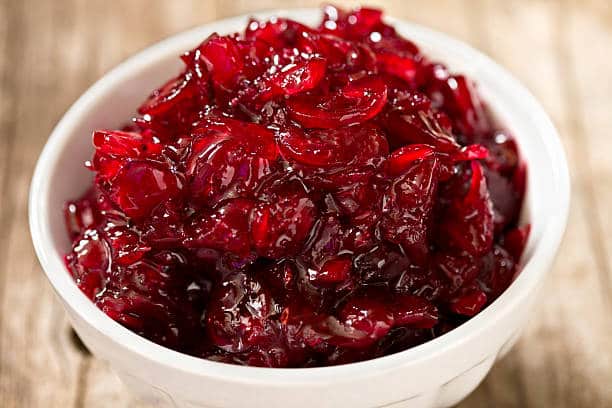
Today’s Spotlight is on Cranberry Relish.
Cranberry sauce or cranberry jam is a sauce or relish made out of cranberries, commonly served as a condiment or a side dish with Thanksgiving dinner in North America and Christmas dinner in the United Kingdom and Canada.
Cranberry sauce is a Thanksgiving staple. It’s a crucial part of the Thanksgiving meal because its tart acidity cuts through the heavy turkey, gravy, stuffing, and mashed potatoes. Cranberries are not overly sweet. Their tartness pairs well with the more bland-tasting turkey. Tannins in the cranberry’s skin bind with protein and fats, such as turkey, gravy, and buttery mashed potatoes.
Cranberry sauce became popular in the late 17th century. By the 1860s, it was so ingrained as an American dish that General Ulysses S. Grant reportedly ordered that cranberry be served to soldiers as part of their Thanksgiving meal.
Cranberries are a Christmas tradition because they’re a recent discovery. Cranberries are one of the only commercially grown fruits native to America. They contain a natural preservative that helps them store well for months without deteriorating.
History
Cranberries have been consumed at Thanksgiving dinners since the first feast prepared by the Pilgrim Fathers. Their Christmas casting was a later add-on. Cranberries were introduced to early settlers and sailors. By 1689, they became an important part of Thanksgiving celebrations.
Cranberry relish is thought to have originated in New England in the early 1900s. The recipe wasn’t widely known until the early 1950s, when it was broadcast on the radio program The Splendid Table.
The recipe for cranberry relish was first published in a 1959 New York Times clipping. Susan Stamberg’s mother-in-law got the recipe from the clipping. In 1993, Stamberg called Craig Claiborne to apologize for not crediting him. Claiborne replied, “Susan, I am simply delighted”.
The first recipe for cranberry sauce was published in American Cookery by Amelia Simmons in 1796. The recipe called for serving roast turkey with cranberry sauce and boiled onions.
The first canned cranberry sauce was created in 1912 by cranberry growers Marcus L. Urann and Elizabeth Lee. The sauce was made by boiling bruised berries from the bog. The jellied cranberry sauce “log” became available nationwide in 1941.
Today, 68% of Americans say they love the taste of cranberry sauce. Another 15% just love the way it jiggles.
Here are some fun facts about cranberries:
- It takes 200 cranberries to make one can of cranberry sauce.
- There are 440 cranberries in a one-pound bag.
- It takes 4,400 cranberries to make one gallon of cranberry juice.
- One cup of cranberries has 50 calories.
- Cranberries are native to the swamps and bogs of northeastern North America.
- The cranberry gets its name from Dutch and German settlers who called it the “crane berry” since the flowers on cranberry vines resemble the head of a crane.
Here is a Cranberry Relish Recipe for you to try:
Ingredients:
- 12 ounces fresh cranberries
- 1 apple cored and cut into quarters.
- 1/2 orange seeds removed, and end trimmed off.
- 1 cup granulated sugar
- fresh cranberries and orange zest for garnish optional
Instructions:
- Place the cranberries in a food processor and pulse until coarsely chopped. Transfer the cranberries to a bowl.
- Add the apple to the food processor and pulse until finely chopped. Add the apple to the bowl with the cranberries.
- Add the orange to the food processor and pulse until finely chopped. Add the orange to the bowl with the cranberries and apples.
- Add the sugar to the bowl and stir to combine. Cover the bowl and refrigerate for at least one hour or up to 3 days.
- Serve, garnished with cranberries and orange zest if desired.
- Enjoy!
Consumption
Americans eat 5,062,500 gallons of jellied cranberry sauce every holiday season. 76% of Americans buy cranberry sauce, and the rest make it themselves. Americans eat about 400 million pounds of cranberries every year. 20% of cranberries are consumed during the week of Thanksgiving.
Americans buy about 75 million cans of cranberry sauce each year. 85% of those cans are sold between Thanksgiving and Christmas. Ocean Spray, the largest producer of cranberry products in the U.S., produces about 79 million cans of cranberry sauce each year. 85% of those cans are sold during the Thanksgiving and Christmas holidays. Ocean Spray has roughly 70% of the market share.
According to one poll, nearly 50% of Americans find canned cranberry sauce “disgusting”. However, 63% of all respondents said that they liked cranberry sauce.
Cranberry sauce Nutrition Facts
Sources include: USDA
Amount Per:
- 1 slice (1/2″ thick, approx 8 slices per can) (57 g)
- 1 slice (1/2″ thick, approx 8 slices per can) (57 g)
- Calories 86
% Daily Value*
Total Fat 0.1 g 0%
Saturated fat 0 g 0%
Cholesterol 0 mg 0%
Sodium 17 mg 0%
Potassium 15 mg 0%
Total Carbohydrate 22 g 7%
Dietary fiber 0.6 g 2%
Sugar 22 g
Protein 0.1 g 0%
Vitamin C 1%
Calcium 0%
Celebrating Cranberry Relish
National Cranberry Relish Day is celebrated on November 22nd.
It’s a day to celebrate cranberry relish as a seasonal delight. The day is inspired by Susan Stamberg’s “Mama Stamberg’s Relish” recipe. Stamberg is an NPR host who shares her mother-in-law’s cranberry relish recipe with listeners every Thanksgiving. The day is celebrated as a precursor to Thanksgiving. It honors the American pairing of cranberries and Thanksgiving. Cranberries are one of three surviving Native American fruits.
Cranberry relish is a traditional part of many families’ Thanksgiving dinners. It can be served with roasted meats, cream cheese, or vanilla yogurt. It can also be used as a topping for pancakes or waffles. Let us know in the comments if you are a fan of Cranberry Relish?
0 Comments