
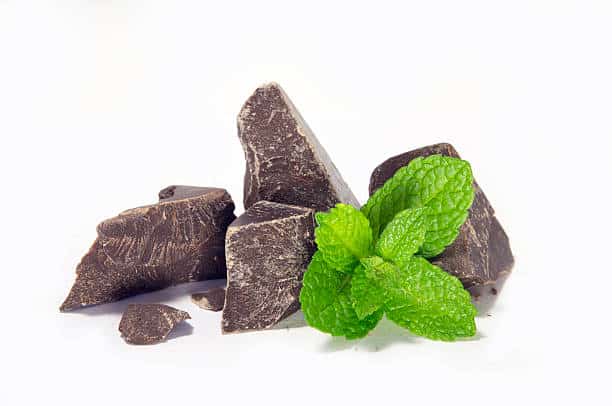
Today’s Spotlight is on Chocolate Mint.
Chocolate mint is a hybrid variety of the mint plant that has a chocolate-like fragrance and flavor. It’s a cultivar of peppermint, meaning it’s a strain cultivated for specific desirable characteristics. In the case of chocolate mint, these characteristics include its brown stems and aroma.
Chocolate mint is native to Europe and the Middle East. It’s a perennial herb that can grow up to 3 feet in height. It can survive deep frosts if well mulched, going dormant over winter.
Chocolate mint has subtle notes of cocoa and vanilla that mix with a traditional spicy mint finish. The fragrant oval green leaves are usually harvested from late spring to early fall. The leaves have a minty taste.
Chocolate mint is commonly grown for its edible qualities, although it does have ornamental merits as well. It can be added to an after-dinner green salad as a palate cleanser that will actually aid in food digestion.
Chocolate mint is also known to repel ants, aphids, cabbage flies, and mice. It can be grown around the foundation of your home or sprinkled in your pantries and closets to keep pests from invading your home.
Chocolate mint is incredibly invasive, so it’s best not to plant it directly into the ground or anywhere near the ground.
Chocolate mint is commonly grown for its edible qualities. Here are some ways you can use chocolate mint:
- Drinks – Add fresh sprigs or dried crushed flakes to hot chocolate. You can also use chocolate mint in cocktails, ice cubes, and popsicles.
- Desserts – Add chocolate mint to ice cream, mousse, and custards. You can also use it in brownies.
- Tea – Dry the leaves and flowers to make tea, or steep fresh leaves on their own. Chocolate mint tea is naturally caffeine-free and gluten-free.
- Chocolate mint has similar medicinal actions as peppermint and spearmint. It can be used to calm overheated conditions and to soothe digestion.
Chocolate mint has a strong minty taste, plus a presence or bouquet of chocolate, and texture is crunchy and succulent. The aroma has been compared to Andes mints.
History
Chocolate mint is named for its color and scent rather than its taste, according to some sources. Others disagree. Chocolate mint is a cultivar of peppermint, a strain cultivated specifically for a few desirable characteristics. In the case of chocolate mint, these characteristics include the pretty brown hue of its stems.
Historians believe Europeans were the first to combine chocolate and mint after traveling to South America. The earliest archaeological evidence of cacao comes from Ecuador and dates back to 3,500 BCE. In Mexico and Central America, vessels with cacao residues date to as early as 1,900 BCE.
The history of chocolate can be traced to the ancient Maya, and even earlier to the ancient Olmecs of southern Mexico. Cacao was domesticated at least 4,000 years ago, first in the Amazon basin and then in Central America.
Baskin Robbins cites Mint Chocolate Chip as being one of the original 31 flavors when they began operations in 1945. Howard Johnson’s restaurants were serving the flavor by the early 1950s, which would become a common flavor into the 1960s and 70s.
The combination of chocolate and mint has a long history:
- Europeans: When Europeans brought cacao beans back to Europe, they used mint to improve the flavor of chocolate drinks.
- Hot drinks: Europeans mixed mint, cinnamon, and other sweet ingredients into hot drinks to combat the strong taste of dark chocolate.
- Chocolate mints: Huylers, a New York chain store, was one of the first mass producers of chocolate mints. Girl Scouts popularized the snack in the 1950s.
- York Peppermint Patties: Invented in Pennsylvania in 1940.
- Mint chocolate chip ice cream: Invented in 1973 by culinary student Marilyn Ricketts.
Other chocolate mint pairings include:
- Pearson’s Mint Patties (Minnesota, 1950)
- After Eight Mints (UK, 1962)
- Cooky-Mint (1939)
- Frangos (Seattle, Washington, 1918)
Here are some more fun facts about chocolate mint:
- Chocolate mint can grow up to 3 feet tall and 3 feet wide.
- Chocolate mint can live for up to 10 years under ideal conditions.
- Chocolate mint is rich in vitamins A and C and contains trace amounts of manganese.
- Chocolate mint’s essential oils can help with nausea.
- The combination of chocolate and mint can help produce serotonin and dopamine.
- Mint is a powerful and aromatic herb that can aid in digestion and freshen breath.
- Mint gets its name from Menthe, a Greek mythical character.
- There are over 30 varieties of mint.
- Ancient Romans and Greeks used mint to flavor cordials and fruit compotes, and for baths and perfumes.
- Ancient Hebrews used to scatter mint over the synagogue floor for its scent.
Here are some recipes that use chocolate mint:
- Chocolate mint leaves – This recipe uses dark chocolate, avocado oil, stevia glycerite, and fresh mint leaves.
- Chocolate peppermint bars – This recipe uses peppermint extract, bittersweet chocolate, confectioners’ sugar, heavy cream, and unsalted butter.
- Classic mint chocolate brownies – This recipe melts chocolate chips and butter in a saucepan or microwave, and then pours it over a mint layer.
- Mint chocolate cake – This recipe uses fresh mint, vegetable shortening, and unsalted butter.
Other chocolate mint recipes include:
- Mint chocolate mousse cupcakes
- Homemade thin mint cookies
- Mint Oreo cupcakes with chocolate Oreo frosting
- Better than thin mints grasshopper poke cake
- Chocolate mint brownie bark
- Dark chocolate mint truffle Oreo fudge
- Chocolate marshmallow mint cookies
- Chocolate peppermint cheesecake bites
- Milk chocolate peppermint bark
- Dark chocolate peppermint fudge
- Chocolate covered peppermint patties.
Celebrating Chocolate Mint
February 19 has been set aside as National Chocolate Mint Day. It a good time to experience perhaps something new. Let us know in the comments if you have ever tried chocolate mint.
0 Comments