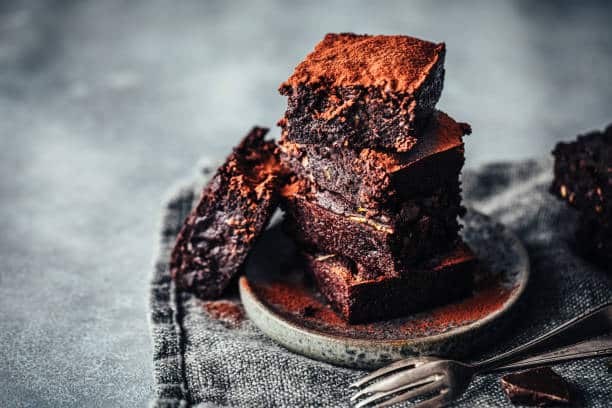
Celebrating Brownies

Feb 9, 2026 | Food Blog

Today’s spotlight is on brownies.

A brownie is a baked chocolate confection.

It’s an American dessert or snack that’s named after the color brown. Brownies are often described as a cross between a cake and a cookie. They’re baked without baking powder, so they’re thicker than other cakes.

A chocolate brownie, or simply a brownie, is a chocolate baked confection. Brownies come in a variety of forms and may be either fudgy or cakey, depending on their density. Brownies often, but not always, have a glossy “skin” on their upper crust.

Brownies can taste fudgy, rich, and sweet. They can also taste malty, earthy, and bitter. Texture Brownies can be cakey, fudgy, or chewy. Cakey brownies are light and airy. Fudgy brownies are dense and gooey. Brownies can taste like chocolate. Some brownies have a deep chocolate flavor. Others have a fudgy taste. Other flavors Brownies can have other flavors, like: Chocolate chips, Walnuts, Malty, Earthy, Blondie.


Other characteristics Brownies can have:

  • Density: Brownies can be fudgy or cakey, depending on their density.
  • Crust: Brownies often have a glossy “skin” on their upper crust.
  • Size: Brownies are small, flat biscuits or cakes.
  • A crackled skin on top
  • A slightly crisp edge
  • A great texture
  • A tempting aroma


Other information

  • Brownies are not classified as cakes.
  • Brownies are classed as finger food, so they’re categorized as a cookie bar (in America).


History

Brownies are thought to be of US origin. Brownies were developed in the United States in the late 19th century. They were popularized in the first half of the 20th century. No one can agree on exactly how brownies were created but regardless, I am glad they are here.

Theories about the invention of brownies include:

  • The most popular theory is that a housewife in Bangor, Maine forgot to add baking powder to a chocolate cake she was making.
  • A Chef accidentally added melted chocolate.
  • Another theory is that a chef accidentally added melted chocolate into biscuit dough.
  • Another theory is that a cook forgot to add flour to the batter while baking cake.

Another compelling theory is that the first brownie was created in the Palmer House pastry kitchen in 1892 for the Columbian Exposition World’s Fair in Chicago. Bertha Palmer, the wife of Palmer hotel owner Potter Palmer, was president of the Ladies Board for Managers for Exposition. She directed Palmer House pastry chefs to come up with a recipe for a dessert that would be easy to transport in boxed lunches at the Women’s Pavilion.

Earliest known published recipes for a modern style chocolate brownie:

  • Home Cookery: (1904, Laconia, NH)
  • Service Club Cookbook: (1904, Chicago, IL)
  • The Boston Globe: (April 2, 1905, p. 34)
  • Fannie Farmer’s cookbook: (1906)

The name “brownie” derives from their color (brown) and from the mythical pixie-like characters common in children’s stories from the same time period.


Here are some fun facts about brownies:

  • Brownie recipe: The classic brownie recipe has only five ingredients: butter, sugar, chocolate, eggs, and flour.
  • Brownie texture: Brownie texture depends on the ratio of flour to fat (chocolate and butter). For example, fudgy brownies have more chocolate and butter and less flour than cakey brownies.
  • Brownie flavors: Some brownie flavors include walnut, Nutella, peanut butter, cream cheese, double chocolate, and chocolate and coffee.
  • Brownie mix-in: Walnuts are the most popular brownie mix-in.


Here is a Brownie Recipe for you to try:

Ingredients:

  • 5 tablespoons (71 grams) unsalted butter
  • 1 1/4 cups (249 grams) granulated sugar
  • 2 large eggs plus 1 egg yolk, cold
  • 1 teaspoon vanilla extract
  • 1/3 cup vegetable oil
  • 3/4 cup (75 grams) unsweetened cocoa powder
  • 1/2 cup (63 grams) all-purpose flour
  • 1/8 teaspoon baking soda
  • 1 tablespoon cornstarch
  • 1/4 teaspoon salt
  • 3/4 cup (128 grams) semisweet chocolate chips


Instructions:

  1. Preheat the oven to 325°F. Line a 8 by 8-inch pan with foil or parchment paper and spray with nonstick cooking spray.
  2. In a microwave safe bowl, add the butter and sugar. Microwave for about 1 minute, or until the butter is melted. Whisk in the eggs, egg yolk, and vanilla. Stir in the oil and cocoa powder.
  3. With a rubber spatula, stir in the flour, baking soda, cornstarch, and salt until combined. Stir in the chocolate chips.
  4. Spread the brownie batter evenly into the prepared pan. Place in the oven and bake for 30 minutes, or until the brownies are set and a cake tester inserted into the center has moist crumbs attached. Do not overcook. Let cool completely before cutting and serving.
  5. Enjoy!


Consumption

According to a Betty Crocker Brownie Survey, Americans eat about 4 billion brownies a year. However, a Pinterest post says that Americans eat approximately 1.5 billion brownies per year.

Here are some other brownie statistics:

  • In 2020, 166.8 million Americans used dry brownie mixes.
  • On average, brownies are consumed 2.04 times every year.
  • A box of brownies can make 8 to 100 pieces.


Celebrating Brownies

Brownies are certainly something to celebrate. There are a few holidays dedicated to celebrating brownies.

Brownie holidays include:

  • National Brownie Day is on December 8.
  • National “Have a Brownie” Day is on February 10.

Here are some ways to celebrate National “Have a Brownie” Day:

  • Bake brownies: Make your own brownies or use a pre-made mix.
  • Visit a local bakery: Get a brownie treat from a local bakery.
  • Throw a brownie party: Invite friends over for a brownie party.
  • Make brownie kabobs: Create brownie kabobs.
  • Create a scavenger hunt: Create a brownie-themed scavenger hunt.

Let us know in the comments how you celebrate brownies, any time of the year.

0 Comments

Submit a Comment

Your email address will not be published. Required fields are marked *

Subscribe to our Blog to receive more content like this. Click here to subscribe.

Be sure to watch our shows on QVC+  or our YouTube channel

Give us your feedback on our Social Channels 

FacebookInstagramTik TokLinkedInPinterestTwitter  

National Bratwurst Day

National Bratwurst Day

Today’s Spotlight is on Bratwurst.
Bratwurst is a type of German sausage, also known as a "brat". It's typically made from pork and veal, but can also be made with beef, or any combination of meat. Bratwurst has a smooth texture, pale color, and mild flavor. It can be seasoned with salt, white pepper, nutmeg, lemon peel, marjoram, caraway, and garlic. They are often consumed for breakfast in German cities.
Bratwurst is prepared and stored fresh, so it doesn't have a long shelf life like a sausage can. It's usually grilled or fried in a pan

Read More

National Rum Day

National Rum Day

Today’s spotlight is on Rum.
Rum is a liquor that is distilled from sugarcane or sugarcane byproducts such as molasses or sugarcane juice. The sugarcane is fermented and then distilled, producing a clear liquid that is often aged in oak barrels. This aging process gives the final product its characteristic color and flavor.
Rum has a typical alcohol concentration of 40% ABV. Some rum is "overproof," meaning that it has an alcohol concentration of at least 57.5% ABV. Most overproof rum exceeds this minimum, usually reaching 75.5% ABV, which is equivalent to 151 proof.

Read More

National Lemon Meringue Pie Day

National Lemon Meringue Pie Day

Today’s spotlight is on Lemon Meringue Pie.
Lemon meringue pie is a dessert pie consisting of a shortened pastry base filled with lemon curd and topped with meringue. Lemon meringue pie has a buttery, flaky, and crispy pie crust. The filling is jelly-like, translucent, and smooth, and is yellow due to the lemon juice, lemon rind, butter, and egg yolk. The pastry is thin and flat due to being rolled out using a rolling pin. During baking, the edges turn golden brown.

Read More

National Filet Mignon Day

National Filet Mignon Day

Today’s Spotlight is on Filet Mignon.
Filet mignon is a cut of beef from the small end of the tenderloin, or psoas major, which is located near the spine of the cow. The tenderloin runs along both sides of the spine and is usually butchered as two long snake-shaped cuts of meat. The tenderloin is sometimes sold whole. The tenderloin is the most well-known muscle on a cow and is also the most tender. Filet mignon is a lean cut of beef, which means you'll enjoy a fork-tender steak without much fat or connective tissue.
Filet mignon is one of the most tender and milder cuts of steak, making it a favorite among steak lovers. It's also one of the most expensive cuts of steak, due to its prized texture and that it's only about 2 to 3% of the total animal.

Read More

National Kool-Aid Day

National Kool-Aid Day

Today’s spotlight is on the flavored water treat known as Kool-Aid.
Kool-Aid is an American brand of flavored drink mix. It's typically made with sugar, water, and artificial colorings. The powder form was created in 1927 by Edwin Perkins based on a liquid concentrate called Fruit Smack. Kool-Aid is owned by Kraft Heinz, based in Chicago, Illinois.

Read More

National Smores Day

National Smores Day

Today’s spotlight is on a fireside favorite – S’mores.
S'mores are a confection made of toasted marshmallows and chocolate sandwiched between two graham crackers. They are a traditional camping snack that are popular in the United States and Canada. S'mores are traditionally cooked over a campfire and warmed over an open flame until melted and gooey.

Read More

National Rice Pudding Day

National Rice Pudding Day

Today’s Spotlight is on Rice Pudding.
Rice pudding is a creamy mixture of rice and milk and other ingredients such as cinnamon, vanilla and raisins. It's cooked until it's thick and soft. It can be sweet or savory. Variants are used for either desserts or dinners. When used as a dessert, it is commonly combined with a sweetener such as sugar. American rice pudding often uses leftover rice and can be baked in the oven or cooked on the stove.

Read More

Sneak Some Zucchini onto Your Neighbor’s Porch Day

Sneak Some Zucchini onto Your Neighbor’s Porch Day

Today’s Spotlight is on Zucchini (and your neighbors)!
There are a lot of odd holidays but this one has got to be one of my favorites. Sneak Some Zucchini Onto Your Neighbor's Porch Day is celebrated on August 8th every year. The holiday encourages people to sneak their extra zucchinis onto the porches of unsuspecting community members. The day celebrates the bounty of the summer's zucchini harvest by demonstrating generosity, desperation, and cunning.

Read More

Raspberries and Cream Day

Raspberries and Cream Day

Today’s food spotlight is aimed at Raspberries and Cream.
Raspberries and cream is a simple treat that combines fresh, ripe berries with sweetened, hand-whipped cream. It's a good option for anyone with a sweet tooth.
Raspberries are the fruit of several shrubs in the rose family. They are usually red but can also be black or yellow. When ripe, they separate from the receptacle and are rounder and smaller than blackberries. The name "raspberry" may have come from "raspise", which means "a sweet rose-colored wine". The name may also be related to the Old English word "rasp", which means "rough berry".

Read More

National Root Beer Float Day

National Root Beer Float Day

Today’s spotlight is on Root Beer Floats!
The root beer float is traditionally made with vanilla ice cream and root beer, but it can also be made with other ice cream flavors. It's sometimes referred to by the nicknames “brown cow” or “black cow”. Root beer floats were a popular dessert drink in 1950s diners.

Read More

Pin It on Pinterest