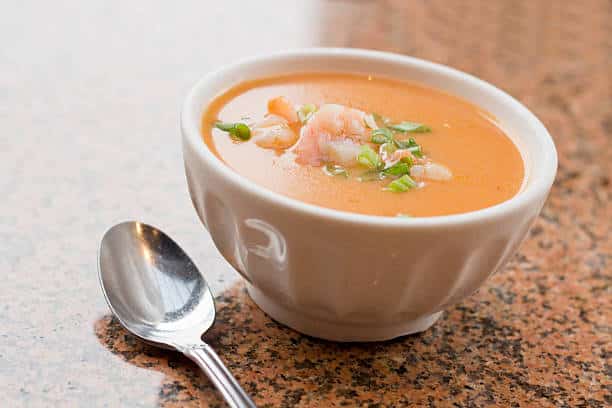
Celebrating Seafood Bisque

Oct 18, 2025 | Food Blog

Today’s Spotlight is on Seafood Bisque.

A bisque is a French style of soup that is made from crustaceans, such as lobster, crab, shrimp, and crayfish; their shells are used to make a stock and the meat is incorporated into the finished dish. So, in a way, calling the soup a “seafood bisque” is somewhat redundant.

The main characteristic of a bisque is that it is smooth and has a velvety texture. Most recipes will include wine and cream to give it its signature flavor and texture. But it’s not merely the choice of ingredient that makes bisque different from other types of soups. It’s also the technique for utilizing that ingredient, including the parts you can’t eat, making a bisque what it is.

Bisque vs. Chowder

Although bisque and chowder are both cream-based soups and most often feature seafood, it is their consistency that defines them and makes them quite different from each other. Whereas a bisque is smooth, a chowder is chunky, chock full of hearty pieces of ingredients such as potato and clams or corn. We also see bacon as an important ingredient in a chowder when it would not be featured in a bisque.


History

Seafood bisque has been around for centuries. Seafood bisque is a creamy, highly seasoned soup that originated in 16th century France.  The word “bisque” comes from the French word “biscuit” which generally referred to twice-baked bread.  Food historians believe that bisque was originally a fisherman’s dish that was made with whatever shellfish was available.

The French boatmen would use shrimp, crab, and even lobster. The initial version of bisque was thicker and known as pottage. The main ingredient was crayfish, which is also known as the American rock lobster. Traditional French chefs define bisque as a thick, creamy soup made with shellfish and thickened by a paste made from their shells. Julia Child popularized lobster bisque in the United States. Her recipe uses both the shells of the lobster and rice to thicken the bisque. The name “Bisque” is likely derived from Biscay, as in the Bay of Biscay.


Here are some fun facts about seafood bisque:

  • The word “bisque” comes from the French phrase “bis cuites” which means “twice cooked”. The shells in bisque are cooked twice.
  • The method for cooking bisque reflects this, as it must be cooked twice, the first time with stock and again, with cream.
  • Authentic recipes for bisque actually ground the shells of the crustacean into a fine paste, using that to thicken the soup. Nowadays, it is more common to use rice as a thickener.
  • The French colonization of Louisiana in the early eighteenth century led to strong French influence in creole and cajun cuisine. In the gulf of Louisiana, where seafood (particularly shellfish like shrimp and crawfish) is plentiful, this version of the French classic is made with shrimp.
Lobster Bisque with Toasted Baguette Slices

Here is a Seafood Bisque Recipe for you to Try:

Ingredients:

  • 1 lb crawfish meat (or more shrimp and crab if unable to find)
  • 5 lb shrimp meat
  • 1/2 lb crab meat
  • 1 lb unsalted butter
  • 1 bunch green onions (white and green parts), finely chopped.
  • 1/2 cup All-Purpose flour
  • 1 qt heavy cream
  • 1 qt half and half
  • 1 16oz can creamed corn.
  • 1 1/2 tsp Tony’s Cajun Seasoning
  • 1 tsp Old Bay Seasoning
  • 1 tsp salt, to taste
  • 2 tsp freshly ground black pepper.
  • 1 tsp cayenne pepper


Instructions:

  1. In a large pot, melt butter and sauté onions.
  2. Sprinkle the flour over the butter and onions and stir until flour is fully incorporated.
  3. Add remaining ingredients and simmer for 40 minutes, stirring frequently.
  4. Serve with white wine and a good loaf of sour dough bread.


Consumption

According to Tastewise, the average person eats lobster bisque 1.19 times per year.

Seafood bisque is a good source of nutrients, including:

  • Lean protein
  • Vegetables
  • Omega-3 fatty acids
  • Zinc

Seafood bisque is also relatively low in insulin-spiking carbohydrates.

Here are some nutritional facts for lobster bisque:

  • 129 calories per 248 g serving.
  • 4 g of fat
  • 13 g of protein
  • 2g of carbohydrate
  • 20% vitamin A
  • 8% vitamin C
  • 10% calcium
  • 4% iron


Celebrating Seafood Bisque

National Seafood Bisque Day is celebrated on October 19. The day celebrates the delicious and comforting soup. Let us know in the comments about your favorite Seafood Bisque.

0 Comments

Submit a Comment

Your email address will not be published. Required fields are marked *

Subscribe to our Blog to receive more content like this. Click here to subscribe.

Be sure to watch our shows on QVC+  or our YouTube channel

Give us your feedback on our Social Channels 

FacebookInstagramTik TokLinkedInPinterestTwitter  

National Bacon Lovers Day

National Bacon Lovers Day

Today’s Spotlight is on Bacon.
By definition, bacon is a type of salt-cured pork that comes from a pig. It is typically made from the belly or less fatty parts of the back. Bacon is often smoked after being cured. Bacon can be eaten on its own as a side dish, or used as an ingredient in dishes like sandwiches, salads, soups, and even sweets. It can also be used as a flavoring or accent, such as in bacon bits in a salad.

Read More

National Soft Serve Ice Cream Day

National Soft Serve Ice Cream Day

Today’s Spotlight is on Soft Serve Ice Cream.
Soft serve is a frozen dessert that is similar to ice cream but is softer and less dense. Soft serve is made by churning air into the ice cream mixture as it freezes, giving it a lighter and creamier texture. Soft serve is at least 50% air, while ice cream is between 30% and 50% air.
Soft serve also contains less milk fat than hard ice cream, often 3% to 6%. Hard ice cream is more likely to contain other flavorings, like pieces of chocolate, fruit, nuts, and other sweets. The final product is formed at retail, made from a powdered or liquid premix.

Read More

National Potato Day

National Potato Day

Today’s spotlight is on the Potato.
A potato is a starchy tuber, or underground stem, that grows under the ground. The part of the potato that people eat is the tuber, which can be round or oval and have small white roots called "eyes". The size and color of the potato's skin can vary by variety, and can be white, yellow, or purple.
Potatoes are a root vegetable, which refers to any underground part of a plant that is eaten by humans. They are native to the Andes Mountains in South America and have been grown for thousands of years. Potatoes are a staple food in many countries around the world and are used in a wide variety of dishes.

Read More

National Ice Cream Pie Day

National Ice Cream Pie Day

Today’s Spotlight is shining on Ice Cream Pie.
Ice cream pie is a frozen dessert made with a sweet crust, creamy ice cream, and whipped cream topping. The crust can be made from a standard pastry, crumbled cookies, or graham cracker. The ice cream can be filled with your favorite flavors and topped with hot fudge or more whipped cream.

Read More

Celebrate National Cheeseburger Day

Celebrate National Cheeseburger Day

Today’s Spotlight is on the Cheeseburger.
A cheeseburger is a grilled sandwich made of a patty of ground meat, topped with a slice of cheese, and placed between two halves of a bun. The patty is often seasoned with chopped onions, spices, or breadcrumbs before cooking. The cheese is added near the end of the cooking time. The burger is then placed in a bun and topped with condiments like lettuce, tomato slices, onion slices, pickles, and ketchup. The bun should be slightly crunchy on the outside and soft inside. The cheese should be melting over the meat.

Read More

National Vanilla Custard Day

National Vanilla Custard Day

Today’s Spotlight is on Vanilla Custard.
Custard is a culinary preparation made with milk or cream, egg yolks, sugar and vanilla. Depending on its consistency, custard can be served on its own or used as a filling for other desserts or dessert sauce. It can be served warm or cold and is often combined with fruits and cookies to create other dessert dishes. Vanilla custard contains egg yolks which gives it a yellow color.

Read More

National Bratwurst Day

National Bratwurst Day

Today’s Spotlight is on Bratwurst.
Bratwurst is a type of German sausage, also known as a "brat". It's typically made from pork and veal, but can also be made with beef, or any combination of meat. Bratwurst has a smooth texture, pale color, and mild flavor. It can be seasoned with salt, white pepper, nutmeg, lemon peel, marjoram, caraway, and garlic. They are often consumed for breakfast in German cities.
Bratwurst is prepared and stored fresh, so it doesn't have a long shelf life like a sausage can. It's usually grilled or fried in a pan

Read More

National Rum Day

National Rum Day

Today’s spotlight is on Rum.
Rum is a liquor that is distilled from sugarcane or sugarcane byproducts such as molasses or sugarcane juice. The sugarcane is fermented and then distilled, producing a clear liquid that is often aged in oak barrels. This aging process gives the final product its characteristic color and flavor.
Rum has a typical alcohol concentration of 40% ABV. Some rum is "overproof," meaning that it has an alcohol concentration of at least 57.5% ABV. Most overproof rum exceeds this minimum, usually reaching 75.5% ABV, which is equivalent to 151 proof.

Read More

National Lemon Meringue Pie Day

National Lemon Meringue Pie Day

Today’s spotlight is on Lemon Meringue Pie.
Lemon meringue pie is a dessert pie consisting of a shortened pastry base filled with lemon curd and topped with meringue. Lemon meringue pie has a buttery, flaky, and crispy pie crust. The filling is jelly-like, translucent, and smooth, and is yellow due to the lemon juice, lemon rind, butter, and egg yolk. The pastry is thin and flat due to being rolled out using a rolling pin. During baking, the edges turn golden brown.

Read More

National Filet Mignon Day

National Filet Mignon Day

Today’s Spotlight is on Filet Mignon.
Filet mignon is a cut of beef from the small end of the tenderloin, or psoas major, which is located near the spine of the cow. The tenderloin runs along both sides of the spine and is usually butchered as two long snake-shaped cuts of meat. The tenderloin is sometimes sold whole. The tenderloin is the most well-known muscle on a cow and is also the most tender. Filet mignon is a lean cut of beef, which means you'll enjoy a fork-tender steak without much fat or connective tissue.
Filet mignon is one of the most tender and milder cuts of steak, making it a favorite among steak lovers. It's also one of the most expensive cuts of steak, due to its prized texture and that it's only about 2 to 3% of the total animal.

Read More

Pin It on Pinterest