
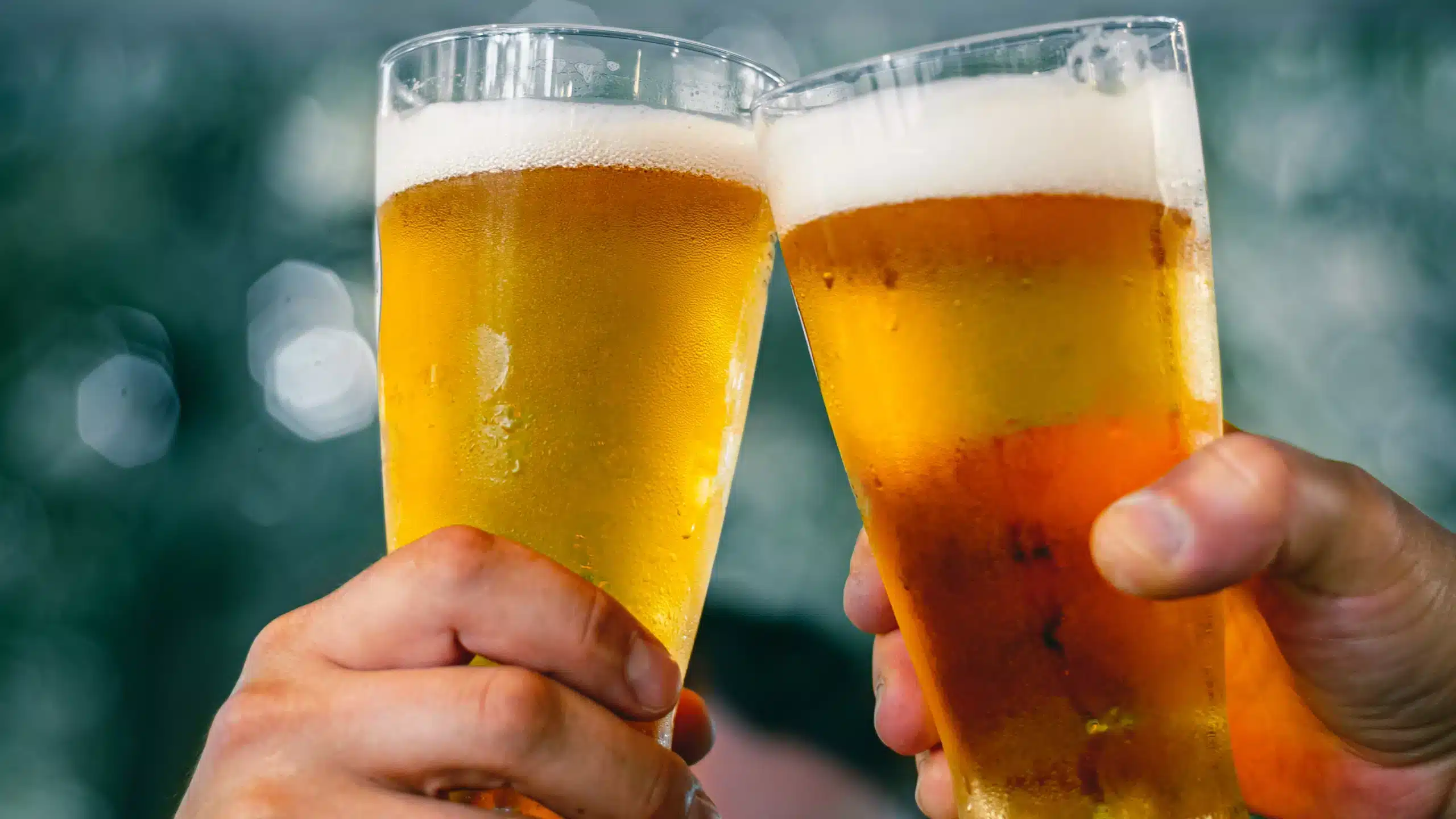
Today’s spotlight is on Beer.
Beer is an alcoholic beverage made from a combination of barley, water, hops, and yeast. The ingredients are combined and fermented to become alcoholic. The alcohol content of beer varies depending on the brewing process, ingredients used, and fermentation.
Typical American alcoholic beers average 4% to 5% alcohol (ethanol) by volume, but some can be much higher. Alcohol-free beer has a much lower percentage of alcohol, usually less than 0.5 percent ABV. The brewing process is complex and even small changes in the recipe can impact the color, aroma, and flavor of beer. The three main types of beer are lager, ale, and hybrid. Some beers can be classified as hybrids, containing both lager beers and ale characteristics.
The five main ingredients in beer are:
- Water: Makes up 90% of the volume of a beer and has a big impact on the flavor.
- Malts: The sugar needed in the brewing process.
- Hops: The “balancing agent” because hops add bitterness, counterbalancing the sweetness of the malt.
- Yeast: The secret component that unites all the ingredients and turns them into beer.
- Fruit puree: Another ingredient that can be added to create desired flavors.
The proportions of these ingredients can vary depending on the style of beer being made. For example, the most common grain is barley, but other grains such as wheat, rice, corn, oats, and rye can be used.
The two main types of beer are ales and lagers. However, there are over 100 beer styles in the world, plus countless variations. The type of beer is determined by many factors, including the ingredients, region of origin, and brewing method.
Ales are fermented with top-fermenting yeast at warm temperatures (60˚–70˚F). Lagers are fermented with bottom-fermenting yeast at cold temperatures (35˚–50˚F). Some beers can be classified as hybrids, containing both lager and ale characteristics.
The Beer Judge Certification Program (BJCP) issues style guidelines for nearly 100 types of beer.
History
Despite beer being the stereotypical “manly” drink, it was women who were the world’s first beermakers. The first evidence of beer production dates back to the Sumerians of ancient Mesopotamia around 5,000 years ago. The Sumerians lived in what is now Iraq. The earliest evidence of beer production comes from chemical tests of ancient pottery jars from around 3,500 BC in what is now Iran. Ancient tablets have been unearthed showing the original brewers were women. The Sumerians even had a goddess of beer, Ninkasi.
The ancient Chinese are also credited with one of the first beers. A recipe from 7000 BCE called for water, rice, honey, grapes, and hawthorn fruits.
The earliest information from the Near East and the Middle East indicates that humans knew how to make bread and beer by 6000 BC. Classical Greek writers credited the Egyptians with inventing beer.
The oldest continuously operating brewery in the world is Weihenstephan Brewery in Weihenstephan, Germany. It began brewing beer in 1040. The original setup was a monastery run by Benedictine monks.
Commercial brewing arrived in North America in 1632. The Dutch West India Company opened the first commercial brewery. The first commercial brewery in the United States was established in New Amsterdam (now New York City) in the early 17th century. The Dutch West India Company opened the brewery on Brewer Street (now Stone St.).
Yuengling is the oldest beer in America and has been around since 1829. It was one of the only early American breweries to survive prohibition because it produced “near bears,” which only had a 0.5% alcohol content.
The word “beer” comes from the Old English word “beor”. The exact etymology of the word is not clear. Some say it comes from the Latin word “bibere” which means “to drink”. Others say it comes from the Proto-Germanic word “beuwoz-” which comes from “beuwo-” meaning “barley”.
The word “beer” has been used for centuries to describe fermented beverages made from grains. The word became common in the 16th century. The word “beer” appears in old poems and songs dating back to the 18th century. The word “beer” has stuck around due to historical usage and cultural adoption.
Here are some fun facts about beer:
- The first commercial brewery in the United States was built in 1632 in Lower Manhattan.
- The world’s biggest glass of beer is 7 feet and 4 inches tall.
- The most common type of beer is lager, which accounts for up to 80% of the world’s beer consumption.
- In ancient Egypt, workers in Giza were paid in beer three times a day.
- The Guinness Book of World Records was conceived by Hugh Beaver, the Executive Director of the Guinness Brewing Company.
Guinness is an Irish dry stout that originated in Dublin in 1759. Arthur Guinness leased a small, abandoned brewery at St. James’s Gate for 9,000 years at an annual rent of £45. The brewery produced a variety of ales and beers, but in 1799 it decided to focus on porter, a dark beer with a rich head. In 1821, Arthur Guinness II released the Extra Stout recipe. This beer is sharper and crisper than Guinness Draught and Foreign Extra Stout.
Guinness is one of the most successful alcohol brands worldwide. It is brewed in almost 50 countries and available in over 120. The first non-Irish brewery opened in London in 1936.
Consuming Beer
Beer was a common breakfast drink in the Middle Ages. It was a nourishing drink that was a significant part of people’s diets. Beer was also a safer choice because it was made with boiled water. In colonial times, beer was the everyday beverage for most people. Water was often contaminated, so people drank beer or cider for breakfast, lunch, and dinner.
In England and Ireland, many pubs served drinks throughout the morning. A beer with breakfast was expected for all sorts of workers. The origins of beer at breakfast can be traced back to as early as 1634, at the Paulaner monastic brewery in Munich. In some parts of Germany, a cold beer is a common part of brotzeit, or second breakfast. This is a small meal of bread and cheese, a pretzel, or a veal sausage and mustard.
Home Made Beer
The four main ingredients in beer are malt, hops, yeast, and water. The proportions of these ingredients vary depending on the style of beer.
Here are some steps for making beer at home:
- Sanitize all equipment.
- Dechlorinate and heat about 3 gallons of water until just below boiling.
- Add malt extract and stir until completely dissolved.
- Boil the brew wort.
- Add hops if the malt extract doesn’t include them.
- Mash grains at 151-152° F (66-67° C) for an hour or until starch conversion is complete.
- Age five more days than bottle or keg the beer.
It takes about four hours to brew beer, one to two weeks to ferment and condition, two hours to package in bottles, and one to two weeks to naturally carbonate in bottles.
Celebrating Beer
National Drink Beer Day is celebrated in the United States every year on September 28. Let us know in the comments how you plan to celebrate.
0 Comments