
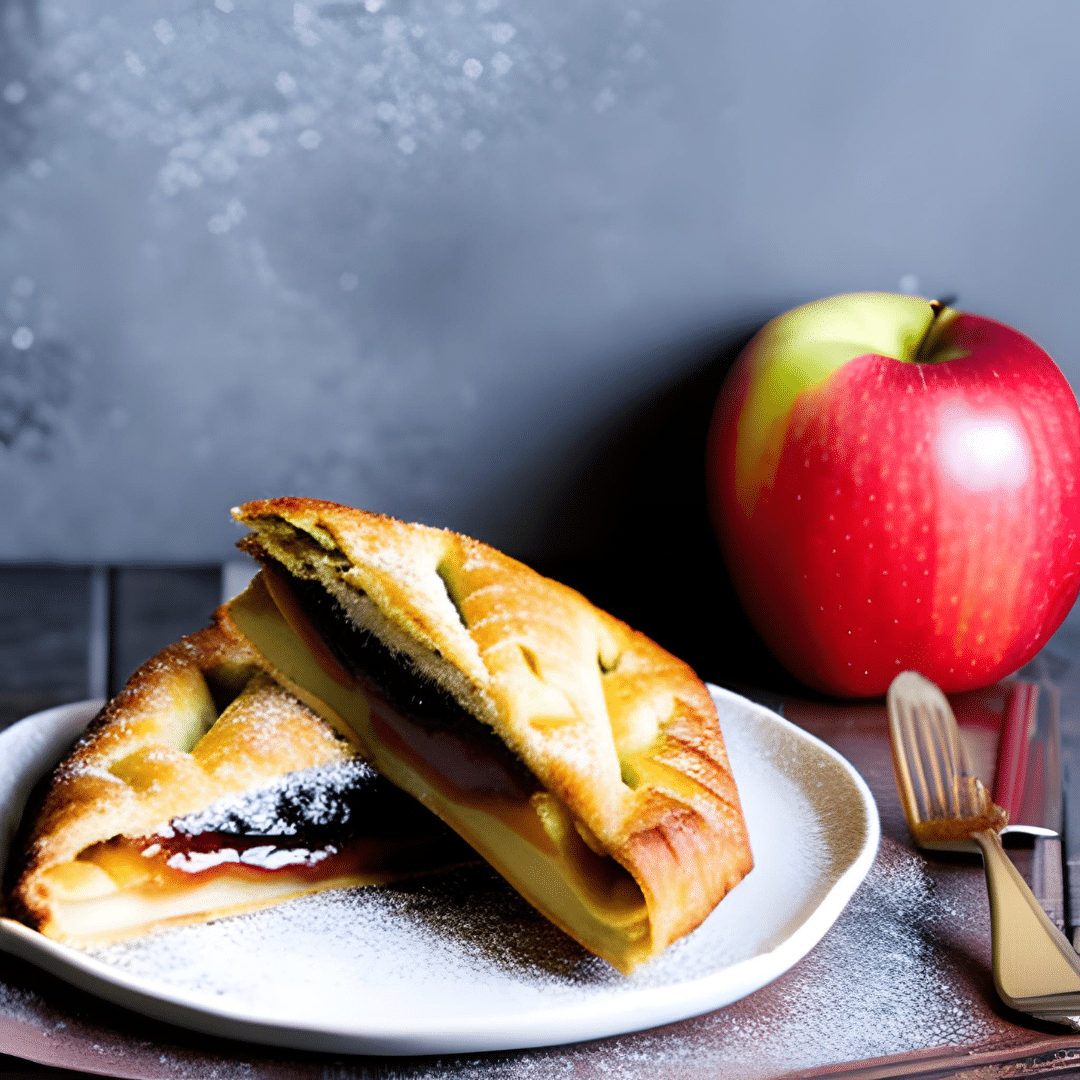
America is Apple Pie and Lemonade, so it seems fitting that the nation honors Apple Turnovers the day after the nation’s birthday. National Apple Turnover Day is celebrated on July 5th to celebrate apple turnovers. The day is also a nod to the turnover’s European roots.
Apple Pie Before Turnovers
The first known recipe for apple pie dates back to 1381 in England. It was included among other recipes in A Cook’s Tales by Geoffrey Chaucer. The recipe called for figs, raisins, pears, and saffron in addition to apples.
The first apple pies emerged in the 1300s in England and were baked in a crust called a “coffin”. Meanwhile, the Dutch were already making a type of lattice-crust apple pie in the early 1500s.
Apple pie was brought to the colonies by European settlers, where the dish quickly caught on. The patriotic origins of the classic dessert date back to the 1600s, when the colonists first arrived in America, long before the first Independence Day.
Apple pie is a symbol of America because it became associated with freedom and prosperity after 1918. During World War II, soldiers said they were fighting for “mom and apple pie”. This established apple pie as a metaphor for the United States.
The phrase “as American as apple pie” was first used in the early 1800s, but it didn’t become widely known until World War II. The phrase was used to describe the homemaking abilities of First Lady Lou Henry Hoover in a 1928 New York Times article.
The phrase became widely known during World War II when soldiers would tell reporters that they were defending their nation “for mom and apple pie”. The phrase has since been used to describe things that are quintessentially American, such as blue jeans, baseball, and rock-n-roll music.
And Then the Turnover
According to legend, apple turnovers were invented in 1630 in St. Calais, France. During an epidemic, the lady of the town, or the Chatelaine, gave people flour, butter, and apples to raise their spirits. The resulting pastry was what we now know as apple turnovers.
Apple turnovers are also called hand pies because their design makes them portable. They are made by filling a smaller, flaky pie crust with fruit or meat and folding it in half. Once the edges are sealed, the pie is baked or fried. For added sweetness, you can add a dusting of sugar or icing on top.
Apple turnovers are the most popular of turnovers and are enjoyed by millions of people. They are served as a dessert or as a snack.
Here are some fun facts about apple turnovers:
- Apple turnovers are also known as apple pastries or apple pies.
- The word “turnover” comes from folding the pastry dough over the filling.
- Apple turnovers are believed to have originated in Europe during the Middle Ages.
- Research suggests this puffy fruit-filled pastry was first served in the 19th century.
- Ancient cultures called them portable pies.
- The first recorded instance of turnovers was in 1440 in response to an edict preventing bakers from making cakes.
- The best apple turnovers are made with homemade puff pastry dough and a warm honey apple filling.
- Apple turnovers are not the most nutrient dense food, because of the buttery pastry and the sugar. However, there are lots of nutritional benefits from apples.
Each year, American grocery stores sell 186 million apple turnovers.
According to a typical recipe, a small (about 80g) turnover contains 1½ to 2 teaspoons of added sugar, about 250 calories, and 6.4g saturated fat.
Here is an Apple Turnover Recipe for you to Try:
Ingredients
- 1 cup all-purpose flour
- 1/2 teaspoon salt
- 1/2 cup cold butter, divided
- 1/4 cup ice water
Filling Ingredients:
- 1/3 cup sugar
- 2 teaspoons cornstarch
- 1/8 teaspoon ground cinnamon
- 2 medium tart apples, peeled and thinly sliced
- 1 teaspoon lemon juice
- 1 large egg, beaten, room temperature
- 1-1/2 teaspoons water
Glaze Ingredients:
- 1/4 cup confectioners’ sugar
- 1 teaspoon water
Directions:
- In a small bowl, combine flour and salt; cut in 1/4 cup butter until crumbly. Gradually add water, tossing with a fork until a ball forms. On a lightly floured surface, roll dough into a 12×6-in. rectangle.
- Cut the remaining butter into thin slices. Starting at a short side of dough, arrange half of the butter slices over two-thirds of rectangle to within 1/2 in. of edges. Fold unbuttered third of dough over middle third. Fold the remaining third over the middle, forming a 6×4-in. rectangle. Roll dough into a 12×6-in. rectangle.
- Repeat steps of butter layering and dough folding, ending with a 6×4-in. rectangle. Wrap in plastic; refrigerate for 15 minutes. Roll dough into a 12×6-in. rectangle. Fold in half lengthwise and then widthwise. Wrap in plastic; refrigerate for 1 hour.
- Preheat oven to 450°. Meanwhile, in a small saucepan, combine the sugar, cornstarch and cinnamon. Add apples and lemon juice; toss to coat. Bring to a boil over medium heat, stirring constantly. Reduce heat; simmer, uncovered, until apples are tender, stirring often, 5-10 minutes. Remove from the heat.
- In a small bowl, combine egg and water. Roll dough into a 12-in. square; cut into four squares. Brush with half of the egg mixture. Spoon about 1/4 cup filling on half of each square; fold dough over filling. Press edges with a fork to seal. Place on an ungreased baking sheet. Brush with remaining egg mixture. With a sharp knife, cut three small slits in the top of each turnover.
- Bake until golden brown, 17-22 minutes. Remove to a wire rack. Combine glaze ingredients, drizzle over turnovers. Serve warm.
Here are some interesting facts about apple turnovers:
- Apple turnovers are similar to hand pies, but the crust is different.
- Apple turnovers are made from puff pastry dough or pie crust.
- Apple turnovers are filled with cooked fruit and sealed by turning the dough over onto itself.
- Apple turnovers can be stored in an airtight container at room temperature for up to two days.
- Apple turnovers can be stored in an airtight container in the refrigerator for about five days.
- To keep apple turnovers crispy, you need to bake them until they are golden brown on top and fully baked on the bottom.
- Apple turnovers can be served hot from the oven or cold with afternoon tea
National Apple Turnover Day is also a day to celebrate pies and culinary identities. We’d love to know where your favorite was purchased or made?
0 Comments