
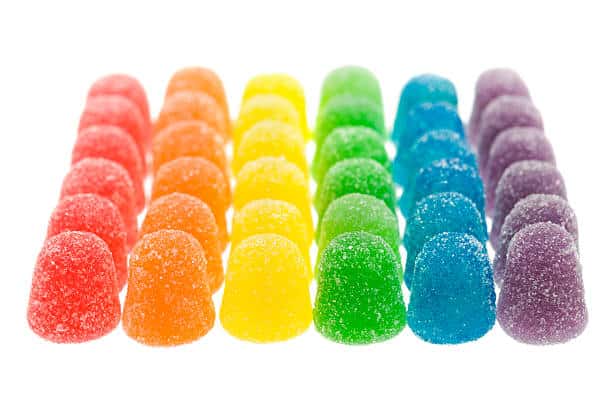
Today’s Spotlight is on Gumdrops.
Gumdrops are a small, firm, jelly-like gummy candy with a chewy consistency. They are made from a mixture of sugar, corn syrup, (or gelatin), and flavorings. The mixture is heated and then poured into molds to create small, colorful candies.
Gumdrops are usually conical in shape, but can also be shaped like orange slices, licorice babies, and spearmint leaves. The most popular flavors are cherry, grape, orange, lemon, and spice flavors like clove, cinnamon, mint, and anise (licorice). They are brightly colored pectin-based pieces, shaped like a narrow dome, often coated in granulated sugar and having fruit and spice flavors; the latter are also known as spice drops.
Gumdrops are a descendent of Turkish delight and appeared around the early 1800s. They were sent to Civil War soldiers and fighters in the two World Wars. The largest gumdrop ever made weighed just under 10 pounds.
Gumdrops are sweet, chewy, and versatile. Their bright colors and unique texture make them a great choice for decorating desserts and other culinary projects.
History
Gumdrops first appeared in the 19th century United States, purportedly as early as 1801, although at that time they likely referred to small, hard sweets also derived from fruit gelatin. The name “gumdrop” is not found in print until 1859, appearing in an advertisement published by the Decatur, IL Illinois State Chronicle for a candy shop owned by a George Julier. By that time, a gelatin-based, rubbery candy akin to modern gummies went by the gumdrop name, but also a pastier candy with a potato starch base.
One of the oldest types of gumdrops still produced are “spice” gumdrops, using traditional spices including clove, anise, allspice, spearmint, cinnamon, and wintergreen for flavoring.
Here are some more fun facts about gumdrops:
- The earliest known printed reference to gumdrops is an 1859 advertisement from The Illinois State Chronicle.
- The candy maker Percy Truesdell is credited with inventing the modern soft gumdrop in 1915.
- The classic board game, Candy Land, features both a Gumdrop Pass and a Gumdrop Mountain.
- The NASA Apollo Command modules were nicknamed “Gumdrops” because of their conical shape.
Here is a gumdrop recipe you can try at home:
Ingredients:
- 2½ cups granulated sugar divided.
- 1½ cups applesauce – no sugar added.
- 6 oz Jello {i.e., cherry, lime, etc.}
- ½ oz unflavored gelatin 2 envelopes
- 1 tsp lemon juice.
Instructions:
- Coat a 9×13 baking dish with cooking spray. Set aside.
- Combine 2 cups sugar, applesauce, Jell-O, unflavored gelatin and lemon juice in a large saucepan. Stir to combine. Let stand for 1 minute.
- Bring to a boil over medium heat stirring constantly.
- Boil for 1 minute and then immediately pour into prepared baking dish.
- Refrigerate until firm – about three hours should do it. I left mine in overnight.
- Cover a large cutting board with parchment paper and sprinkle with sugar.
- Loosen the sides of the gelatin with a spatula and invert onto parchment paper.
- Use small, sharp cookie cutters to cut out gumdrops. If needed, you can dip the cutters into hot water first. You may need to periodically rinse off the cutters as well to keep them clean.
- Leave the cutout gumdrops on top of the sugar-coated parchment paper for about 8 hours or until just slightly sticky.
- Roll the gumdrops in the remaining sugar and store in an airtight container.
- Enjoy!
Consumption
On average, people consume gumdrops 1.18 times per year. The average American eats 22 pounds of candy each year. DOTS is the top-selling gumdrop brand in the United States. It was launched in 1945.
Gumdrops are often used as decorations for baking and confectionery projects, such as gingerbread houses and cupcakes. They can also be enjoyed as a standalone candy.
Celebrating Gumdrops
National Gumdrop Day is celebrated on February 15th. The holiday recognizes the gumdrop, a favorite candy of many. To celebrate, you can eat gumdrops and buy or make your own. Let us know in the comments which one you decide.
0 Comments