
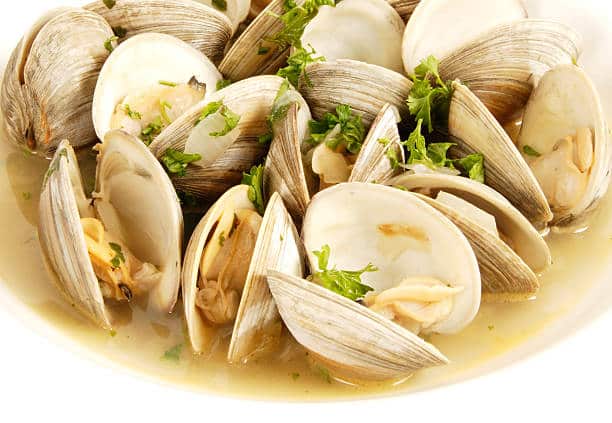
Today’s Spotlight is on Clams.
Clams are invertebrates, or animals without a backbone. They are part of the Mollusca phylum, the second largest group of animals in the world. In this phylum, clams are classified as bivalve shellfish, meaning their body is enclosed in two hard outer shells that hinge at the base.
Clams are popular ocean-sourced seafood known as molluscs. They are bivalve molluscs, a form of shellfish with a shell.
Clams have the following characteristics:
- Shell: Clams have rounder shells that are light gray or dirty white in color.
- Heart: Clams have a bivalved heart.
- Kidney: Clams have an organ complex formed by the heart along with the kidney.
- Foot: Clams have a retractable foot.
- Siphon: Clams have a siphon for sucking up water.
- Muscles: Clams have powerful muscles.
- Pearl: Clams sometimes have a pearl.
Clams live in both freshwater and marine environments. In salt water they prefer to burrow down into the mud. The greatest diversity of these is in North America.
Clams are herbivores, eating mainly plankton. They incorporate nitrogen from their food into their tissues and shells. When clams are harvested, the accumulated nitrogen is removed from the water.
Giant clams are the largest species of clam on Earth. They are omnivores, eating both plants and small animals. Giant clams are used for both food and building material. Habitat degradation, technological advances in exploitation, and expanding trade networks have decreased giant clam numbers throughout their range.
Clams can be eaten by humans. They are a popular ocean-sourced seafood known as molluscs. Clams are bivalve molluscs, a form of shellfish with a shell.
Clams can be eaten raw or cooked. Raw oysters and clams have a more delicate flavor and texture than cooked shellfish and retain more nutrients. However, certain people are at risk of illness from eating them raw and need to be sure to eat these foods only if they are cooked properly.
Some clams that are best eaten raw include:
- Tiny littlenecks
- Mid-sized cherrystones
Other clams, like quahogs or mahogany, are too chewy to be eaten raw, but are perfect for chowders and other cooked preparations.
Most people are able to digest clams without any issues. However, some may experience digestive discomfort, such as bloating, gas, or abdominal pain. This is often due to food intolerance or allergy.
Giant clams are nicknamed “man-eating clams” because of a myth that they are voracious predators that wait patiently on the seafloor to trap an unsuspecting swimmer. The myth was so persistent that decades later, Navy diving manuals still advised frogmen how to free themselves if caught in the “vise-like” grip of a giant clam.
However, there are no actual cases of a giant clamshell snapping shut on an unsuspecting diver. Scientists say its adductor muscles, used to close the shell, move far too slowly to take a swimmer by surprise. Even the largest specimen would simply retreat into its shell rather than attempt to sample human prey.
History
Indigenous peoples along the Pacific and Atlantic coasts consumed clams. They used them for many purposes, including making tools and utensils, as currency, and decoration. Cultures living in the interior are also reported to have eaten clams that they acquired through trade with coastal peoples.
Native Americans prepared clams in a variety of ways. The Algonquin People made a stew consisting of clams, corn, and beans. Sometimes smoked fish or meat was added. This was the original recipe for clam chowder.
Native Americans also crafted quahog shells into scrapers to carve wooden boats and bowls, and into eating utensils, trowels, and even into tweezers. Beads made from the quahog shell, known as wampum, were used in trade throughout the region. There was even a time when 1,900 wampum could buy you a year of tuition at Harvard.
The first settlers started using the clams themselves and they incorporated them into European-style food traditions.
Here are some world records for clams:
- Ming the clam: The oldest animal in the world at 507 years old. Ming was a species of Icelandic clam known as an ocean quahog. She was collected off the coast of Iceland in 2006. Researchers opened her to verify her age, which killed her.
- Aber-clam Lincoln: A 214-year-old clam.
- 374-year-old mollusk: Collected off Iceland in 1968.
- 220-year-old quahog: Pulled from American waters in 1982.
Other species of clams that have been documented to live a century or longer include:
- Pacific geoduck clam (168 years)
- Freshwater pearl mussel (190 years)
- Giant deep-sea oyster
Here is a clam recipe for you to try:
Ingredients:
- 5 tablespoons Finlandia Unsalted Butter, divided.
- 1 tablespoon fresh minced garlic
- 1 cup white wine
- 1 tablespoon lemon juice
- 3 dozen little neck clams rinsed and scrubbed.
- ⅓ cup chopped fresh Italian parsley
- Wedges from 1 lemon for garnish, if desired
Instructions:
- In a large skillet (that has a lid), melt 2-½ tablespoons of the butter over medium heat. Add garlic and cook, stirring constantly, until fragrant (about 30 seconds).
- Add wine and lemon juice. Bring to a boil.
- Add clams and remaining butter. Cover and steam until clams have opened (about 7-8 minutes). Occasionally shake skillet while steaming.
- Discard any clams that do not open. Sprinkle evenly with parsley and garnish with lemon wedges, if desired. Serve with a French baguette or over a bed of cooked pasta.
- Enjoy!
Celebrating Clams
There are several holidays that celebrate clams:
- National Deep Fried Clams Day: November 1st
- National Clam Day: March 31st
- National Fried Clam Day: July 3rd
- National Clams on the Half Shell Day: March 31st
- National Clam Chowder Day: February 25th
Here are some ways to celebrate clams:
- Yarmouth Clam Festival: An annual family-friendly summer event in Yarmouth, Maine
- Celebrating Clams and Claws: A 5th anniversary celebration
- Celebrating the Versatility of Clams: A celebration of the versatility of clams
- Cooking with Clams: A book with recipes to celebrate clams.
Clams are an important part of the cycling of nutrients, including nitrogen. When clams are harvested, the accumulated nitrogen is removed from the water.
Clams are also rich with memories for many, particularly those with the seacoast in their history or in their veins. These memories include summers at the shore, steaming mugs of chowder on a wintery New England day, or memories of digging for your own dinner.
Let us know in the comments how you enjoy your clams.
0 Comments