
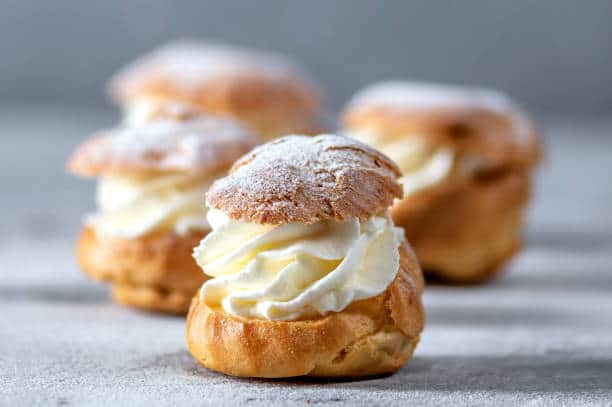
Today’s Spotlight is on Cream Puffs.
A cream puff is a filled French choux pastry ball with a typically sweet and moist filling of whipped cream, custard, pastry cream, or ice cream. The puffs may be decorated or left plain or garnished with chocolate sauce, caramel, or a dusting of powdered sugar.
Cream puffs are made with a high water content, which turns into steam during baking. The steam expands the dough, leaving behind hollow pockets of air with a crisp outer shell.
The science behind cream puffs includes:
- Steam – The heat from the oven causes the liquid in the paste to evaporate and turn to steam. The steam rapidly expands the paste.
- Gluten – The gluten in the flour combines to form a stretchy web that traps air bubbles and sets.
- Eggs – The eggs act as the leavening agent. The proteins in the eggs add to the structure of the cream puff. The yolks add fat for a tender and light texture.
- Starch – The starch in the flour sets as it heats to add to and support the structure.
Cream puffs can go flat if the temperature is set too high. Higher temperatures may brown the puffs too quickly, before the structure has had time to firm up.
History
Cream puffs, also known as profiteroles or choux à la crème, originated in France in the 1540s. Catherine de Medici’s pastry chef created the baked puffed shells for her husband, Henry II of France. It’s rumored that the recipe was imported from Tuscany.
In the 19th century, celebrated French chef Antonin Carême was the first to add cream to the puffs. The cream puff became a classic in French cuisine and many bakeries throughout Europe.
The recipe became popular in the United States by the 1800s. In the 1850s, “some hundreds” of “cream puff cakes” were sold daily in Brooklyn bakeries. Around the same time, the dessert hit the menu at Boston’s Revere House Restaurant.
The Wisconsin State Fair Cream Puff was created in 1924. Governor John Blaine asked Wisconsin food inspector Charles Kremer to come up with a food item that would highlight Wisconsin’s dairy industry for fairgoers.
Here are some fun facts about cream puffs:
- Cream puffs are also known as profiteroles or choux à la crème.
- They originated in France in the 1540s.
- They first appeared on US restaurant menus in 1851.
- They are a national dish of Gibraltar.
- The word choux in French means cabbage.
- The Wisconsin State Fair Cream Puff was created in 1924.
- They are a culinary classic that any baker should be familiar with.
- They are made out of a pastry ball filled with whipped cream, custard, pastry cream, or ice cream.
- The word choux in French means cabbage.
- The word choux in French means cabbage.
Here is a Cream Puff Recipe for you to try:
Ingredients:
PASTRY CREAM:
- 1 cup whole milk (236ml)
- 1 cup heavy cream (236ml)
- ⅓ cup (67g) + 3 Tablespoons granulated sugar divided
- 1 vanilla bean¹ split in half lengthwise
- ¼ teaspoon salt
- 5 large egg yolks room temp
- 3 Tablespoons cornstarch
- 4 Tablespoons unsalted butter softened and cut into 4 pieces
CHOUX PASTRY
- 1 cup water (236ml)
- ½ cup unsalted butter cut into 8 pieces (113g)
- ¼ teaspoon salt
- 1 cup all-purpose flour (125g)
- 4 large eggs room temperature
- Powdered sugar for dusting cream puffs
Instructions:
PASTRY CREAM
- Combine cream, milk, ⅓ cup (67g) sugar, vanilla bean, and salt in a medium-sized heavy bottomed saucepan. Place on stovetop over medium heat. Stir frequently until sugar is dissolved and mixture comes to a simmer. Remove from heat and allow to cool for 10 minutes (stir occasionally).
- Meanwhile, in a separate large bowl, whisk together egg yolks and 3 Tablespoons of sugar. Whisk vigorously for about 15 seconds, until sugar is beginning to dissolve.
- Sprinkle cornstarch over egg/sugar mixture and whisk until combined and slightly thickened.
- Once your cream mixture has cooled, slowly drizzle about ⅓ cup of the cream mixture into the egg mixture while whisking constantly (this will temper your eggs and gradually adding the heated cream will prevent them from cooking!). Slowly, while still whisking, drizzle in the remainder of your cream mixture until the cream and egg mixture are completely combined.
- Pour mixture back into saucepan and return to stovetop over medium heat. Whisk frequently until thickened.
- Remove from heat and pour mixture through a fine mesh strainer into a heatproof bowl (vanilla bean should be caught by the strainer and should be discarded now).
- Whisk in butter, one piece at a time until completely combined. If you didn’t use a vanilla bean, stir in the vanilla extract at this point, too.
- Place plastic wrap directly in contact with the surface of the pastry cream to keep a skin from forming. Allow to cool at room temperature for about 30 minutes or until near room temperature, then transfer to the refrigerator to chill for at least 2-4 hours. Meanwhile, prepare your choux pastry.
CHOUX PASTRY
- Preheat oven to 400F (200C) and line a large baking sheet or two smaller baking sheets² with parchment paper. Set aside.
- Combine water, butter, and salt in a medium-sized heavy-bottomed saucepan over medium heat and bring to a rolling boil.
- Once mixture is boiling, add flour and turn down heat to medium/low. Stir continuously with a spatula until moisture is absorbed and mixture forms a ball that pulls away from the sides of the pot.
- Remove from heat and stir for several minutes to cool down the mixture. Add eggs, one at a time, stirring very well after each addition until mixture is smooth and velvety.
- Transfer mixture to a piping bag (or to a large Ziploc bag with one corner snipped) and pipe onto prepared baking sheets by mounds about 2” wide by 1” tall, spacing each mound at least 1 ½ inches apart. Lightly dampen your fingers with cold water and gently press down any peaks on the pastry mounds.
- Transfer to 400F (200C) oven and bake for 30 minutes or until cream puffs appear dry and light golden brown.
- Remove from oven and use a sharp knife to pierce the lower center of each cream puff, inserting knife about halfway into cream puff (be careful, cream puffs will be hot!)³. Replace each puff on baking sheet and return to oven. Turn off oven and let pastry sit in the oven with the oven door cracked for another 10 minutes.
- Once 10 minutes has passed, remove from oven and allow to cool completely on baking sheet.
- Allow to cool completely before piping with pastry cream.
- To fill with cream, place pastry cream in a piping bag fitted with a small tip (I used a Wilton 5). Insert piping tip into each cream puff and fill until pastry cream is beginning to come out the hole.
- Lightly dust the top of each cream puff with powdered sugar just before serving (the sugar will dissolve in the refrigerator if not served right away).
- Enjoy!
Here are some common problems when making cream puffs:
- Dough consistency – If the dough is too dry, it won’t have enough steam power to lift the cream puffs. If the dough is too wet, it won’t be able to harden in time to hold the puffed shape.
- Eggs – If too much egg is added, the mixture will be runny and unusable. If not enough egg is incorporated, it won’t puff, causing it to be dense inside.
- Temperature – If the oven is too hot, the surface of the choux pastry dries out and firms too fast. If the oven is not preheated enough, the liquids in the choux pastry take too long to turn into steam.
- Other problems – The dough might have undissolved solids or be not smooth. The salt or sugar might not have dissolved properly. The flour might have lumps that haven’t been mixed properly, or you might have added raw flour to the dough after adding eggs.
Consumption
Around 350,000 cream puffs are consumed each year. The Wisconsin State Fair sells around 400,000 cream puffs each year. Fairgoers purchase 50 to 60 cream puffs per minute.
The Wisconsin State Fair’s Cream Puff Pavilion allows fairgoers to watch cream puffs being made. The pavilion has five ovens and more than 200 employees working in three shifts.
Celebrating Cream Puffs
National Cream Puff Day is celebrated annually in the United States on January 2. Although the treat originated in France, it has been loved by people around the world. And although January 2nd is the designated holiday, that doesn’t mean you can’t celebrate Cream Puffs any day of the year.
Let us know in the comments, when you like to celebrate cream puffs?
0 Comments