
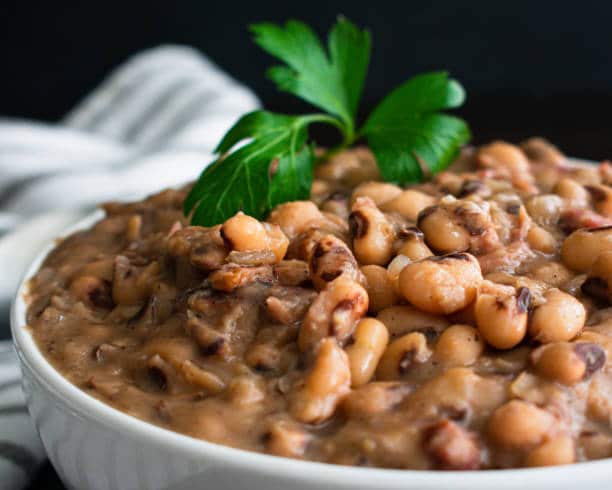
Today’s Spotlight is on Black Eyed Peas.
Black-eyed peas are a type of legume that are actually beans, not peas. They are a variety of the cowpea, which is a member of the legume, pea, or bean family. They are also known as “goat pea” and “southern pea”. It is a subspecies of the cowpea, an Old World plant domesticated in Africa, and is sometimes simply called a cowpea.
Black-eyed peas are medium-sized, beige beans with black markings. They are creamy white with black marks or “eyes” outlining where they were once attached. Black-eyed peas are highly nutritious and associated with many health benefits. They may help support weight loss, improve heart health, and promote digestive health.
They contain nutrients such as:
- Zinc, Iron, Amino acids, Fiber, Folate, Potassium.
Black-eyed peas are popular in American Southern and soul food dishes. They are also consumed in India, Africa, Europe, Asia, and South America.
Black-eyed peas were first cultivated in North Africa and eventually became popular worldwide. They arrived in the southern U.S. in the 17th century. Southerners believe eating black-eyed peas on New Year’s Day brings good luck.
History
Black-eyed peas are named after the black “eye” in the center of the bean, where it was attached to the pod. The black eye reminded some of a nun’s head attire, so they were originally called mogette (French for nun).
The Black Eyed Peas is also the name of a band. The band was originally called Black Eyed Pods. The band members were will.i.am, apl.de. ap, Jaime Gomez (Taboo), and Kim Hill. They changed “Pods” to “Peas”.
According to legend, Union troops raided Confederate food supplies during the Civil War, leaving behind only black-eyed peas and salt pork. The Confederates considered themselves lucky to survive the winter with just these meager supplies, so the peas became symbolic of luck.
Black-eyed peas were originally used as food for livestock. During the Civil War, General Sherman’s troops ignored black-eyed peas and corn. They were left behind in the fields and became important food for the Confederate South.
The tradition of eating black-eyed peas on New Year’s Day is thought to have originated in West Africa. It’s believed that eating black-eyed peas on New Year’s Eve brings good luck and prosperity in the coming year.
Here’s some information about the history of black-eyed peas:
- Black-eyed peas were domesticated in West Africa, near Lake Chad, in what is now northeastern Nigeria and northern Cameroon.
- They were cultivated in China and India since prehistoric times.
- They were brought to the West Indies by enslaved West Africans in 1674.
- They were originally used as food for livestock, but became a staple of the slaves’ diet.
- They were brought to the southern U.S. in the 17th century by African slaves.
- They became a staple food across the Deep South of the United States.
- The tradition of cooking black-eyed peas with rice is African in origin.
- The tradition of eating black-eyed peas on New Year’s Day may have started during the Civil War in Vicksburg, Virginia.
Here are some fun facts about black-eyed peas:
- Black-eyed peas are kidney-shaped, white, and have a small black eye. They have a scented aroma, creamy texture, and distinctive flavor.
- Black-eyed peas are rich in nutrients, including vitamin A, folate, manganese, and fiber. These nutrients may help lower blood pressure, support digestion, maintain skin health, and more.
- Black-eyed peas are one of the most widely dispersed beans in the world.
- Black-eyed peas were originally called mogette (French for nun) because the black eye reminded some of a nun’s head attire.
- There’s evidence that Jewish people ate black-eyed peas as a part of the holiday Rosh Hashanah, the Jewish New Year, for hundreds of years.
Here is a Black-Eyed Pea Recipe for you to try:
Ingredients:
- 4-5 thick slices bacon, chopped
- 5 ounces smoked sausage or turkey, diced (about 1 cup)
- 1 large onion, diced
- 1 stalk celery, diced
- 2-3 teaspoons garlic, minced
- 1 optional jalapeno, minced (can replace with ¼ teaspoon cayenne)
- 2 teaspoons fresh thyme, minced
- 1 bay leaf
- 1-2 teaspoons Creole seasoning
- 7-8 cups chicken broth
- 2 cups (or more) collard greens (or you can use kale)
- Salt and pepper to taste
Instructions:
- Rinse dry black-eyed pea beans, pick through, and discard any foreign objects. Add beans to a large pot and cover with 3-4 inches of cold water. Let sit for 2-3 hours (or overnight).
- In a large, heavy sauté pan, saute chopped bacon until brown and crispy (4-5 minutes), then add sausage and saute for 2-3 more minutes. Remove bacon and sausage mixture, and set aside.
- Throw in the onions, celery, garlic, jalapenos, thyme, and bay leaf, and saute for 3-5 minutes until the onions are wilted and aromatic.
- Then pour in the chicken broth or water.
- Drain the soaked beans, rinse, and place them in the pot. Season with Creole seasoning and salt to taste. Stir and bring to a boil.
- Reduce heat to a simmer and cook uncovered for about 20 minutes.
- Toss the collard greens, bacon, and sausage into the pot, and continue cooking for another 10 minutes or more, stirring occasionally, until the beans are tender and the broth thickens to your desired texture.
- Add more stock or water if the mixture becomes dry and thick. The texture of the beans should be thick and somewhat creamy but not watery.
- Remove the bay leaf.
- Taste and adjust seasonings with salt, pepper, and Creole seasoning if needed. Serve over rice and garnish with chopped green onion.
- Enjoy!
Consumption
Black-eyed peas are rich in nutrients, including:
- Vitamin A, Folate, Manganese, Fiber, Calcium, Iron, Copper, Zinc, Potassium.
Black-eyed peas are good for:
- Improving digestion
- Preventing anemia
- Lowering blood pressure
- Increasing folate intake
- Promoting skin and eye health
- Supporting weight loss
- Improving heart health
- Fortifying the immune system
- Helping liver function
Black-eyed peas are versatile and can be added to soups, stews, curries, salads, and dips.
Celebrating Black Eyed Peas
According to Southern tradition, eating black-eyed peas on New Year’s Day brings good luck and prosperity. The tradition is thought to have originated in West Africa and was brought to the United States during the time of slavery.
The tradition is that the first food to be eaten on New Year’s Day should be black-eyed peas for luck and prosperity. Specifically, one pea for each day of the year. To really ensure a good year, add a mess o’ greens for wealth. The peas represent coins. The tradition is that the more you eat the more monetary good luck you will have in the new year.
Other theories include:
- The enslaved ate black-eyed peas when the Emancipation Proclamation became effective on January 1, 1863.
The Southern phrase, “eat poor on New Year’s and eat fat
0 Comments