
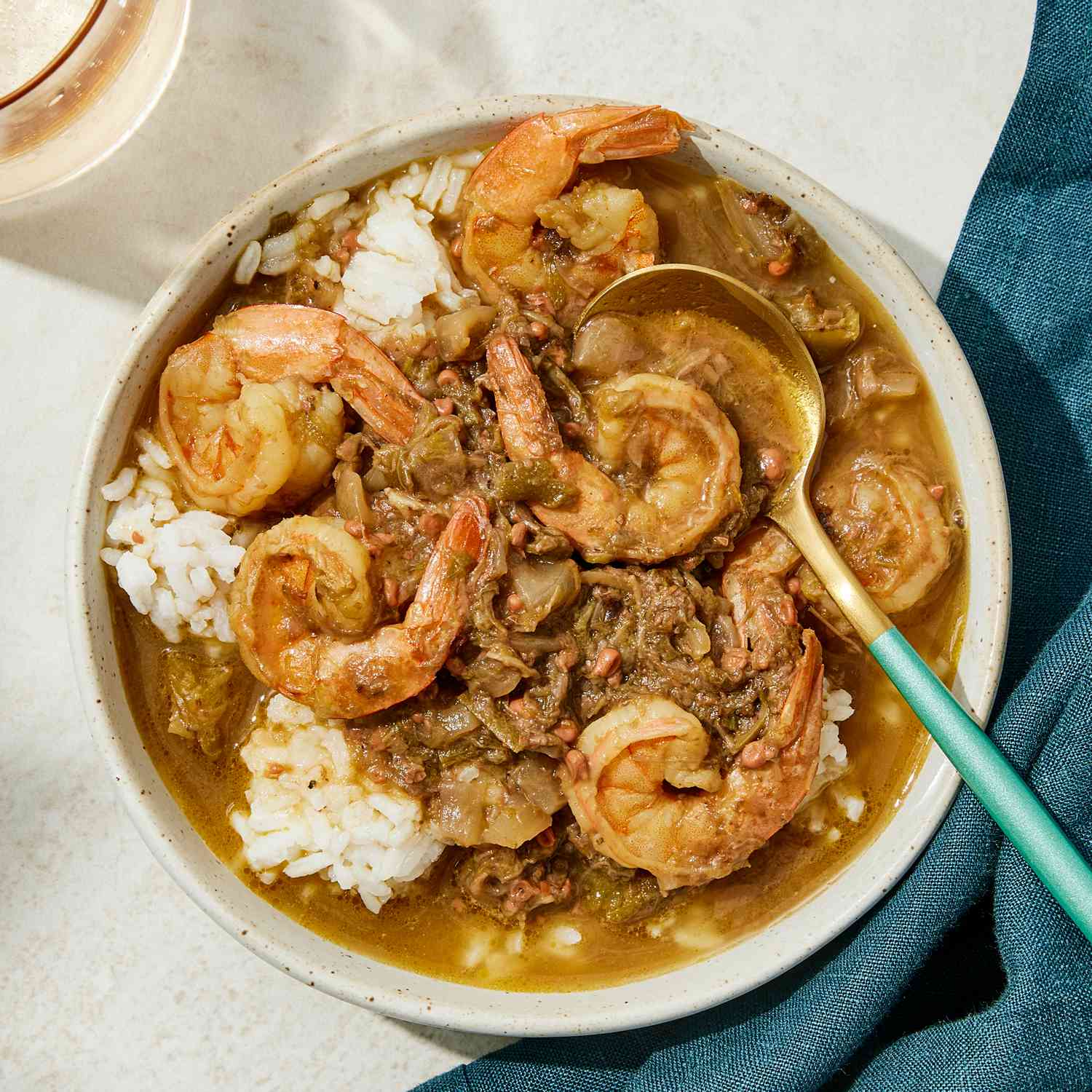
Today’s Spotlight is in Gumbo!
Gumbo is a hearty stew that is the official state cuisine of Louisiana. Gumbo consists primarily of a strongly flavored stock, meat or shellfish (or sometimes both), a thickener, and the Creole “holy trinity” ― celery, bell peppers, and onions. Gumbo is often categorized by the type of thickener used, whether okra or filé powder (dried and ground sassafras leaves).
Gumbo is sometimes thickened with okra, file, or a roux, which is a French and Creole method of cooking equal parts flour and fat. The broth has a thick, almost viscous consistency. Gumbo is one of the most famous dishes to result from Louisiana’s shared Creole-Cajun heritage. It takes its name from a Bantu word for okra, one of the dish’s typical ingredients. Gumbo is much denser than a simple soup. The main difference between gumbo and jambalaya is the role of the rice. Gumbo is served with rice that is cooked separately, but rice goes into the jambalaya pot.
Gumbo can be made with or without okra or filé powder. The preferred method in the historical New Orleans variation is with a French dark, even chocolate-like, roux. The flavor of the dish has its origins in many cultures. Creole gumbo generally contains shellfish, and a dark roux, filé, or both. Today, tomatoes are occasionally found in Creole gumbo and frequently appear in New Orleans cuisine, but many gumbo cooks believe that tomatoes should never be used in gumbo. Cajun gumbo is generally based on a dark roux and is made with shellfish or fowl. Sausage or ham is often added to gumbos of either variety. After the base is prepared, vegetables are cooked down, and then meat is added. The dish simmers for a minimum of three hours, with shellfish and some spices added near the end. If desired, filé powder is added after the pot is removed from heat. Gumbo is traditionally served with rice. A third, lesser-known variety, the meatless gumbo z’herbes, is essentially a gumbo of slow-cooked greens.
The dish combines ingredients and culinary practices of several cultures, including African, French, Spanish, and Native American Choctaw. Gumbo may have been based on traditional native dishes or may be a derivation of the French dish bouillabaisse, or Choctaw stew, but most likely all of these dishes contributed to the original recipe.
History
Did you know that gumbo is not original to Louisiana? Most food historians agree that this popular South Louisiana dish has its origins in West Africa. Consider the word “gumbo” which comes from the West African word “ki ngombo” for “okra”. West Africans used okra as a thickener in their version of the dish.
Gumbo originated in West Africa and was brought to the Caribbean and the US South by enslaved Africans. The word “gumbo” comes from the West African word “ki ngombo” which means “okra”. In the West African version of the dish, okra was used as a thickener. Gumbo may have also been influenced by traditional native dishes, the French dish bouillabaisse, or Choctaw stew. The earliest recorded recipes for gumbo include okra as a main ingredient.
Sassafras and filé powder had been used by Native Americans for centuries before European immigrants arrived. The okra plant is another thickener used in gumbo. Okra was introduced to the Southern U.S. from Africa, which accounts for the African component of gumbo.
Gumbo was first described in 1802 and was listed in various cookbooks in the latter half of the 19th century. In 1802, John Sibley described “the dish they call gumbo which is made principally of the ochre into a thick kind of soup & eat with rice, it is the food of everybody for dinner and supper.” In 1803, French governor Pierre Clement de Laussat hosted a soirée in which 24 different gumbos were prepared. According to author Cynthia Lejeune Nobles, these two events “give clues to gumbo’s Spanish colonial popularity and illustrate that the dish could be both humble and refined”. An 1824 cookbook, Mary Randolph’s The Virginia House-Wife, was the first to include a recipe for gumbo.
The dish gained more widespread popularity in the 1970s, after the United States Senate dining room added it to the menu in honor of Louisiana Senator Allen Ellender. The popularity of chef Paul Prudhomme in the 1980s spurred further interest in the dish by sharing his recipes with many presidents and political figures.
Here is a Gumbo Recipe for you to try:
Ingredients for the Gumbo:
- 1 medium green bell pepper
- 1 medium yellow onion
- 3 stalks celery
- 6 cloves garlic
- 1/2 bunch fresh parsley (optional)
- 2 to 3 tablespoons salt-free Cajun seasoning (see Recipe Notes), divided
- 2 teaspoons dried thyme
- 2 bay leaves
- 1/2 teaspoon cayenne pepper, plus more as needed
- 1 pound boneless, skinless chicken thighs, or 1 rotisserie chicken
- 1 1/2 teaspoons kosher salt, plus more as needed
- 1 1/2 teaspoons freshly ground black pepper
- 14 ounces andouille sausage
- 1/4 cup plus 1 tablespoon neutral cooking oil, such as canola or vegetable, divided
- 6 cups (48 ounces) low-sodium chicken broth, at room temperature
- 2 teaspoons filé powder (optional, see notes below)
- 4 tablespoons (1/2 stick) unsalted butter
- 1/2 cup all-purpose flour
Ingredients for Serving:
- 1/2 bunch medium scallions
- 3 cups cooked white rice
- Crystal or Tabasco hot sauce
Instructions:
- Cut the vegetables: Prepare the following, placing each in the same medium bowl as you complete it: Trim and dice 1 medium green bell pepper (1 1/2 cups), 1 medium yellow onion (1 3/4 cups), and 3 celery stalks (1 1/2 cups).
- Prepare the remaining aromatics: Prepare the following, placing each in the same small bowl as you complete it: Mince 6 garlic cloves; coarsely chop the leaves from 1/2 bunch fresh parsley, if using, until you have about 1/2 cup; add 2 tablespoons of the salt-free Cajun seasoning, 2 teaspoons dried thyme, 2 bay leaves, and 1/2 teaspoon cayenne pepper; stir to combine.
- Cut the chicken: If using raw chicken, dice 1-pound boneless, skinless chicken thighs into 1-inch pieces. Season with 1 1/2 teaspoons kosher salt, 1 1/2 teaspoons black pepper, and the remaining 1 tablespoon Cajun seasoning. If using rotisserie chicken, pick the meat and shred (about 4 cups); discard the skin and bones. (No need to season the rotisserie chicken meat.)
- Cook the sausage: Cut 14 ounces andouille sausage crosswise into 1/2-inch-thick rounds. Cook in a large pot or Dutch oven over medium-high heat until the sausage is browned all over and releases its fat, about 5 minutes. Transfer the sausage to a plate.
- Brown the chicken: If using raw chicken, add 1 tablespoon of neutral cooking oil and the chicken to the pot. Cook, stirring often, until the chicken is browned all over, about 10 minutes. Using a slotted spoon, transfer the chicken to the plate of sausage. (Skip this step if using rotisserie chicken.)
- Cook the roux: Reduce the heat to medium. Scrape up any browned bits from the bottom of the pot with a wooden spoon. Add 4 tablespoons unsalted butter, the remaining 1/4 cup neutral oil, and 1/2 cup all-purpose flour. Cook, stirring constantly and scraping the bottom of the pot with the wooden spoon, until the roux resembles the color and texture of melted milk chocolate, 10 to 20 minutes. It will go from smelling like flour to toasted popcorn to nutty coffee. Don’t turn your back on the roux or it will burn!
- Add the aromatics and meat: Increase the heat to medium-high and add bell pepper mixture. Stir to coat in the roux. Cook, stirring frequently, until the onions are translucent, about 10 minutes. Add the garlic mixture and return the sausage and chicken and any accumulated juices to the pot. Cook, stirring frequently, until the garlic is fragrant, 2 to 3 minutes.
- Simmer: Add 6 cups low-sodium chicken broth. Increase the heat to high and bring to a boil. Reduce the heat to medium-low and simmer uncovered until the gumbo is thickened slightly and the flavors have melded, 35 to 45 minutes. Meanwhile, thinly slice 1/2 bunch scallions and cook white rice for serving if desired.
- Serve: Taste and season with more kosher salt as needed. (You’ll likely need to add more salt if starting with rotisserie chicken.) The gumbo can be served immediately or the day after (which is when it tastes best). Serve with a scoop of cooked white rice, scallions, a dash of Crystal hot sauce, and filé powder as desired. Filé powder adds herbal notes and thickens the gumbo a bit.
- Enjoy!
Consumption
There is no surprise that Gumbo is the most popular in Louisiana. In 1973 the Louisiana Governor issued a proclamation naming Bridge City, Louisiana “The Gumbo Capital of the World”.
How many gallons of gumbo does it take to feed 100 people? Yields 100 Servings. This recipe yields 8 gallons of chicken and sausage gumbo and 6 gallons and 1 quart rice to make 100–2¼ cup bowls (1¼ cups gumbo, 1 cup rice, and 2 teaspoons green onions).
Check out this list, compiled by Jude Walker, to ensure you never make a faux pas, on the ten commandments of gumbo.
I – Thou Shalt Never Use Tomatoes in real gumbo.
II – Thou Shalt Not Use Un-Cajun Sausage in your gumbo can only come from authorized vendors.
Celebrating Gumbo
October is the unofficial start of gumbo season, and soon, big pots of flavorful soup will simmer in almost every kitchen. One of the best gumbos was made by Tony Chachere, the “Ole Master” of Creole cooking. October 12 is National Gumbo Day.
This day honors the Louisiana state dish, which is a stew-like soup made with a strong stock, meat or shellfish, and seasoned vegetables.
Gumbo originated in southern Louisiana in the 18th century.
It’s a fusion of many cultures, just like Louisiana itself.
To celebrate National Gumbo Day, you can:
- Eat gumbo.
- Make enough to share.
- Share recipes
- Post on social media using #NationalGumboDay #ForkUacademy
Let us know in the comments if you love gumbo. Share any details that will help us like it more.
0 Comments