
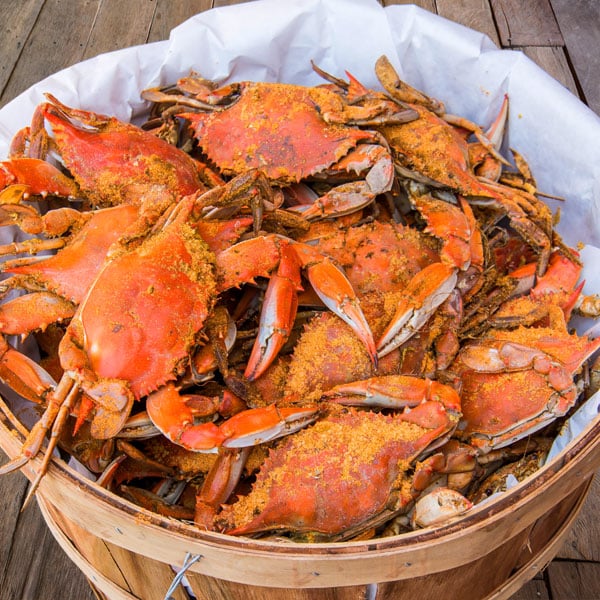
Today’s Spotlight is on crabs.
Crabs are one of the most famous seafoods. There are around 4,000 different species of crabs in the world. Crabs are crustaceans with 10 legs and a thick shell-like covering called an exoskeleton. They have a flat, round body with a short tail and five pairs of legs. The front pair of legs has large claws. The remaining eight legs are used for walking.
Crabs are invertebrates, which means they have no backbone. They are related to insects and spiders, but they have more legs.
Crabs can be found in both fresh and saltwater. They vary in size from the pea crab, which is a few millimeters wide, to the Japanese spider crab, which has a leg span up to 4 m (13 ft).
Crabs can walk in all directions, but mostly walk and run sideways. They have gills hidden inside their shells, which they use to pull oxygen from the water.
Female crabs can release 1000 to 2000 eggs at once. The lifespan of a small crab averages around 3-4 years, but larger species such as the giant Japanese spider crab can live as long as 100 years.
The Japanese spider crab (Macrocheira kaempferi) is also the largest crab in the world. It can weigh up to 42 lbs. and has a carapace width of 16 inches. The Japanese spider crab’s legs are the longest of any arthropod and can span up to 12 feet from claw to claw. The largest Japanese spider crab on record was named “Big Daddy” and measured 10 ft 2.5 in. “Big Daddy” also holds the record for the longest crab leg at 4 ft 8.5 in.
The largest king crab on record weighed 24 lbs. The largest female king crab weighed 10.5 lbs. King crabs are usually between 6 and 10 lbs. on average.
History
Humans have been eating crabs for a long time. Archaeologists found evidence that Neanderthals cooked and ate crab meat 90,000 years ago. They discovered the remains of various shellfish, including brown crabs, in a cave in Portugal where Neanderthals lived.
It’s thought that early humans discovered crabs were edible when they caught them in their primitive fish traps. If the traps didn’t catch fish, but instead caught crabs, they became part of the menu.
China has a long history of eating crabs. Crab and wine were a simple autumn pleasure in ancient Chinese culture. Crabs were so important that literati wrote poems about them and appointed “crab servants” to cook them.
The common ancestor of humans and macaques discovered crabs 25 million years ago after a vine-swinging incident led to a nipped claw.
Fun Facts about Crabs
- There are over 4,500 species of crabs.
- Crabs make up 20% of all shellfish fishermen catch in a single year.
- Female crabs can release 1000 to 2000 eggs at once.
- The Japanese Spider Crab is the biggest crab in the world, measuring about 12 feet between its claws.
- The Japanese Blue crab is the most widely fished and consumed species of crab in the world.
- A group of crabs is known as a cast.
Crab is a nutrient-dense food that contains high levels of protein, vitamins, and minerals. Crab is low in saturated fat and contains omega-3 fatty acids, which can help protect against heart disease and aid brain development.
Crab is also a good source of:
- Vitamins A, B12, C, and E
- Minerals like zinc and iron
- Vitamin C, riboflavin, niacin, iron, magnesium, and phosphorus
- Copper and selenium
Crab can help with:
- Building and maintaining muscle
- Boosting the immune system
- Promoting bone health
- Keeping the nervous system functioning optimally
- Reducing the risk of heart disease
- Aiding brain development
- Inhibiting aggressive behavior
Crab can also help lower cholesterol after just one or two servings. The chromium in crab can increase the level of HDL (good cholesterol) in your body, which can reduce the risk of heart disease and strokes.
Here is a crab recipe for you to try:
Ingredients:
- 6 pounds crab legs Dungeness crab, king crab, snow crab or a combination of different types
- 1/2 cup butter
- 1 tablespoon minced garlic
- salt and pepper to taste.
- 2 tablespoons chopped parsley.
- lemon wedges (optional).
Instructions:
- Place 3 inches of water in a large, deep pot over medium heat. Bring the water to a boil.
- Crack the crab legs with a seafood cracker.
- Place the crab legs in the pot and cover.
- Cook for 5-7 minutes until crab is heated through. If you have raw crab, cook for 10-12 minutes until flesh is red/orange and opaque.
- Drain the crab legs and cover them to keep warm.
- Melt the butter in the pot. Add the garlic and cook for an additional 30 seconds. Turn off the heat and stir in the salt, pepper, and parsley.
- Return the crab to the pot and toss to coat with the garlic butter. Serve immediately, with lemon wedges if desired.
Crab Consumption
About 1.4 million tonnes of crabs are consumed annually, which is 20% of all crustaceans caught and farmed worldwide. There are over 4,500 species of crab found all over the world.
In 2022, watermen landed 42.1 million pounds of crabs in Chesapeake Bay, which was 15% more than in 2021. However, this was still well below the long-term average harvest of 60 million pounds.
A bushel of large crabs will feed about 8 people. If you are serving other food, you can estimate about a 1/2 dozen crabs per person.
Crab populations have declined by as much as 90% in some areas. Possible causes include:
- Climate change: Loss of nursery habitats, sea level rise, and low dissolved oxygen can all impact crab populations.
- Overfishing: The Bering Sea snow crab was deemed overfished in 2022.
- Warmer water: The US Environmental Protection Agency (EPA) believes that warmer water may have caused crabs to move away from coasts.
- Stressors: These include ocean acidification, rising ocean temperatures, and marine heatwaves.
- Predation: Increased predation may have contributed to the population decline.
- Food source: The popularity of crab meat as a food source may be contributing to crab endangerment.
In Alaska, the population of snow crabs in the Bering Sea dropped by 99% from 2021 to 2022. This population crash coincided with a marine heat wave in the Bering Sea.
Celebrating Crabs
International Crab Fest Day is celebrated annually on September 14th. It’s a day to enjoy crab from different recipes. People can celebrate by going to the seashore with crab baskets or to the local seafood store to buy crabs. They can then boil the water and get out the steamer.
0 Comments