
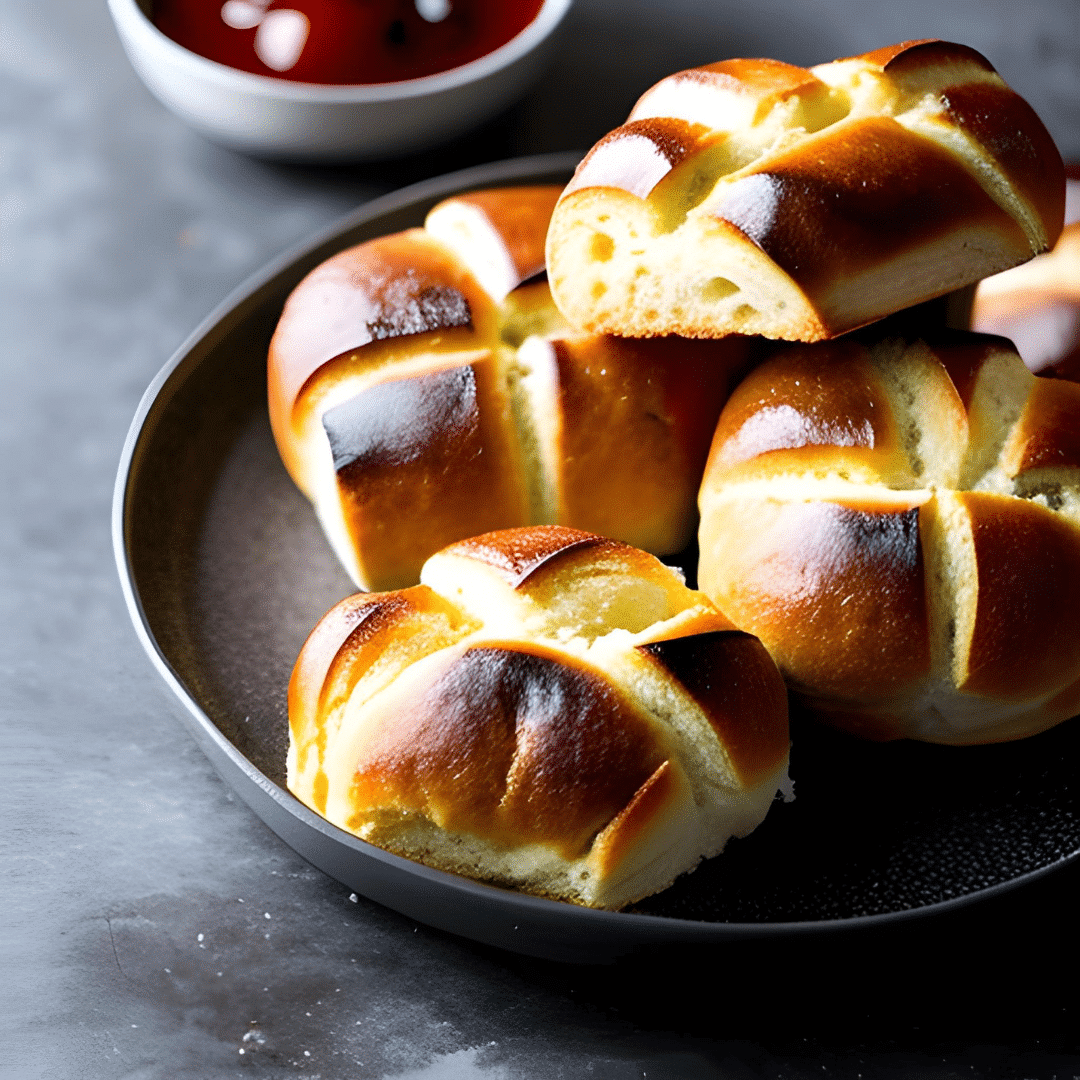
Today’s spotlight is on Hot Cross Buns.
A hot cross bun is a spiced bun usually made with fruit, marked with a cross on the top, which has been traditionally eaten on Good Friday and are associated with Easter in the United Kingdom, Australia, New Zealand, South Africa, Canada, India, Pakistan, Malta, United States and the Commonwealth Caribbean.
Hot cross buns are a Christian tradition that symbolize the crucifixion of Jesus on Good Friday. They are sweet, spiced buns made with milk, butter, and dried fruit, such as raisins or currants. The buns are decorated with a cross, which can be made from flour paste or icing. This represents the cross on which Christ died. The cross represents the crucifix and the spices in the buns are said to represent the spices used to embalm Christ after his death.
Some believe that hot cross buns have other supernatural qualities, such as:
- Protecting against evil spirits
- Curing illnesses
- Protecting against shipwrecks
- Expelling bad spirits
- Never spoiling if prepared on Good Friday
History
Hot cross buns were invented by Christians in ancient Rome. They were originally a Saxon tradition that became an Easter tradition to celebrate Good Friday. They are traditionally eaten toasted with butter.
Hot cross buns may have originated in the 12th century when an English monk baked buns and marked them with a cross on Good Friday. According to the story, an Anglican monk baked the buns and marked them with a cross in honor of Good Friday. Over time they gained popularity, and eventually became a symbol of Easter weekend. The custom became popular, and the buns became a symbol of Easter weekend.
The buns also have pagan origins. The Ancient Greeks, Romans, and Saxons also baked buns to mark the changing seasons. The Saxons would make buns with a cross to offer to the goddess Eostre, the goddess of dawn and spring. Ancient Egyptians used small round breads topped with crosses to celebrate the gods. The cross divided the bread into four equal sections, representing the four phases of the moon and/or the four seasons.
The contemporary hot cross bun may have originated in St Albans, England. In 1361, Brother Thomas Rocliffe, a Christian monk at St Albans Abbey, developed a similar recipe called an “Alban Bun”. He distributed the buns to the poor on Good Friday.
The world’s oldest hot cross bun is believed to be more than 200 years old. It is owned by a couple from Essex in England, who claim the bun was made in 1807.
Here are some fun facts about hot cross buns:
- The cross on top of a hot cross bun is supposed to ward off evil spirits.
- People in the Middle Ages believed that if hot cross buns were hung in a kitchen, they would prevent kitchen fires.
- If taken on a sea voyage, hot cross buns are said to protect against shipwrecks.
Here is a Hot Cross Bun Recipe for you to Try:
Ingredients
BUNS:
- 3 teaspoons instant or rapid rise yeast (9 grams), Note 1, CHECK still active!
- 1/2 cup (110g) caster sugar (superfine sugar)
- 1 1/2 cups (375ml) milk, warm, full fat or low fat (Note 2)
- 4 1/4 cups (640g) bread flour (or plain / all purpose) (Note 3)
- 2 tsp cinnamon powder
- 2 tsp All Spice OR Mixed Spice (Note 4)
- 1/2 tsp salt
- 1 1/2 cups (210g) sultanas (Note 4)
- 1 – 2 oranges, zest only (Note 4)
- 50g / 3.5 tbsp unsalted butter, melted and cooled.
- 1 egg, at room temperature
EXTRA FLOUR FOR DOUGH
- 1/4 cup (35g) Extra bread flour
CROSSES:
- 1/2 cup (75g) flour (any white flour)
- 5 tbsp water
GLAZE:
- 1 tbsp apricot jam (Note 7)
- 2 tsp water
Instructions:
- Mix dry – Place flour, yeast, sugar, all spice, cinnamon, and salt in a large bowl. Briefly mix with a stand mixer fitted with a dough hook.
- Add wet – Add butter, milk, egg, sultanas and zest.
- Stand mixer: Mix for 5 minutes until a smooth elastic dough forms. Start on speed 2 then once the ingredients are combined, increase to speed 4. After 1 minute, add extra flour if required, just enough so dough comes away from side of bowl when mixing and doesn’t stick terribly to your fingers.
- Hand kneading: Alternatively, dust a work surface with flour and knead by hand for 10 minutes.
- Dough is kneaded enough when it’s smooth and does not break when stretched – see photos & video for before/after comparison.
RISE #1:
- Leave dough in the bowl, cover with cling wrap and place in a warm, wind free place to rise until doubled in size. This will take anywhere between 30 minutes to 1 1/2 hours depending on how warm it is.
- FORMING BALLS (WATCH VIDEO, IT’S HELPFUL):
- Line a 31.5 x 23.5 cm / 9 x 13″ tray with baking paper with overhang.
- Remove cling wrap and punch dough to deflate.
- Dust work surface with flour, place dough on work surface, shape into a log – this will deflate the air. Cut into 12 equal pieces.
- Take one piece and press down with palm, then use your fingers to gather into a ball, then roll the dough briefly to form a ball. This stretches the dough on one side and that’s how I get a nice smooth surface.
- Place the ball with the smooth side up on the tray. Repeat with remaining dough. Line them up 3 x 4.
RISE # 2:
- Spray a piece of cling wrap lightly with oil (any), then loosely place over the tray.
- Return tray to warm place and leaver 30 – 45 minutes, until the dough has risen by about 75% (less than double in size).
- Partway through Rise #2, preheat oven to 180°C/350°F (all oven types).
- CROSSES:
- Mix flour and water until a thick runny paste forms – see video for thickness required.
- Spoon into a round 3 mm piping bag or small ziplock bag then snip corner.
- Remove the cling wrap and pipe crosses onto the buns. Go slow so it hugs the curves.
- BAKING/GLAZE:
- Bake in preheated oven (180°C/350°F) for 22 minutes, or until the surface is a deep golden brown. The surface color is the best test for this recipe.
- Meanwhile, place jam and water in a bowl, microwave for 30 seconds. Mix to combine.
- Remove buns from oven. Use overhang to lift buns onto a cooling rack.
- Brush with jam mixture while warm. Allow it to cool to warm before serving.
In the UK, around 20 million packs of hot cross buns are sold each year. Coles expected to sell more than 2.5 million hot cross buns before the end of 2021. Many bakers predicted that sales of hot cross buns would be significantly higher than last year.
National Hot Cross Bun Day is celebrated annually on September 11th. Why not take this opportunity to try this interesting bread treat. Let us know in the comments if you have ever had Hot Cross Buns or if they are a tradition in your home.
0 Comments